
Epoxy Moisture Barrier vs Primer What Buyers Need to Know
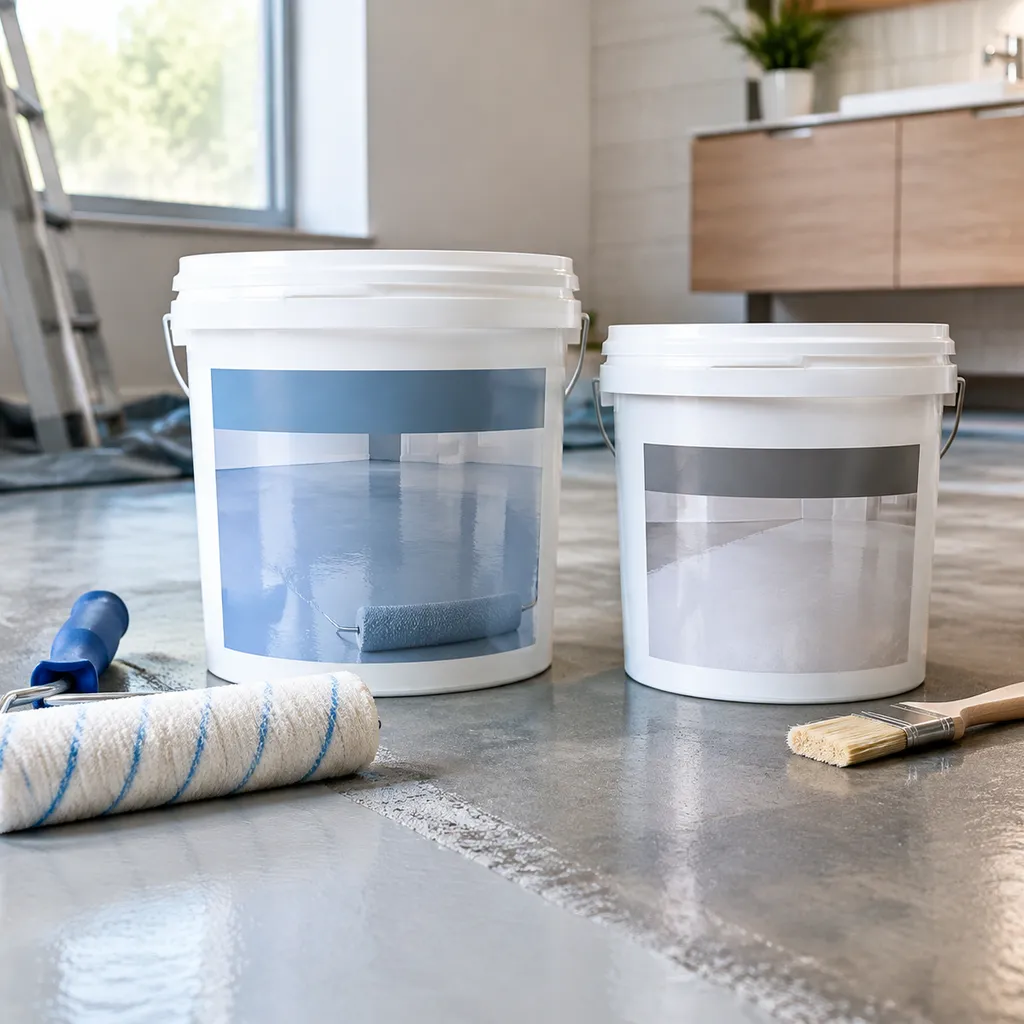
Are you trying to decide between an epoxy moisture barrier vs primer for your next flooring project?
Pick the wrong one, and your coating could blister, peel, and completely fail within months.
While a standard primer ensures a tight bond to clean concrete, it simply cannot hold back rising vapor pressure. That is where a dedicated moisture barrier changes the game.
In this guide, you’ll learn the critical differences between an epoxy moisture barrier vs primer, how to accurately test your substrate, and how to choose the right system to protect your floor for the long haul.
Let’s dive right in.
Quick Answer
The primary difference between an epoxy moisture barrier vs primer comes down to moisture tolerance and vapor mitigation:
- Standard Epoxy Primer: Formulated to penetrate concrete pores, promote mechanical adhesion, and seal the surface to prevent outgassing and pinholes in topcoats. It is designed for dry, fully cured slabs with low moisture vapor emissions.
- Epoxy Moisture Barrier: Engineered specifically to stop high concrete moisture vapor emissions and resist hydrostatic pressure. It forms an impermeable, dense cross-linked shield that prevents moisture from pushing upward and causing blistering, bubbling, or complete coating failure.
| Feature | Standard Epoxy Primer | Epoxy Moisture Barrier |
|---|---|---|
| Core Function | Substrate adhesion and pore sealing | Moisture vapor mitigation and deep bonding |
| Moisture Resistance | Low to moderate (dry slabs only) | High (withstands elevated MVER and RH levels) |
| Film Build | Thin penetrating layer (3–5 mils) | Heavy protective body (10–18+ mils) |
| Primary Risk Managed | Outgassing and poor adhesion | Osmotic blistering and delamination |
The Bottom Line: Use a standard epoxy floor primer when concrete moisture readings are verified to be within safe, normal thresholds. Upgrade to a dedicated moisture barrier epoxy whenever you are coating on-grade slabs, green concrete, substrates lacking an under-slab vapor retarder, or slabs showing elevated moisture levels.
What Buyers Need to Know First
Before deciding on your coating stack, understand this fundamental rule: a standard primer and a moisture barrier are not interchangeable. Confusing the two is the number one reason we see premature coating failure on concrete slabs.
When you look at the debate of epoxy moisture barrier vs primer, you are comparing a bond-promoting layer against a specialized vapor-blocking shield:
- Standard epoxy floor primer: Formulated to penetrate concrete pores, eliminate pinholes, and create a strong mechanical bond for mid-coats and topcoats. It is designed for sound, dry slabs and provides minimal resistance against moisture drive.
- Moisture barrier epoxy: Engineered as a high-density, low-permeance barrier (often 100% solids) that physically halts concrete moisture vapor and tolerates high vapor emission rates.
- Surface appearance is misleading: A concrete slab can look completely dry on top while moving significant amounts of moisture vapor toward the surface.
- The cost of guessing wrong: Applying a standard primer over a slab with unresolved vapor drive leads directly to osmotic blistering, delamination, and total epoxy adhesion failure.
If your slab has elevated moisture levels or lacks an intact sub-slab vapor retarder, skipping a dedicated barrier to save short-term material costs will inevitably lead to an expensive floor tear-out.
What a Standard Epoxy Primer Does
A standard epoxy floor primer is designed to prepare clean, dry concrete for subsequent topcoats. When applied to an open surface profile, it sinks deep into the concrete pores to establish a strong mechanical bond.
Its primary jobs include:
Penetrating concrete pores: It wets out the concrete to maximize direct surface adhesion.
Sealing surface porosity: It locks down micro-dust and minimizes outgassing, which prevents pinholes and bubbles in intermediate and finish coats.
Evening out porosity: It ensures that high-build body coats cure evenly without dry spots or blotching.
While an epoxy floor primer creates an ideal bonding foundation, it remains permeable. It cannot hold back hydrostatic pressure or continuous concrete moisture vapor moving up through the slab.
What a Moisture Barrier Does Differently
A moisture barrier epoxy is chemically formulated to block high moisture vapor emissions and hydrostatic pressure. Rather than simply priming the slab, it forms an impermeable barrier with an extremely low perm rating (typically under 0.1 perms) that stops trapped moisture from reaching the layers above.
Key performance differences include:
Dense cross-linking: It cures into an ultra-tight, non-porous matrix capable of resisting high relative humidity (up to 95%–99% RH under ASTM F2170) and high moisture vapor emission rates (MVER up to 15–25 lbs/1,000 sq ft/24 hr under ASTM F1869).
Heavier application profile: It is installed as a high-build, 100% solids layer—often at 10 to 18+ mils dry film thickness—compared to standard primers applied thin at 3 to 5 mils.
Osmotic blister prevention: It prevents the trapped moisture beneath the slab from converting into vapor pressure that triggers epoxy adhesion failure.
| Feature | Standard Epoxy Primer | Epoxy Moisture Barrier |
|---|---|---|
| Primary Target | Adhesion and outgassing reduction | Concrete moisture vapor mitigation and adhesion |
| Film Thickness | Thin build (typically 3–5 mils) | Heavy build (typically 10–18+ mils) |
| Permeability | Permeable to moisture transmission | Impermeable (< 0.1 perm rating) |
| Vapor Tolerance | Low (standard dry slabs only) | High (withstands severe MVER and RH levels) |
| Solids Formulation | Solvent, water-based, or 100% solids | Exclusively high-density, 100% solids |
Concrete Moisture and Vapor Pressure
Concrete acts like a porous sponge. Even when a slab looks completely dry on the surface, moisture continually moves upward through capillary pores. This movement creates concrete moisture vapor pressure driven by differences in temperature and humidity between the ground and the building interior.
When you seal a floor with resin, you cap those open capillaries. If the vapor transmission rate is higher than what the coating can breathe or resist, pressure builds up directly beneath the film. Understanding the difference between an epoxy moisture barrier vs primer comes down to how each system handles this continuous upward force:
- Capillary action: Liquid water is pulled upward through micro-channels in porous concrete.
- Vapor drive: Moisture converts to gas and moves toward drier, warmer indoor air.
- Hydrostatic pressure: Standing water or high water tables actively force liquid through the slab.
When Moisture Causes Coating Failure
Standard primers lack the density to withstand severe vapor transmission. When moisture levels exceed the tolerance of a basic resin seal, the bond line fails.
The most common field failures include:
- Epoxy adhesion failure and delamination: Trapped vapor pressure pushes the cured film directly off the concrete, causing large sheets of epoxy to peel.
- Osmotic blistering: Moisture draws water-soluble salts out of the concrete, forming high-pressure fluid pockets that bubble and crack the surface layer.
- Outgassing pinholes: Vapor forcing its way through a slow-curing primer leaves open pinholes, voids, and craters that ruin the finish.
- High-pH chemical degradation: Moisture brings alkaline salts (calcium hydroxide) to the surface. This high pH level breaks down the bond line of standard primers, turning the interface into a soft, chalky residue.
If a slab has active vapor drive or lacks an intact sub-slab retarder, applying a standard primer leads directly to coating failure. Mitigating these risks requires a dedicated moisture barrier epoxy engineered to stop vapor transmission completely.
How to Test the Substrate
I never guess when it comes to concrete moisture. Visual checks tell you nothing about what is moving through the slab. To prevent catastrophic debonding, perform standard quantitative tests before applying any resin coating.
- In-Situ Relative Humidity (RH) Probes (ASTM F2170): Drill into the concrete to measure moisture deep inside the slab. This provides the most reliable measurement of potential long-term vapor pressure.
- Calcium Chloride Testing (ASTM F1869): Measures the moisture vapor emission rate (MVER) at the surface over a 60- to 72-hour period, expressed in pounds per 1,000 square feet per 24 hours.
- Plastic Sheet Method (ASTM D4263): A quick, qualitative baseline. Tape a heavy poly sheet to the clean concrete for 24 hours to check for visible condensation or substrate darkening.
- Surface Profile Check (ICRI CSP Guidelines): Ensure the mechanical profile meets the minimum roughness (CSP 2 for standard primers, CSP 3+ for thick moisture barriers) to guarantee mechanical interlock.
How to Choose Primer vs Moisture Barrier
Choosing between a standard epoxy floor primer and a dedicated moisture barrier epoxy comes down to verified data, environmental exposure, and concrete age.
| Decision Factor | Standard Epoxy Primer | Epoxy Moisture Barrier |
|---|---|---|
| In-Situ RH (ASTM F2170) | Below 75% – 80% | Up to 95% – 99% |
| MVER (ASTM F1869) | Under 3 lbs / 1,000 sq ft / 24 hr | 3 to 25 lbs / 1,000 sq ft / 24 hr |
| Concrete Age | Fully cured (28+ days minimum) | Fresh, green, or fast-track concrete |
| Sub-Slab Vapor Retarder | Present, intact, and functional | Missing, compromised, or unknown |
| Primary Job | Seal pores, stop outgassing, bond topcoat | Block vapor transmission, resist hydrostatic pressure |
| Applied Film Thickness | Thin build (3–5 mils) | High build (10–18+ mils) |
Select a standard epoxy primer if:
Your moisture test readings fall safely below standard limits.
The slab is suspended (above grade) or sits on an intact, effective vapor barrier.
The objective is simply to promote topcoat adhesion and eliminate pinholes.
Select an epoxy moisture barrier if:
Moisture readings exceed manufacturer limits for standard primers.
You are coating an on-grade or below-grade slab with no proven vapor retarder.
You are installing over damp concrete where osmotic blistering or vapor drive will cause coating failure.
What Information Should You Send to RW ATELIER?
To help us recommend the right system between an epoxy moisture barrier vs primer, we need a clear snapshot of your project conditions. As an industrial epoxy resin supplier and OEM epoxy resin manufacturer, we evaluate your job site parameters to supply either a standard epoxy floor primer, a high-performance moisture barrier epoxy, or a custom epoxy formulation engineered directly for your slab.
Send us the following technical details before placing your order:
- Floor Moisture Test Results: Provide your quantitative moisture readings, including Relative Humidity percentages (ASTM F2170 in-situ probes) or Moisture Vapor Emission Rates (ASTM F1869 calcium chloride tests). This confirms whether concrete moisture vapor levels demand a true mitigation barrier.
- Slab Age and Location: Specify if the concrete is freshly poured, fully cured (over 28 days), on-grade, below-grade, or suspended above-grade, along with any known sub-slab vapor retarder details.
- Surface Preparation Method: Tell us your planned Concrete Surface Profile (CSP), whether achieved through mechanical diamond grinding or shot blasting.
- Environmental & Service Demands: Note any exposure to standing water, chemical washdowns, extreme cold, or elevated heat that might require damp concrete coating capabilities, cryogenic stability, or a high temperature epoxy resin.
- Project Scope and Volume: Share your total square footage and whether you require factory-direct pail, drum, or IBC tote quantities for contractor distribution or turnkey OEM runs.
Providing these baseline metrics allows us to eliminate the risk of epoxy adhesion failure and specify the exact resin system your installation requires.
How Can RW ATELIER Support This Project?
Navigating the choice between an epoxy moisture barrier vs primer comes down to risk management, substrate conditions, and cost efficiency. At RW ATELIER, we operate as a direct industrial epoxy resin supplier and OEM epoxy resin manufacturer, helping contractors, specifiers, and asset owners select and apply the exact chemistry required for long-term slab performance.
Direct Technical and Formulation Support
- Custom Epoxy Formulation: When standard off-the-shelf primers fall short against high moisture vapor or unusual jobsite conditions, we adjust solids content, cure speeds, and viscosity to match your concrete profile.
- Factory-Direct Supply: As a bulk epoxy resin supplier, we eliminate middleman markups, shipping freshly produced material directly to your site or warehouse.
- Moisture Risk Evaluation: We review your floor moisture test readings (ASTM F2170 in-situ RH or ASTM F1869 MVER) to confirm whether a standard epoxy floor primer will suffice or if a dedicated moisture barrier epoxy system is mandatory.
- Targeted Product Systems: From high-solids damp concrete coatings to high-performance moisture-tolerant primers, we provide fully compatible resin systems engineered to eliminate epoxy adhesion failure.
We deliver the exact material grade your project demands, backed by reliable volume capacity and direct batch-to-batch consistency.
