
Smooth Epoxy Flooring for Parking Bays A Buyers Guide
Quick Answer
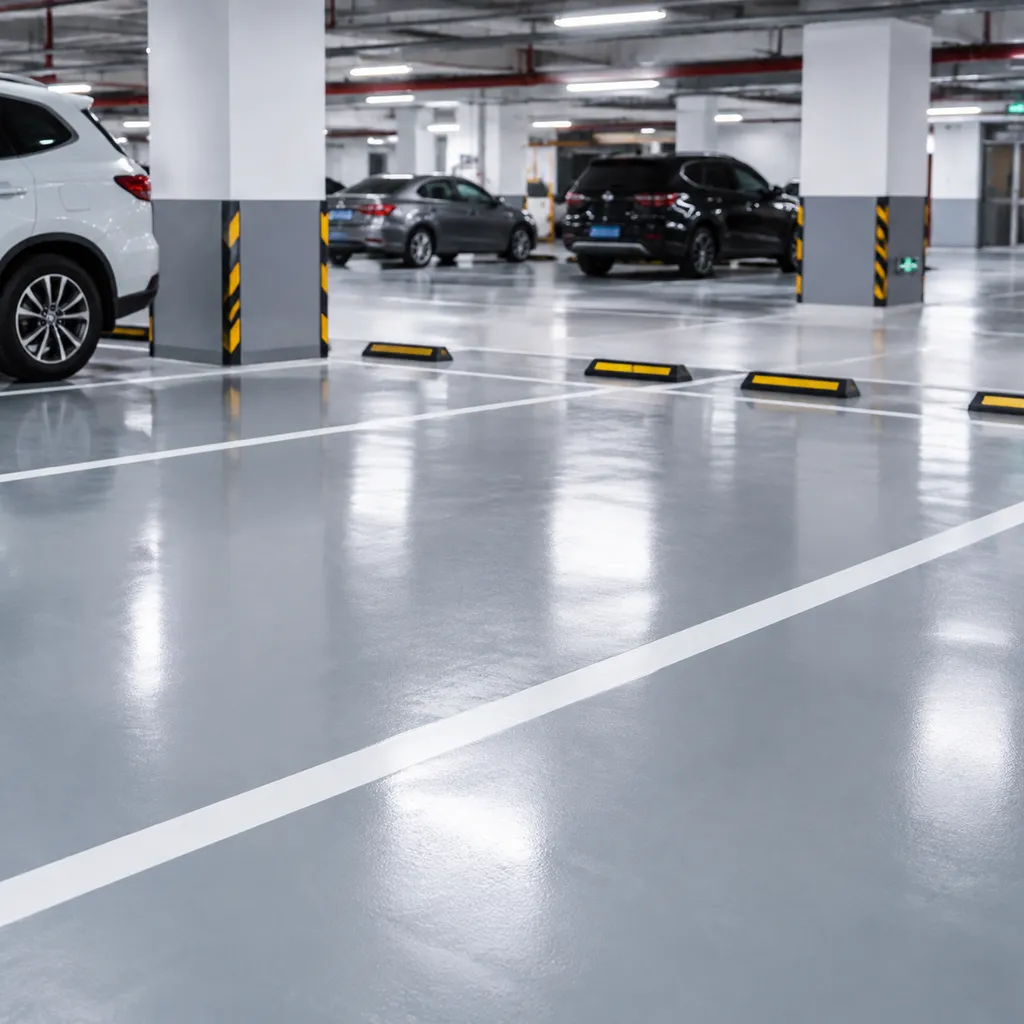
Smooth epoxy flooring for parking bays delivers a seamless, high-gloss protective barrier engineered specifically for stationary vehicle parking stalls. Unlike high-texture anti-slip coatings used on ramps and high-speed turning lanes, a smooth parking bay epoxy creates a non-porous, fluid-resistant surface designed to shield concrete substrates from daily automotive stress.
- Fluid Impermeability: Resists standing motor oil, hydraulic fluids, battery acid, and chemical spills without staining or softening.
- Hot Tire Pick-Up Protection: High-bond formulation prevents delamination caused by high contact pressure and heat transfer from freshly driven tires.
- Optimized Cleanability: Seamless finish eliminates dirt-trapping crevices, ensuring rapid mechanical sweeping and effortless washdown.
- Light Reflectivity: High-gloss surface enhances ambient interior illumination across commercial decks and private garages.
What Buyers Need to Know First
Before specifying or ordering materials, I always urge buyers to look closely at how a parking bay actually functions. Installing a smooth epoxy flooring for parking bays project delivers an ultra-clean, seamless finish, but vehicle parking areas present distinct mechanical and chemical demands that dictate your material choices.
Here are the critical factors you need to assess before choosing your parking bay epoxy system:
- Location Suitability: A completely smooth garage floor or bay finish works best in sheltered, interior parking spaces, VIP stalls, and commercial show bays. For entry aprons, exposed exterior zones, or steep turning points, transitional non-slip profiles are often required to maintain vehicle traction in wet conditions.
- Chemical Exposure: Parked vehicles routinely drop motor oil, coolant, hydraulic fluid, and brake fluid. Your car park floor resin must provide non-porous protection so these chemicals sit on the surface without penetrating the concrete or softening the coat.
- Hot-Tire Resistance: Freshly parked vehicles transfer high heat and pressure directly into the coating. Without proper adhesion and cured film strength, standard paints suffer from hot-tire pickup, pulling the layer straight off the concrete.
- Turnaround and Curing Time: Commercial facilities rarely afford prolonged downtime. Knowing your installation window helps balance standard epoxy cures against high-productivity formulations.
| Critical Factor | Smooth Finish Inside Bays | Textured Ramps & Driving Aisles |
|---|---|---|
| Primary Advantage | Effortless sweep cleaning, bright light reflection | Enhanced traction, anti-skid safety |
| Maintenance Level | Low; leaves no texture to trap grime | Medium; requires power washing |
| Tire Mark Resistance | High with proper resin hardness | High, though surface texture holds rubber residue |
Getting your system right means matching the exact resin build to the day-to-day traffic weight of your structure. Working factory-direct gives you control over the solids content, primer pairing, and durability profile needed for long-term concrete protection.
Performance Requirements for Standard Parking Bays
When we supply smooth epoxy flooring for parking bays, we focus on real-world vehicle stress. Parking bays take concentrated static loads, continuous tire rotation, and frequent chemical drops. A high-performance bay floor must handle these conditions daily without chipping, staining, or lifting.
| Requirement | What the Floor Faces | What We Deliver |
|---|---|---|
| Hot Tire Resistance | Heated radial tires cooling on the resin surface | Zero hot-tire pick-up or plasticizer migration |
| Chemical Resistance | Motor oil, brake fluid, coolant, and grease leaks | Non-porous barrier preventing fluid penetration |
| Abrasion & Impact | Turning wheels, dropped tools, and foot traffic | Tough resin matrix resisting surface wear |
| Adhesion Strength | High shear forces during vehicle parking | Deep mechanical bond to the concrete base |
Every parking bay epoxy project requires balanced compressive and tensile strength to withstand daily vehicle weight without cracking the underlying slab.
Substrate Preparation and Primer
A smooth garage floor or car park coating is only as solid as the concrete beneath it. We never apply resin over raw, unprepared slabs. Proper preparation creates an open, clean concrete profile ready to soak up the primer.
- Surface profiling: We require mechanical diamond grinding or captive shot blasting to achieve an open concrete surface profile free of laitance, old sealers, and grease.
- Moisture verification: Concrete must be dry and free of hydrostatic pressure before coating.
- Deep-penetrating primer: We apply a dedicated epoxy primer formulated to penetrate concrete pores, eliminate outgassing pinholes, and lock the slab together.
- Bond integrity: The primer coat serves as the structural anchor for all subsequent intermediate and topcoat layers in the system.
Putty or Intermediate Smoothing Layer
To achieve true smooth epoxy flooring for parking bays, the intermediate smoothing layer is non-negotiable. After priming, concrete often reveals micro-cracks, pinholes, and profile marks from surface prep. We rely on an epoxy putty or body coat to lock in an even, flawless foundation before the finish coat goes down.
Here is why this layer makes or breaks your parking bay epoxy installation:
- Pore and Void Sealing: The putty seals off concrete pores completely, stopping outgassing air bubbles from ruining the final finish.
- Surface Leveling: It smooths out rough textures and uneven spots, ensuring the topcoat lays flat without dips or surface shadows.
- Structural Support: As an intermediate buffer, it distributes vehicle weight evenly, reinforcing the car park floor resin against heavy tire loads and point impacts.
- System Integrity: It bonds the primer to the finish layer, creating a unified epoxy primer putty topcoat system built for high-traffic facilities.
Applying this intermediate layer prevents surface flaws from transferring through, guaranteeing that clean, professional look facility managers demand.
Smooth Topcoat Selection
The final topcoat defines how your parking bays perform against daily traffic and fluid spills. For an industrial smooth epoxy floor, we choose self-leveling formulations engineered specifically for high automotive resistance.
When specifying a smooth topcoat for vehicle bays, focus on these critical factors:
- Hot Tire Resistance: Vehicle tires generate heat during driving. The topcoat must cure to a hard finish that prevents hot tire pick-up and rubber bonding.
- Chemical and Oil Defense: Parking areas deal with constant leaks. The resin must resist motor oil, transmission fluid, battery acid, and brake fluids without softening or staining.
- Light Reflectivity: A smooth, glossy or semi-gloss surface improves ambient lighting, reducing energy costs across covered garages while keeping bays bright and clean.
- Easy Washdown: A seamless finish allows maintenance teams to sweep tire dust and mop oil spills quickly, cutting long-term facility upkeep costs.
Selecting the right smooth epoxy topcoat ensures every parking bay stays durable, vibrant, and ready for continuous vehicle turn-over.
Line Marking and Traffic Zones
A well-planned parking facility requires clear visual cues to control vehicle flow and pedestrian safety. When we install smooth epoxy flooring for parking bays, we treat demarcation lines and driving lanes as structural elements of the floor system, not just an afterthought.
Applying a heavy-duty parking line coating directly over the cured epoxy creates sharp, highly visible boundaries that will not chip under continuous tire shear:
- Stall Demarcation: High-contrast polyurethane or epoxy line marking bonds chemically with the base coat, maintaining crisp lines across every individual parking bay.
- Traffic Direction: Directional arrows, pedestrian crossings, and stop bars provide immediate guidance, reducing congestion in tight turning zones.
- Zoned Coloring: We use distinct color schemes to separate standard stalls from EV charging stations, accessible spaces, and service bays.
| Zone Type | Recommended Color | Function |
|---|---|---|
| Standard Parking Bay | White / Light Grey | Outlines parking boundaries |
| Drive Aisles | Neutral Grey / Base Tint | Continuous vehicle transit |
| Pedestrian Walkways | Safety Yellow / Green | Dedicated foot traffic lanes |
| EV / Accessible Bays | Blue / Green Stencil | Reserved priority parking |
Cleaning and Maintenance
The completely non-porous finish of a smooth epoxy flooring for parking bays installation makes daily upkeep straightforward. Unlike textured coatings or bare concrete, smooth resin surfaces do not trap rubber residue, brake dust, or fluids deep in micro-crevices.
- Daily Sweeping: Run dry dust mops or industrial sweepers over the surface to remove abrasive sand and loose grit tracked in by tires.
- Routine Washing: Use walk-behind auto-scrubbers fitted with soft nylon brushes and a pH-neutral commercial floor cleaner.
- Fluid Spills: Wipe up motor oil, coolant, and brake fluid immediately to preserve the gloss and prevent slip hazards.
- Periodic Deep Clean: Wash down high-turnover stalls with warm water and neutral degreasers to break down stubborn tire rubber deposits without dulling the protective epoxy topcoat.
What Information Should You Send to RW ATELIER?
To help us configure the right smooth epoxy flooring for parking bays, we need specific details about your site and project goals. Providing clear operational data ensures our technical team matches your concrete conditions with the exact epoxy primer, intermediate body coat, and topcoat system required.
Here is the essential checklist to share with us:
- Total Surface Area and Layout: Specify the square meters or square footage for the parking bays, drive lanes, and ramps. Clarify whether line marking materials are included in the scope.
- Substrate Condition: Note the age, compressive strength, and surface profile of the concrete slab, including any existing coatings, oil saturation, cracks, or rising damp issues.
- Traffic Load and Frequency: Define vehicle types (light passenger cars, SUVs, delivery vans) and expected daily turnover to ensure proper build thickness and abrasion tolerance.
- Environmental Exposure: Identify whether the parking area is fully enclosed underground, exposed to outdoor sunlight, or subject to seasonal temperature shifts.
- Color and Demarcation Needs: Provide your required RAL/standard color codes for standard parking spaces, accessible bays, pedestrian walkways, and directional arrows.
- Supply Model and Volume: As a direct industrial epoxy resin supplier and OEM manufacturer, let us know if you require bulk epoxy resin drums, pre-batched kits, or customized formulation adjustments for your local climate.
Sending these specifications upfront allows us to calculate material consumption rates, recommend the optimal build sequence, and deliver an accurate commercial proposal without delay.
How Can RW ATELIER Support This Project?
We deliver end-to-end resin solutions designed specifically for large-scale and specialized car park builds. When you partner with us for your smooth epoxy flooring for parking bays, you work directly with an established industrial epoxy resin supplier focused on high-traffic performance and hassle-free logistics.
- Epoxy Resin Factory Direct Supply: Cut out the middlemen. We provide bulk epoxy resin supplier pricing and reliable delivery schedules directly to your job site, keeping multi-bay projects on budget.
- Custom Epoxy Formulation: Every parking deck has distinct requirements. Whether your facility demands high-temperature resistance, protection against thermal movement, or enhanced chemical resistance against automotive fluids, our OEM epoxy resin manufacturer capabilities allow us to adapt formulations to your project specs.
- Complete System Integration: We supply fully compatible layer systems—from moisture-tolerant primers and smoothing intermediate putties to wear-resistant topcoats and high-visibility parking line coatings.
- Hands-on Technical Guidance: We support contractors, architects, and facility owners with application data sheets, consumption calculations, and curing timeline advice to avoid hot-tire pick-up and maximize long-term floor durability.
