Non Yellowing Deep Pour Epoxy UV Resistant Formula
Quick Answer
What Buyers Need to Know First
No epoxy resin is 100% immune to UV degradation over long periods, but a high-performance non yellowing deep pour epoxy drastically reduces and delays yellowing through advanced chemical stabilization. Achieving long-term clarity requires balancing chemical protection with precise thermal control during curing.
- UV Absorbers & HALS: Premium low yellowing resin formulations combine UV absorbers with Hindered Amine Light Stabilizers (HALS) to filter light damage and neutralize free radicals.
- Thermal Control: Pouring a thick pour epoxy beyond its recommended depth creates excessive exotherm (heat), causing immediate thermal yellowing before the resin even cures.
- Base Chemistry: Cycloaliphatic amine hardeners are critical for epoxy yellowing prevention in high-clarity clear river table epoxy projects.
Selecting a premium UV resistant casting resin engineered for slow heat dissipation ensures permanent optical clarity for commercial and custom wood casting applications.
Is any epoxy completely UV-proof?
Direct Answer
No epoxy resin on the market is 100% UV-proof forever. Standard epoxy chemistries naturally degrade under continuous ultraviolet radiation. However, high-grade non yellowing deep pour epoxy formulations integrate advanced HALS (Hindered Amine Light Stabilizers) and UV blockers to drastically slow down discoloration, maintaining crystal-clear optical clarity for years under normal indoor lighting and indirect sunlight.
Key Selection Factors or Failure Risks
- Additive Quality: True epoxy yellowing prevention requires a dual-stage protection system combining UV absorbers with HALS to actively neutralize free radicals created by light exposure.
- Direct Outdoor Exposure: Unprotected low yellowing resin will eventually amber if left continuously outdoors under direct sun without a specialized UV-resistant polyurethane topcoat.
- Exothermic Heat Spikes: Excessive heat during curing accelerates molecular degradation. Selecting a dedicated thick pour epoxy engineered for slow, low-temp curing protects against heat-induced yellowing.
- Application Integrity: Using standard coating resins for deep casts causes thermal runaway, scorching the core and ruining a clear river table epoxy project before it fully sets.
Why does overheating increase discoloration?
Direct Answer
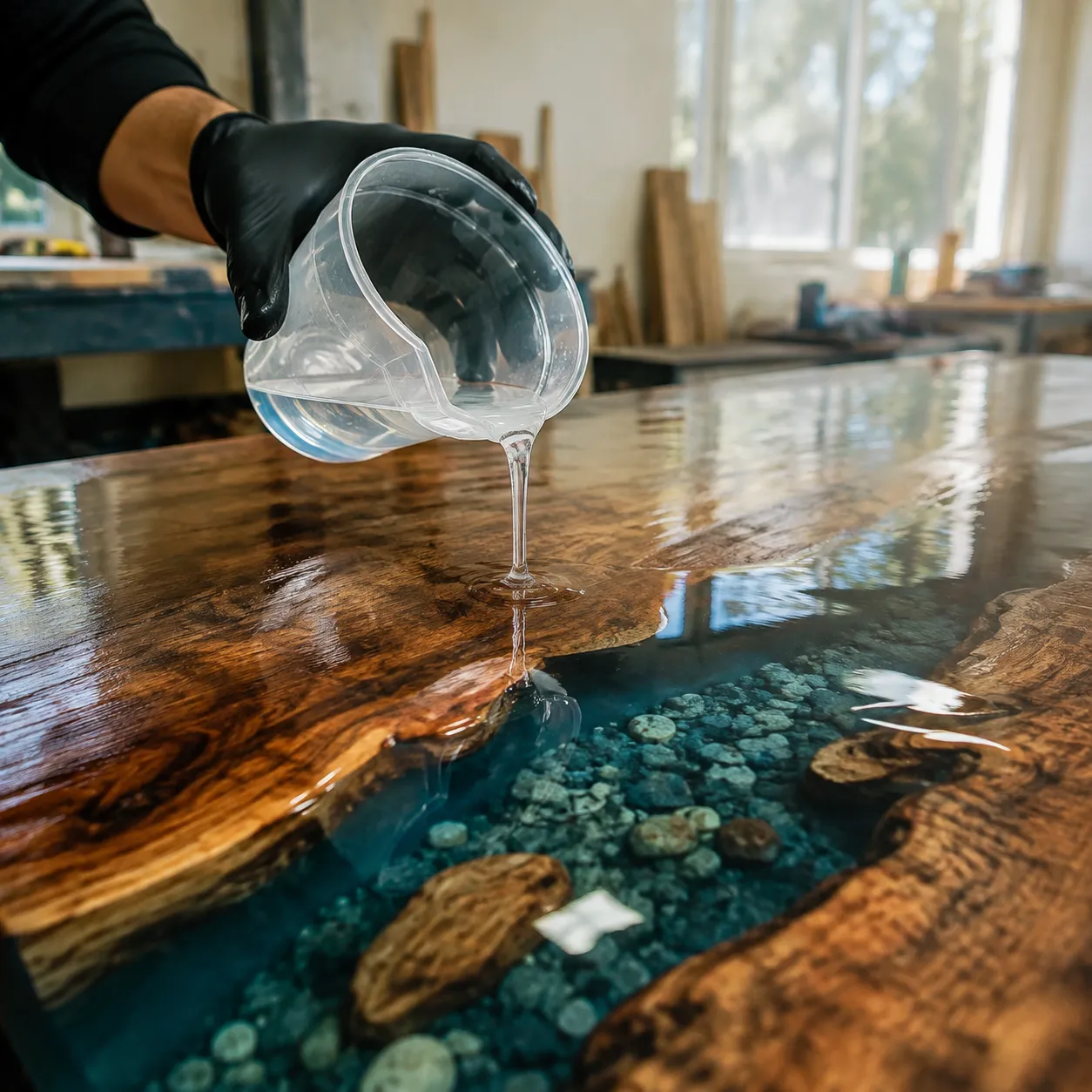
Deep pour epoxy hardens through an exothermic reaction, generating heat as polymer chains cross-link. When you pour a thick pour epoxy beyond its maximum recommended depth or work in an overly warm room, trapped heat rapidly builds up. This intense thermal spike scorches the resin matrix and degrades the hardener, causing an instant amber or yellow tint before the cure even finishes. Controlling heat during the curing process is essential for effective epoxy yellowing prevention.
Key Selection Factors or Failure Risks
- Exotherm Control: Standard resins generate rapid heat spikes. Using a engineered low yellowing resin with delayed reactivity ensures a slow, controlled heat dissipation.
- Pour Thickness Limits: Exceeding maximum depth limits on a clear river table epoxy traps thermal energy, pushing core temperatures past safe limits (above 150°F).
- Ambient Temperature: High room temperatures accelerate the chemical reaction rate, drastically increasing thermal buildup and resin scorching.
- Mold Insulation: Insulated molds or dense wood substrates retain heat longer, raising the risk of thermal discoloration in heavy pours.
Do pigments hide or worsen yellowing?
Direct Answer
Pigments can either mask or amplify discoloration in non yellowing deep pour epoxy depending on their opacity, chemical stability, and color spectrum. Opaque pigments and metallic micas physically block UV light penetration and conceal base ambering over time. Translucent tints, clear liquid dyes, and unstable organic colorants do not hide yellowing—they often shift shade or fade, making the underlying yellowing in clear river table epoxy even more noticeable.
Key Selection Factors or Failure Risks
- Pigment Opacity Matters: High-opacity liquid pastes and inorganic powders offer natural protection by blocking UV rays from penetrating deep into thick pour epoxy castings.
- Organic vs. Inorganic Colorants: Low-grade organic dyes tend to fade or breakdown under sunlight, creating color shifts that mimic or accelerate visible yellowing. UV-stable inorganic mica powders retain their original shade long-term.
- The Optical Tinting Technique: Adding a tiny fraction of blue or violet pigment acts as an optical brightener, neutralizing subtle amber undertones to maintain a crisp look in low yellowing resin formulations.
- Additive Compatibility: Solvent-based or low-quality color carriers can chemically disrupt UV stabilizer packages in UV resistant casting resin, compromising overall epoxy yellowing prevention.
How Should Yellowing Resistance Be Compared?
Direct Answer
We evaluate yellowing resistance by comparing standardized lab data—specifically ASTM accelerated weathering test results—rather than relying on marketing labels. A high-performance non yellowing deep pour epoxy uses a balanced blend of UV absorbers and Hindered Amine Light Stabilizers (HALS) to measure color shift over time under high-intensity light.
Key Selection Factors or Failure Risks
To make an accurate comparison for your clear river table epoxy or casting projects, focus on these critical lab metrics and hidden risks:
- Delta E Color Shift Ratings: Request ASTM G154 lab test data. A Delta E change below 2.0 after 500+ hours of QUV exposure indicates superior low yellowing resin performance.
- HALS vs. Standard UV Inhibitors: Basic UV blockers only filter light temporarily. True UV resistant casting resin includes HALS to trap free radicals and stop polymer breakdown continuously.
- Exotherm Heat Resistance: Excessive heat during cure destroys additives before they can protect the piece. A quality thick pour epoxy controls heat dissipation so built-in stabilizers remain fully active.
- Unstandardized Sample Tests: Avoid relying on informal short-term window-sill tests. Real comparative testing requires controlled UV light and elevated temperature cycles to expose real-world degradation.
Can a Topcoat Improve Outdoor Durability?
Direct Answer
Yes, applying a high-performance UV-resistant topcoat significantly extends the outdoor lifespan of a non yellowing deep pour epoxy. While high-grade thick pour epoxy formulations include UV stabilizers, no epoxy resin is completely immune to long-term direct sunlight. Adding a clear, UV-blocking polyurethane or polyaspartic topcoat creates a sacrificial barrier that shields the underlying clear river table epoxy, preventing surface ambering and gloss loss.
Key Selection Factors or Failure Risks
When integrating topcoats into your epoxy yellowing prevention strategy, keep these critical factors in mind:
- Chemistries Must Match: Use aliphatic polyurethanes or polyaspartic coatings specifically designed to adhere to a fully cured low yellowing resin. Non-compatible coatings will crack or turn cloudy.
- Surface Mechanical Prep: Always scuff-sand cured UV resistant casting resin with 220-grit to 320-grit sandpaper before topcoating. Skipping sanding causes severe coating delamination when exposed to outdoor thermal expansion.
- Cure Time Compliance: Applying topcoats onto under-cured deep pour resin traps residual moisture and off-gassing, leading to micro-bubbles, loss of clarity, and localized film failure.
- Maintenance Schedules: Topcoats absorb UV exposure so the main casting doesn’t have to. Periodic light sanding and reapplication keep outdoor installations looking crystal clear over time.
What Information Should You Send to the Manufacturer?
To get the right non yellowing deep pour epoxy formulation for your operation, sending clear specs upfront eliminates guesswork and prevents costly curing failures.
Application, Substrate and Process Details
- Target Pour Depth: Specify your layer thickness, such as casting a single thick pour epoxy river table or pouring shallow decorative layers.
- Substrate Type: Note whether you are working with live-edge wood, concrete, metal, or silicone molds.
- Workshop Environment: Share average ambient temperatures and humidity, as thermal mass directly impacts epoxy yellowing prevention and heat buildup.
- Process Timeline: Detail your required pot life, working window, and target demold time.
Performance, Packaging and Estimated Quantity
- Performance Requirements: Outline specific needs like optical clarity, UV stability, bubble release efficiency, and final shore hardness.
- Packaging Formats: Choose between small consumer kits, 5-gallon pails, 55-gallon drums, or private label epoxy resin packaging.
- Order Volumes: State your immediate batch size and annual volume to get precise quotes from your wholesale epoxy resin manufacturer or bulk epoxy resin supplier.
How Can Rongwei Support This Project?
We support your commercial goals directly as a specialized wholesale epoxy resin manufacturer. We provide end-to-end technical customization and scalable manufacturing for every non yellowing deep pour epoxy order.
Sample Matching and Formula Adjustment
We tune the chemical balance of our thick pour epoxy formulations to fit your exact casting environment and performance target.
- Targeted Formula Matching: Send us your benchmark resin sample or physical target specs. We match cure times, viscosity, and clarity in our lab.
- Custom UV Protection: We adjust UV absorber and HALS levels in our non yellowing deep pour epoxy to maximize long-term optical clarity for clear river table epoxy applications.
- Exotherm Control: We optimize reactivity speed so your customers can achieve deep, single-stage pours without heat discoloration or bubbling.
OEM / Private Label Packaging and Bulk Supply
As a direct bulk epoxy resin supplier, we make scaling your retail or industrial resin brand straightforward with flexible production options.
| Service Level | Delivery Option | Key Advantage |
|---|---|---|
| Private Label Epoxy Resin | Custom bottle sizes, custom labels, and retail-ready packaging | Turnkey product line built to your exact brand design |
| Bulk Supply | Drums, IBC totes, and full container shipments | Epoxy resin factory direct pricing for maximum profit margins |
| Quality Control | Batch-to-batch testing for viscosity, hardness, and clarity | Uncompromising consistency to protect your brand reputation |
Buyer Checklist
Questions to Confirm Before Placing an Order
Before finalizing your order for non yellowing deep pour epoxy, verifying key technical specifications with your manufacturer prevents costly job-site failures and ensures consistent performance across batches.
- Maximum Pour Depth: Confirm the exact single-pour thickness rating at standard room temperature (70°F–75°F). A true thick pour epoxy should easily manage 2 to 4 inches per pour without overheating or cracking.
- UV Stabilizer Additives: Ensure the formulation uses both UV absorbers and Hindered Amine Light Stabilizers (HALS). This dual-action additive package provides the highest level of long-term epoxy yellowing prevention.
- Mixed Viscosity & Air Release: Check the mixed viscosity (cPs rating). A low-viscosity formula allows trapped air to escape spontaneously, which is essential for achieving glass-clear results in clear river table epoxy projects.
- Peak Exotherm and Cure Cycle: Review the gel time and full cure schedule. A slower cure curve keeps heat low, making the material a safer low yellowing resin for large-volume castings.
- Packaging and OEM Options: Verify minimum order quantities, private label capabilities, and container options with your bulk epoxy resin supplier to align with your distribution or project volume needs.
