
Deep Pour Epoxy on Moist Wood Buyer Guide
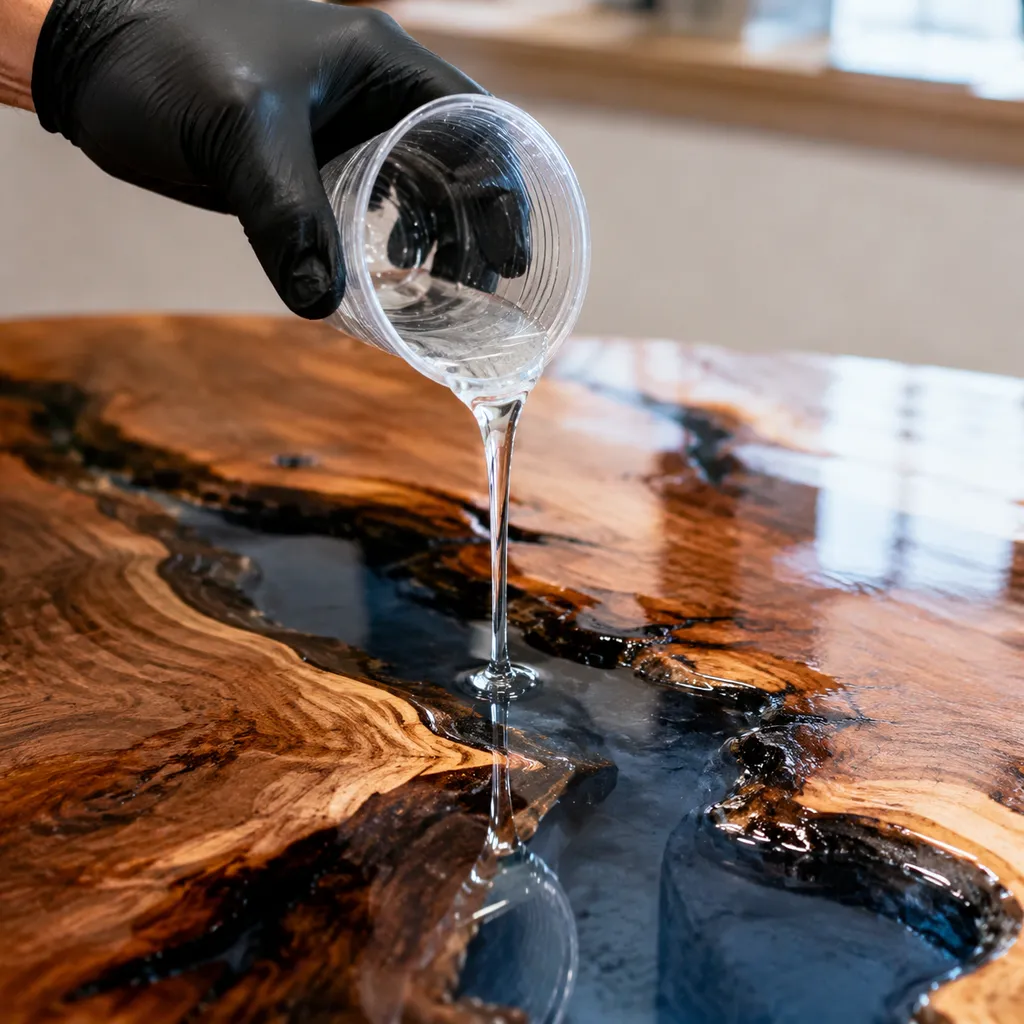
Quick Answer
What Buyers Need to Know First
Deep pour epoxy must never be applied directly to moist or unseasoned wood. For reliable epoxy adhesion to wood, the wood moisture content (MC) must be strictly below 12%, with 6% to 10% being the industry benchmark for river table and thick pour applications.
- Bond Failure & Delamination: Excess moisture prevents deep pour epoxy from penetrating wood pores properly, destroying adhesion and leading to severe delamination over time.
- Cloudiness & Gas Bubbles: Trapped moisture reacts during the epoxy exothermic curing process, causing internal cloudiness, foam, and trapped gas bubbles.
- Wood Warping & Stress: Casting deep pour epoxy on moist wood locks water inside. As the timber naturally dries and shifts, internal stress will crack both the wood and the cured resin matrix.
- Surface Sealing Limit: Applying a seal coat to wet wood will not stabilize the substrate. Wood must be fully kiln-dried or air-seasoned before any thick pour resin application.
Is any epoxy completely UV-proof?
Direct Answer
No epoxy resin is 100% UV-proof. While high-grade formulations use advanced UV absorbers and Hindered Amine Light Stabilizers (HALS) to significantly delay yellowing, all epoxies eventually amber under prolonged sunlight. When applying deep pour epoxy on moist wood, sunlight exposure accelerates degradation even faster. Moisture trapped beneath the surface amplifies heat and solar radiation, compromising resin clarity and long-term durability.
Key Selection Factors or Failure Risks
Selecting the right resin for outdoor exposure or high-sunlight indoor areas requires evaluating key formulation factors and common risk points:
- Dual-Action UV Protection: Choose resins that incorporate both UV absorbers and HALS. UV absorbers block radiation, while HALS neutralizes free radicals to halt yellowing at a molecular level.
- Moisture-Driven Discoloration: High wood moisture destabilizes resin clarity under UV light. Pouring deep pour epoxy on moist wood traps water vapor, creating a cloudy, yellowish haze when exposed to direct sunlight.
- Weakened Epoxy Adhesion to Wood: Trapped moisture combined with solar thermal stress damages epoxy adhesion to wood, leading to cracking, cloudiness, or complete delamination over time.
- Protective Polyurethane Topcoats: Resin alone cannot survive continuous exterior sunlight. Applying a UV-blocking urethane or marine varnish topcoat over your cured thick pour epoxy is required for lasting outdoor protection.
Why does overheating increase discoloration?
Direct Answer
Overheating during the cure phase causes permanent chemical damage. Epoxy curing is an exothermic reaction that generates internal heat. When a thick pour epoxy gets too hot, excess thermal energy scorches the hardener, degrades UV stabilizers, and turns clear resin amber or brown. When using deep pour epoxy on moist wood, this spike in temperature also vaporizes internal moisture into steam micro-bubbles, creating a cloudy finish that makes discoloration look far worse.
Key Selection Factors or Failure Risks
- Thermal Degradation: Runaway exotherm bakes the polymer matrix, destroying optical clarity from the inside out.
- Moisture Flash-Off: High internal heat boils trapped wood moisture, forming dense cloudiness and ruining epoxy adhesion to wood.
- Mass & Volume Limits: Pouring deeper than a product’s rated limit traps heat, making cooling impossible during large river table wet wood pours.
- Accelerated Aging: Thermally damaged epoxy degrades faster under ambient light, shortening the overall lifespan of the piece.
Do pigments hide or worsen yellowing?
Direct Answer
Pigments generally hide ambering, but they do not stop underlying resin degradation. High-density opaque mica powders and pastes mask yellowing effectively, whereas translucent dyes and light tints often worsen visible discoloration by shifting blue or clear highlights into dull green tones. When working with deep pour epoxy on moist wood, colorants may hide initial tint shifts, but they cannot cover up milky hazing, internal foaming, or structural failure caused by poor epoxy adhesion to wood.
Key Selection Factors or Failure Risks
- Opacity Level: Heavy opaque pigments physically block light transmission and conceal yellowing, while transparent liquid dyes expose ambering as the cured thick pour epoxy ages.
- Color Shift Sensitivity: Cool tones like blues, purples, and crisp whites show aging fastest, frequently shifting toward muddy green or off-white when exposed to light.
- Moisture Cloudiness: Pigments cannot conceal the white, cloudy haze created by water vapor escaping while sealing live edge wood. Moisture impairs cross-linking regardless of pigment loading.
- False Security on Wet Slab Builds: Tinting resin does not solve moisture mismatch. Using opaque epoxy on a river table wet wood project hides trapped moisture until vapor pressure causes full adhesion loss and slab warping.
- UV Stability Matching: Always pair color pigments with factory-formulated, UV-inhibited resins rather than relying on heavy pigment loads to prevent sunlight degradation.
How should yellowing resistance be compared for deep pour epoxy on moist wood?
Direct Answer
Comparing yellowing resistance comes down to standardized lab data—specifically accelerated QUV weathering tests (ASTM G154)—rather than visual marketing claims. When applying deep pour epoxy on moist wood, high exotherm heat and trapped humidity drastically speed up resin degradation. To ensure lasting clarity, we formulate our resins with a dual-stage stabilization system that combines UV absorbers with Hindered Amine Light Stabilizers (HALS) to actively stop ambering.
Key Selection Factors or Failure Risks
- Dual UV Protection (HALS + Absorbers): Basic UV blockers only delay surface damage. High-grade thick pour epoxy requires HALS to continuously scavenge free radicals generated by sunlight.
- Moisture-Triggered Discoloration: High wood moisture causes amine blushing, turning the pour hazy or deep yellow. Properly sealing live edge wood before pouring prevents moisture from reacting with the hardener.
- Exotherm Heat Degradation: Overheating during a thick pour breaks chemical bonds and yellows the core. Slow-curing formulas control heat, preserving clarity and solid epoxy adhesion to wood.
- Lab-Verified Testing: Always compare 1,000-hour UV test results rather than fresh liquid clarity to gauge real-world durability on river table projects.
Can a topcoat improve outdoor durability?
Direct Answer
Yes, applying a specialized clear topcoat drastically improves outdoor durability. Deep pour epoxy resin provides structural volume and mass clarity, but even high-grade formulas eventually yellow or chalk under prolonged UV exposure and weather changes. We always recommend applying a high-performance, UV-blocking 2K polyurethane or spar urethane topcoat over cured epoxy to act as a protective shield against solar radiation, moisture ingress, and abrasion.
Key Selection Factors or Failure Risks
- Moisture-Driven Delamination: Using deep pour epoxy on moist wood and sealing it with an exterior topcoat traps liquid inside. Solar heat causes trapped moisture vapor to expand, leading to severe topcoat peeling, clouding, or total adhesion loss.
- Surface Preparation: Polyurethane and acrylic topcoats require a clean mechanical bond. You must let the thick pour epoxy cure completely, scuff-sand the surface thoroughly with 180–220 grit sandpaper, and clear all surface dust before coating.
- Thermal Expansion Mismatch: Outdoor temperature shifts cause live edge wood, epoxy resin, and hard topcoats to expand at different rates. Flexible topcoat formulations prevent micro-cracks along the epoxy-wood bond line.
- Maintenance Schedules: Exterior topcoats act as sacrificial layers. Plan to scuff-sand and re-apply the protective finish every 2 to 4 years to maintain long-term UV resistance and water protection.
What Information Should You Send to the Manufacturer?
Working directly with a wholesale epoxy resin manufacturer requires clear technical communication to select or customize the right formulation. When dealing with difficult applications like applying deep pour epoxy on moist wood, giving us precise project details helps prevent curing failures and guarantees long-term epoxy adhesion to wood.
Application, Substrate and Process Details
To prevent bubbling, cloudiness, or delamination in your resin casts, provide us with your exact working conditions:
- Substrate & Moisture Level: State whether you are working with kiln-dried wood, fresh slabs, or river table wet wood. Mention if you require specialized wood moisture epoxy resin formulas or pre-sealers for sealing live edge wood.
- Pour Thickness & Volume: Specify the depth of your pour. A thick pour epoxy designed for 2-inch depths generates heat differently than deeper single-pass formulations.
- Ambient Environment: Provide average shop temperatures, relative humidity levels, and working conditions during pour and cure cycles.
- Application Technique: Detail your mixing methods, pour speed, and whether you use vacuum chambers or torching for bubble removal.
Performance, Packaging and Estimated Quantity
Whether you need bulk epoxy resin supplier shipments or a custom private label epoxy resin product line, providing your performance and volume metrics ensures accurate manufacturing and fulfillment.
| Category | Information to Share |
|---|---|
| Performance Specs | Desired UV resistance, clarity standards, final hardness (Shore D), heat resistance, and required working time. |
| Packaging Requirements | Preferred formats such as retail twin-packs, 5-gallon pails, 200kg drums, or 1000kg IBC totes. |
| Order Volume | Sample requirements, trial batch volume, and projected annual or monthly wholesale quantities. |
How Can Rongwei Support This Project?
We engineer targeted resin formulations designed to handle challenging applications like applying deep pour epoxy on moist wood. Working directly with our technical team gives you full control over performance, custom branding, and long-term supply stability.
Sample Matching and Formula Adjustment
- Formulation Tuning: We adjust our thick pour epoxy chemistry to balance exotherm control, cure speed, and optical clarity for your specific working environment.
- Moisture Adaptation: When addressing wood moisture epoxy resin risk zones, we refine hardener blends to maximize adhesion and prevent micro-bubbling or surface blushing.
- Lab Sample Matching: Send us your target specs or wood samples; our laboratory matches the exact viscosity, hardness, and thermal resistance your projects demand.
OEM / Private Label Packaging and Bulk Supply
- Private Label Epoxy Resin: Complete private-label packaging, customized container sizes, and turn-key retail kit solutions branded for your company.
- Bulk Epoxy Resin Supplier: As a high-capacity wholesale epoxy resin manufacturer, we supply standard drums, mini-totes, and IBC totes to keep large-scale production running smoothly.
- Factory Direct Supply: Purchasing from an epoxy resin factory direct eliminates middleman markups, ensuring reliable material consistency at competitive market rates.
Buyer Checklist: Deep Pour Epoxy on Moist Wood
Questions to Confirm Before Placing an Order
Ordering resin in volume requires locking down technical specs before production starts. Applying deep pour epoxy on moist wood can lead to severe bonding failures, cloudy cures, or trapped moisture bubbles. Whether you are building a river table with wet wood or sealing live edge wood for commercial distribution, working directly with an epoxy resin factory direct source ensures your material matches real-world shop conditions.
Review these core technical and commercial checkpoints with your wholesale epoxy resin manufacturer before placing a bulk purchase order:
- Moisture Tolerances: Can deep pour epoxy be used on moist or fresh wood under your specific system, or must timber moisture stay strictly below 12%?
- Adhesion Reliability: How does this thick pour epoxy ensure long-term epoxy adhesion to wood when handling high wood moisture epoxy resin challenges?
- Thermal Limits: What is the absolute maximum single-pour depth to prevent exothermic overheating, thermal cracking, and resin discoloration?
- OEM & Supply Options: As a bulk epoxy resin supplier, do you offer custom formula adjustments, private label epoxy resin packaging, and batch-to-batch quality guarantees?
