365nm vs 405nm UV Resin Cure Efficiency Guide
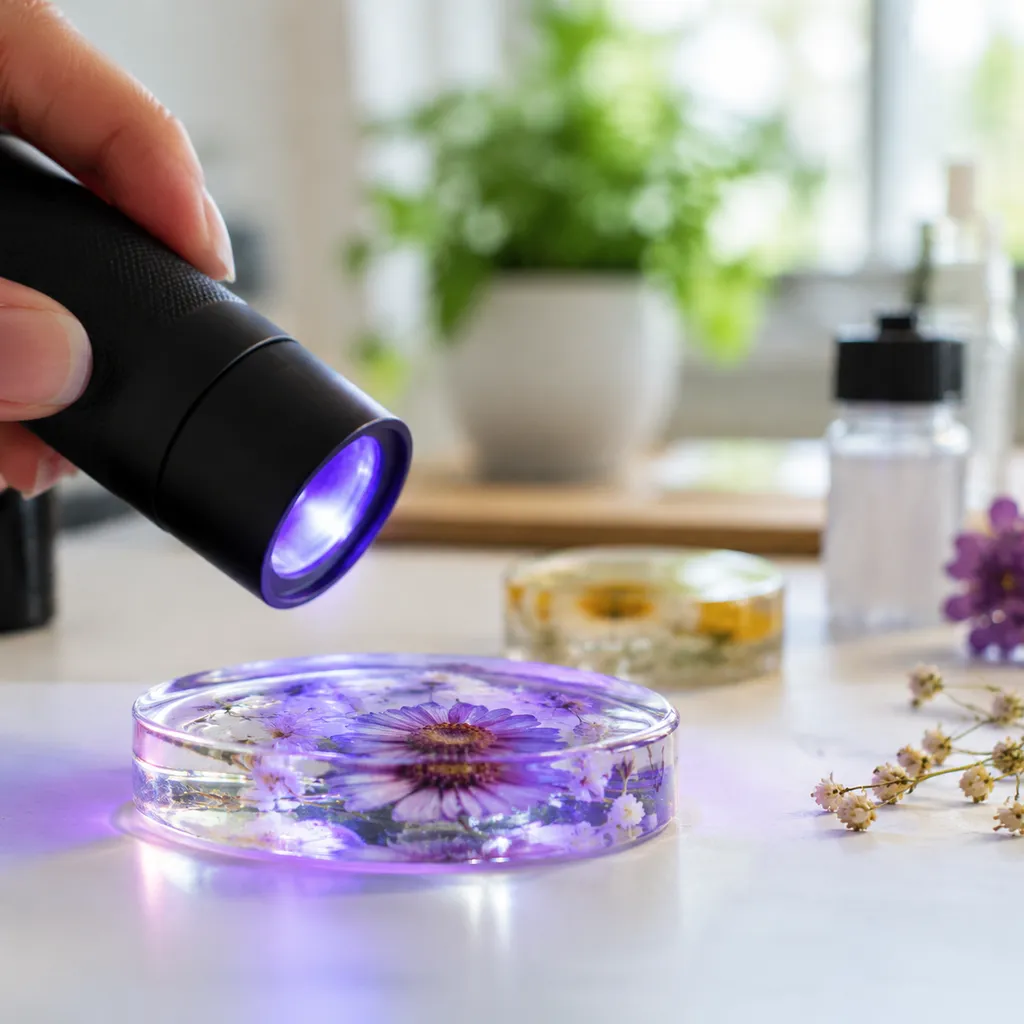
Struggling to decide between 365nm vs 405nm UV resin for your manufacturing line or printing setup?
Getting the wavelength wrong leads to incomplete curing, warped parts, and wasted materials. But when you match your resin’s photoinitiators to the exact irradiance of your light source, you get rapid, rock-solid cures every single time.
In this guide, I’ll break down the real performance differences between 365nm and 405nm UV resin, how to control exposure times and layer thickness, and how to build a simple qualification matrix so you can spec the exact right formulation for your project.
Let’s dive in.
Quick Answer
When comparing 365nm vs 405nm UV resin, the right choice comes down to matching the resin’s formulation to your UV light source and production goals:
- 365nm UV Light: Delivers shorter-wavelength energy suited for rapid surface curing and precision industrial assembly, helping prevent surface tackiness in thin coatings, electronic potting, and surface mounting.
- 405nm UV Light: Provides longer-wavelength penetration suited for deeper curing in transparent casting, resin jewelry, nameplates, and drip applications where optical clarity is essential.
- Custom Formulation Alignment: Because UV glue cures quickly under ultraviolet light and contains no harmful substances, pairing the proper photoinitiator package with your exact lamp output ensures a clean, reliable cure across different regional climates.
At RW Atelier, our R&D factory develops custom UV glue formulations engineered to match your specific UV curing equipment, line speed, and clarity requirements—backed by ISO 9001:2015, SDS, and SGS standards.
Why Wavelength Matching Matters
When selecting a UV LED curable resin, matching the UV LED wavelength of your curing equipment to the resin formulation is critical for achieving a fast, reliable cure. Because UV glue cures rapidly under ultraviolet light to create clear, transparent effects, a mismatch between your lamp output and the chemistry can leave surfaces tacky or cause incomplete curing.
As a UV curing resin manufacturer, we see buyers run into avoidable production delays when they treat all UV lamps as interchangeable. Proper UV resin cure compatibility prevents:
- Surface tackiness: Inadequate energy at the right wavelength slows surface cross-linking.
- Inconsistent clarity: Partial curing can compromise the transparent finish expected in jewelry, nameplates, or coatings.
- Wasted production time: Extending exposure times to compensate for a wavelength mismatch lowers line speed in industrial potting or surface mounting.
Nominal Lamp Wattage vs Irradiance
Many buyers focus on a lamp’s nominal wattage, assuming higher watts always guarantee a faster cure. In practice, nominal wattage only tells you how much electrical power the unit consumes—not how much usable UV curing energy reaches your resin surface.
- Lamp irradiance: What drives the chemical reaction is irradiance (the intensity of UV light hitting the part at a specific UV LED exposure distance) concentrated at either 365nm or 405nm.
- Cure window stability: A lower-wattage lamp focused tightly at the exact target wavelength will outperform a high-wattage lamp whose energy is scattered or poorly aligned with the resin’s cure window.
- Environmental variables: Local temperature and humidity also shift how fast a formula reacts, which is why we test your specific lamp setup and climate conditions during our custom UV resin formulation process.
Compare 365nm and 405nm Resin Responses
When comparing 365nm vs 405nm UV resin, the biggest difference comes down to surface cure versus cure depth. Because UV glue relies on ultraviolet light to cure rapidly and deliver a transparent finish, matching the light source to the resin formula keeps your production line fast and clean.
- 365nm UV LED Wavelength: Delivers higher surface energy, which helps prevent oxygen inhibition. This gives you a fast, tack-free top finish on nameplates, jewelry, and surface coatings.
- 405nm UV LED Wavelength: Penetrates deeper into clear resin layers. It works well for thicker transparent pours, flexible LED strip encapsulation, and industrial surface mounting where light needs to reach the bottom.
| Curing Factor | 365nm UV Light | 405nm UV Light |
|---|---|---|
| Primary Strength | Fast, tack-free surface cure | Deeper light penetration |
| Best Applications | Thin coatings, jewelry, drip art | Thick clear domes, electronics potting |
| Cure Window | Tight; needs direct UV exposure | Broader; handles slight pigment or depth |
Photoinitiator Absorption and Cure Efficiency
Inside every UV LED curable resin, photoinitiators absorb light energy to trigger hardening. A formula built for 365nm will under-cure or stay sticky under a 405nm lamp because the photoinitiator absorption peak does not line up with the lamp output.
At our Dongguan R&D facility, we formulate custom UV glue around your exact curing equipment. Whether you run high-speed industrial UV LEDs or standard craft lamps, we adjust the photoinitiator blend so your resin cures cleanly without harmful substances or surface tackiness.
Control Exposure Time and Layer Thickness
Even when you match your UV LED wavelength properly, pouring too thick or rushing the lamp cycle leaves uncured liquid trapped underneath. When evaluating 365nm vs 405nm UV resin on our production floor, we treat layer thickness and exposure time as paired variables.
- Thin Layers Cure Faster and Cleaner: Applying UV glue in thin, controlled passes lets UV energy reach the substrate quickly, giving you a tack-free surface and clear optical finish without excessive heat buildup.
- Thick Coats Need Multi-Pass Curing: If your drip application, nameplate, or electronic potting requires extra depth, cure in separate layers rather than one heavy pour. (For true single-pour depths from 2 to 30 cm, we recommend switching to our deep-pour two-part epoxy AB resin instead.)
- Watch Your Lamp Distance: Keep a consistent UV LED exposure distance across every batch. Moving the light source even a few centimeters farther away drops the curing energy hitting the resin surface.
Measuring Cure at the Bottom Surface
A hard, dry top skin does not guarantee a complete cure all the way through. Before locking in your resin cure window for bulk production, verify the bottom layer:
- Test on Clear Substrates First: Dispense your target thickness onto a transparent test slide, expose it for your planned cycle, and flip it over to inspect the underside directly.
- Check Adhesion and Tack: Peel or pry the cured sample off the test substrate. If the bottom feels oily, gummy, or leaves wet residue behind, extend your exposure time or reduce the layer thickness.
- Simulate Local Shop Conditions: Run your test batches under your actual facility temperature and humidity, since ambient climate shifts directly affect cure behavior.
Build a Simple Wavelength Qualification Matrix
Before scaling any production line, I always advise buyers to log their actual shop-floor cure results in a quick qualification matrix. Matching your 365nm vs 405nm UV resin directly against your real hardware eliminates guesswork and prevents sticky batches before you commit to a bulk order.
| Qualification Metric | 365nm UV LED Setup | 405nm UV LED Setup | Pass / Fail Check |
|---|---|---|---|
| Application Category | Surface coatings, thin films, electronics | Resin jewelry, nameplates, drip applications | Matches target part geometry |
| Surface Tackiness | Fast, tack-free top cure | Requires verified photoinitiator match | Zero residue when wiped |
| Through-Cure & Clarity | High surface absorption | Deeper penetration for transparent effects | Hard bottom layer, no yellowing |
| Shop Environment | Record ambient temp and humidity | Record ambient temp and humidity | Repeatable across shifts |
- Standardize your distance: Keep your lamp-to-part height identical across every test row so exposure energy stays consistent.
- Test real substrates: Always run trials on the actual metal, plastic, or flexible LED strip you plan to bond or coat, since heat transfer changes cure behavior.
- Evaluate multi-part alternatives: If a thick casting still shows incomplete bottom cure during qualification, switch to a two-part Epoxy AB glue designed for deep pouring rather than forcing a UV cure.
At RW ATELIER, our R&D team uses these exact qualification benchmarks during free sample testing to dial in a custom UV glue formulation for your specific lamp output and local climate.
RFQ Details to Provide: 365nm vs 405nm UV resin
When you reach out to our R&D factory for an instant quote or free sample testing, sharing clear details upfront helps us match your formula right away. At RW Atelier, we customize UV glue formulations to fit your exact production setup—whether you need 1 kilogram for initial trials or 1 ton for full-scale manufacturing.
To help our specialists evaluate your 365nm vs 405nm UV resin requirements and recommend the best solution, include these key details in your inquiry:
- Light Source & Wavelength: Specify whether your curing equipment runs at 365nm, 405nm, or dual-wavelength UV LED, along with your target curing speed.
- Application & Substrate: Let us know what you are making—such as resin jewelry, crafts, nameplates, drip coatings, flexible strip LEDs, or electronic potting—and the materials you are bonding or coating.
- Performance & Finish: Share your expectations for optical transparency, surface tack-free finish, flexibility, or thermal and chemical resistance.
- Operating Environment: Tell us your local temperature and humidity conditions so we can adjust the formula for stable performance in your region.
- Order Volume & OEM/ODM Needs: Mention your estimated order quantity (from 1 kg to 1 ton) and whether you need custom packaging, automated filling, or private labeling.
Providing these specs allows our technical team to respond within hours with tailored formulation advice, SDS/SGS compliance support, and free samples ready for your production line.
Discuss Samples and Specifications With RW ATELIER
Finding the right 365nm vs 405nm UV resin for your production line starts with real-world testing under your exact curing setup. As a dedicated UV curing resin manufacturer and R&D factory in Dongguan, we formulate and adjust our UV LED curable resin directly to match your equipment, local temperature, and humidity conditions—delivering factory-direct pricing up to 30% lower than European and American markets.
Whether you need rapid curing for electronic potting, flexible LED strips, surface mounting, or transparent finishes for resin crafts and nameplates, our technical team supports your project from trial to bulk supply:
| Manufacturing & Support Capability | What You Get With RW ATELIER |
|---|---|
| Custom UV Resin Formulation | Tailored curing speed, optical clarity, flexibility, and environmental adjustments |
| Free Sample Testing | Test our UV glue on your actual substrates and UV LED lamps before ordering |
| Flexible Order Scale | Scalable UV resin OEM and ODM production from 1 kg to 1 ton |
| Certified Quality & Safety | ISO 9001:2015, SDS (MSDS), and SGS certified, free of harmful substances |
| Fast Turnaround & Support | Short lead times, automated filling and labeling, and 1-on-1 responses within hours |
Our 3-Step Custom UV Glue Process
- Requirement Analysis: Share your lamp wavelength (365nm or 405nm), target cure speed, substrate material, and local climate details with our specialists.
- Formulation Design & Sample Preparation: Our R&D team fine-tunes the formula and sends free samples so you can verify UV resin cure compatibility in-house.
- Scaled Production: Once approved, we move into automated filling, labeling, and bulk delivery tailored to your volume needs.
Contact our Dongguan engineering team at Sale5@wingwaiepoxy.com or request an instant quote with your curing specifications to start your free sample trial today.
