
Epoxy Potting for LED Drivers Key Risks and Best Practices
Quick Answer
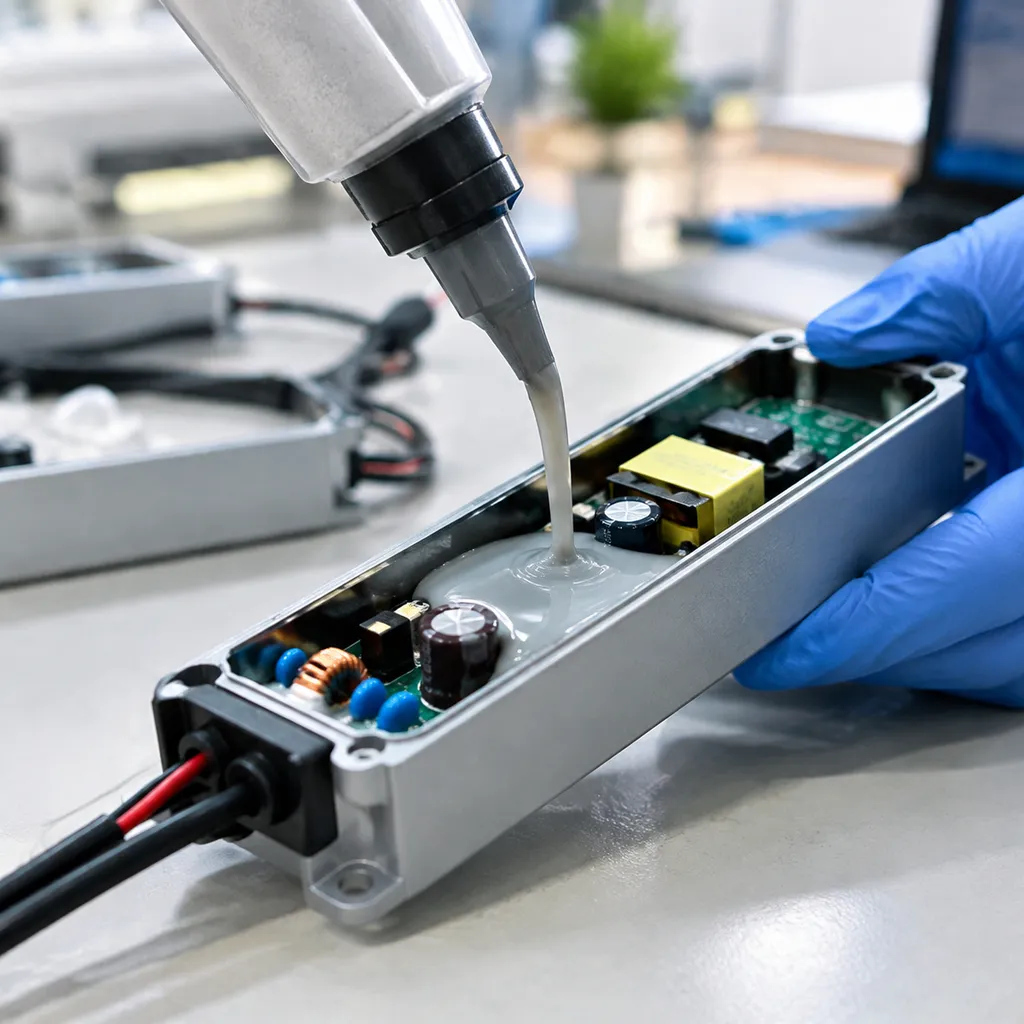
Epoxy potting for LED drivers is the process of completely encapsulating sensitive power electronics with a protective resin system to ensure long-term durability, safety, and peak performance. Applying an engineered electronic potting compound shields critical internal circuits from environmental hazards and thermal stress.
- Heat Dissipation: Conducts internal thermal energy away from sensitive power components to keep operating temperatures stable.
- Electrical Insulation: Provides reliable dielectric strength to eliminate short circuits, arcing, and electrical breakdown.
- Environmental Sealing: Forms a void-free barrier that blocks moisture, water ingress, dust, and corrosive chemicals.
- Mechanical Protection: Absorbs physical impact, mitigates mechanical vibration, and prevents strain on delicate solder joints.
What Buyers Need to Know First
Choosing the right epoxy potting for LED drivers is not just about sealing an enclosure. It directly dictates the lifespan, thermal efficiency, and field reliability of your entire lighting system. Before selecting an electronic potting compound for your assembly line, evaluate these core requirements:
- Operating Environment: Determine whether your drivers face outdoor moisture, chemical exposure, or extreme ambient temperatures. The resin must deliver an impenetrable moisture barrier and stable electrical insulation.
- Heat Dissipation Needs: LED drivers generate continuous heat during operation. Your potting compound must effectively pull heat away from sensitive power components, preventing premature capacitor failure and hot spots.
- Viscosity and Air Release: Densely packed driver boards need an epoxy that flows smoothly around every transformer and pin. Low viscosity ensures complete filling without trapped air bubbles or voids.
- Production Cycle Compatibility: Match the resin’s gel time and cure schedule to your manufacturing workflow. Whether you use meter-mix automated dispensing or manual pouring, processing speed directly impacts your output.
Key Risks in LED Driver Potting
Potting an LED driver protects the sensitive electronics inside, but choosing the wrong formula introduces major reliability issues. When an assembly fails in the field, it usually traces back to a few critical failure points during or after the potting process:
- Internal void formation: Air pockets trapped inside the casing lead to partial discharge and localized hotspots.
- Component shifting: High-viscosity resin can displace tiny surface-mount devices before cure.
- Moisture permeation: Incomplete bonding to the casing allows humidity ingress, triggering short circuits.
- Dielectric breakdown: Insufficient insulation value leads to arc-overs between high-voltage traces.
Using the right electronic potting compound mitigates these process hazards before the units ship to end customers.
Electrical Insulation Requirements
LED drivers step down mains power into tightly controlled current. This creates high voltage gradients across a very compact printed circuit board. High-grade electrical insulation resin is necessary to prevent arcing, leakage currents, and catastrophic board failures under continuous operation.
| Insulation Parameter | Critical Function in LED Drivers | Risk of Poor Material Selection |
|---|---|---|
| Dielectric Strength | Blocks high-voltage flashover across tight trace gaps | Premature driver blowout and safety trip failures |
| Volume Resistivity | Prevents parasitic leakage current between circuit traces | Signal interference, power loss, and reduced driver efficiency |
| Comparative Tracking Index (CTI) | Resists carbon path formation under electrical stress | Internal short-circuiting over extended service life |
When selecting epoxy potting for LED drivers, the dielectric barrier must remain stable across fluctuating operating temperatures. A proper LED driver potting compound maintains its insulation properties even in humid, high-load industrial environments.
Heat Generation and Thermal Management
LED drivers generate continuous heat during operation, especially around the switching components, inductors, and rectifiers. Without proper heat dissipation, this thermal buildup rapidly degrades internal parts, shortens lifespan, and causes early driver failure.
Standard air gaps act as thermal insulators. Using the right epoxy potting for LED drivers replaces these air pockets with a continuous thermal path, moving heat away from sensitive electronics directly to the outer housing.
Key thermal considerations we balance in every formulation:
- Thermal Conductivity: High-efficiency heat dissipation potting draws heat out fast, preventing localized hot spots.
- Operating Temperature Range: The cured thermal management epoxy maintains physical integrity without softening or outgassing during long-term high-temperature runs.
- Viscosity vs. Filler Ratio: We optimize the filler content so the resin flows easily into tight PCB gaps while maintaining optimal heat transfer.
| Property Target | Why It Matters |
|---|---|
| High Thermal Transfer | Lowers component junction temperatures for longer driver life. |
| Uniform Coverage | Eliminates hot spots across transformers, ICs, and electrolytic capacitors. |
| Heat Aging Resistance | Prevents the cured compound from hardening further, shrinking, or cracking over years of heat cycles. |
Stress on Components and Solder Joints
Heat causes materials to expand and contract. Because a circuit board contains copper, FR4, ceramics, and silicon, each material expands at a different rate. If an electronic potting compound is too rigid or shrinks excessively during curing, it creates massive mechanical stress inside the module.
This stress leads to common field failures:
Solder Joint Fatigue: Micro-cracks develop beneath SMD components, breaking electrical contact.
Component Damage: Fragile ferrite cores, glass diodes, and ceramic capacitors can shear or crack under shrinkage pressure.
Board Warping: High curing shrinkage pulls the PCB unevenly, compromising internal traces.
To solve this, our formulations for LED encapsulation balance tensile modulus with low cure shrinkage. By tailoring the coefficient of thermal expansion (CTE) and cure kinetics, the material absorbs thermal cycling shock without ripping sensitive solder joints apart.
Potting Depth and Cure Behavior
Potting depth directly changes how an epoxy cures. When you cast a deep layer of epoxy potting for LED drivers, the material generates internal heat during polymerization. If that exothermic reaction spikes too fast, the resin shrinks, forms internal voids, or burns sensitive electronics inside the housing.
We balance cure profiles based on your driver enclosure dimensions:
- Shallow Pours (<15 mm): Allow faster-curing systems since ambient heat escapes quickly.
- Deep Pours (>15 mm): Require a controlled, low-exotherm LED driver potting compound to prevent stress cracking and heat buildup.
- Shrinkage Control: Low-shrinkage formulations protect delicate SMD components from shear stress during the final cure stage.
- Air Release: Optimized viscosity lets trapped air escape naturally before the gel state, eliminating micro-voids around tight pin layouts.
| Parameter | Shallow Pour (<15 mm) | Deep Pour (>15 mm) |
|---|---|---|
| Exotherm Risk | Low | High |
| Target Gel Time | Standard (30–60 min) | Extended (90–180 min) |
| Viscosity Need | Low to Medium | Low (self-leveling) |
| Cure Stress | Minimal | High (requires low shrinkage) |
How to Qualify the Potting Material
Qualifying an electronic potting compound before full production runs ensures your drivers handle field stress without dielectric breakdown or premature cracking.
We test and validate materials against four critical checkpoints:
- Exotherm Monitoring: Pouring the resin into the actual driver case at target room temperature to verify peak core heat stays within component safety limits.
- Thermal Shock Cycling: Testing potted units through repeated -40°C to +125°C transitions to expose cracking, delamination, or solder joint failure.
- Dielectric Strength Testing: Checking electrical insulation under high voltage to confirm zero pinholes, moisture ingress, or current leakage.
- Adhesion Integrity: Ensuring the epoxy forms a continuous seal to aluminum casings, plastic shells, and wire jackets to keep moisture out permanently.
What Information Should You Send to RW ATELIER?
To match your project with the ideal epoxy potting for LED drivers, we need specific details about your unit’s operating environment and manufacturing setup. Providing these parameters upfront allows our technical team at RW ATELIER to select or tailor the exact electronic potting compound for your assembly line.
Key Technical Details to Share
- Operating and Peak Temperatures: The continuous running temperature and maximum peak heat generated by your LED power supply.
- Thermal Management Requirements: Target thermal conductivity ratings needed for efficient heat dissipation potting across sensitive components.
- Enclosure Geometry and Potting Depth: Case dimensions, fill depth, and PCB layout to evaluate exotherm risks, material flow, and shrinkage.
- Dielectric and Insulation Needs: Working voltage levels, required breakdown voltage, and electrical insulation standards.
- Environmental Exposure: Outdoor ratings (such as IP-level requirements), moisture exposure, UV resistance, or chemical contact.
- Application and Dispensing Method: Manual mixing or automated meter-mix dispensing, alongside your preferred working time (pot life) and curing schedule (room temperature or oven cure).
| Specification | Why It Matters for Your Formulation |
|---|---|
| Component Sensitivity | Determines the glass transition temperature (Tg) and flexibility needed to prevent cracked solder joints. |
| Fill Volume per Unit | Informs bulk supply planning, flow viscosity, and void-free penetration around tight clearances. |
| Compliance Standards | Ensures the raw formulation meets regional safety directives, flammability ratings, and environmental mandates. |
How Can RW ATELIER Support This Project?
We back your production line directly from our facility, ensuring your epoxy potting for LED drivers meets every mechanical, electrical, and thermal target. As an experienced OEM epoxy resin manufacturer and direct formulation partner, we eliminate guesswork and supply chain bottlenecks through dedicated technical and manufacturing services:
- Custom Formulation Development: We tailor viscosity, cure schedules, glass transition temperature ($T_g$), and thermal conductivities to match your specific driver enclosure geometry and component layout.
- Factory-Direct Consistency: Sourcing as an industrial epoxy resin supplier guarantees batch-to-batch chemical stability, low ionic impurities, and reliable shelf-life performance.
- Sample Qualification Support: We provide material testing samples along with comprehensive technical data sheets (TDS) and safety documentation (SDS) for rapid prototyping and validation runs.
- Scale and Global Logistics: Operating as a bulk epoxy resin supplier, we accommodate both mid-tier pilot runs and high-volume commercial container deliveries without long transit delays.
- Application Engineering: We assist with dispensing setup, vacuum degassing recommendations, and cure optimization to eliminate voids and shrinkage stress in your electronics assemblies.
Our Supply and Manufacturing Capabilities
| Service Area | Direct Capability |
|---|---|
| Material Matching | Custom potting formulations based on driver operating temperatures and wattages |
| Supply Channel | Epoxy resin factory direct shipping to avoid distributor markups and aging stock |
| Batch Control | Rigorous quality audits covering viscosity, specific gravity, and electrical resistance |
| Integration Help | Practical processing guidance for meter-mix dispensing and automated production lines |
We provide the formulation control and production capacity required to keep your LED driver manufacturing running smoothly, safely, and efficiently.
