Self Leveling Epoxy vs Roller Coating Cost and Durability
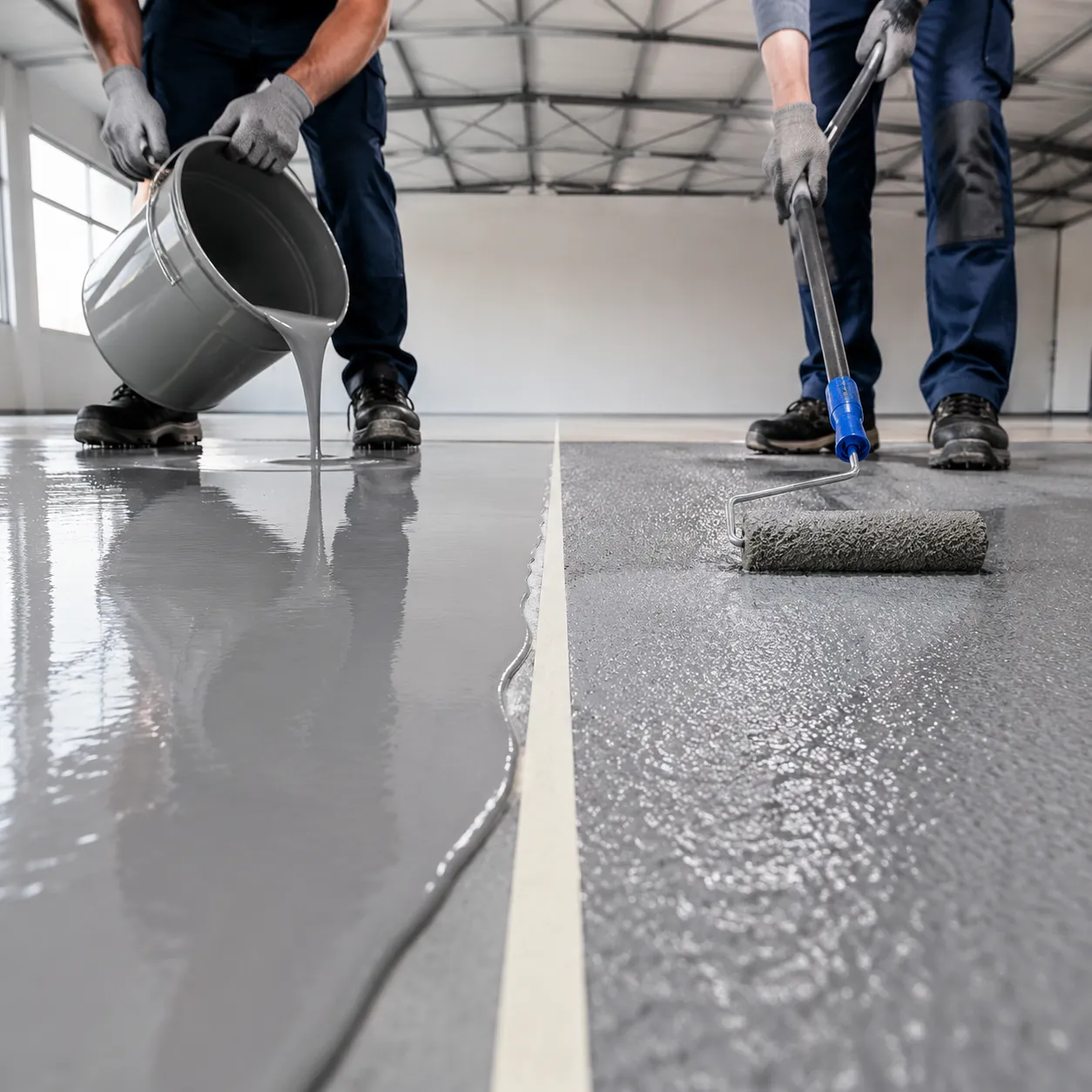
Self Leveling Epoxy vs Roller Coating: Technical Specification Matrix
Choosing between a self-leveling epoxy resin system and a thin-film roller coating comes down to structural load requirements, concrete substrate conditions, and long-term operating budgets. We evaluate both industrial floor coating systems against standard engineering metrics.
| Technical Specification | Self-Leveling Epoxy System (High-Build) | Roller-Coated Epoxy System (Thin-Film) |
|---|---|---|
| Application Method | Pour & spread (gauge rake, notched squeegee, spiked roller) | Dip & roll (medium/short nap roller, cross-rolling) |
| Typical Dry Film Thickness (DFT) | 1.5 mm – 4.0 mm (1,500 – 4,000 µm) | 0.2 mm – 0.5 mm (200 – 500 µm) |
| Material Consumption Rate | 2.0 – 3.5 kg/m² | 0.3 – 0.5 kg/m² (per coat) |
| Substrate Leveling Ability | High self-smoothing capability; fills spalls, pits, and small cracks | Conforms to concrete texture; telegraphs surface defects |
| Mechanical & Impact Resistance | Superior resistance to heavy forklift traffic, impact, and point loads | Suitable for light cart traffic, foot traffic, and staging areas |
| Surface Hardness Potential | Shore D 85 – 90+ | Shore D 75 – 80 |
| Service Lifespan & Recoat Cycle | 10 – 15+ years under heavy industrial load | 3 – 5 years before maintenance recoat required |
Engineering Performance Key Takeaways
- High-Build Self-Leveling Epoxy: Provides a seamless, ultra-dense protective slab overlay. Designed for cleanrooms, manufacturing facilities, and heavy-duty logistics hubs facing severe mechanical stress.
- Thin-Film Roll Coating: Functions primarily as a protective dust-proofing seal and aesthetic tint layer. Ideal for light commercial spaces, mechanical rooms, and low-impact storage zones.
Deep-Dive: Roller-Coated Epoxy Systems (Thin-Film)
We deploy thin-film roll coat epoxy systems when concrete floors require rapid dust-proofing, basic chemical protection, and minimal downtime under light operational loads.
Application Mechanics & Tooling
- Equipment: 1/4-inch to 3/8-inch solvent-resistant, lint-free short to medium nap rollers.
- Method: Dip-and-roll execution directly from application trays or controlled ribbon pours.
- Technique: Immediate perpendicular cross-rolling to equalize wet film thickness (WFT) and minimize roller lines.
Thin-Film Roll Coating Performance Profile
| Performance Metric | Technical Specification |
|---|---|
| Material Consumption | 300 – 500 g/m² per coat |
| Dry Film Thickness (DFT) | 150 – 300 microns (6 – 12 mils) total multi-coat system |
| Recoil & Cure Speed | Touch-dry in 8–12 hours; foot traffic ready in 24 hours |
| Load Capacity | Pedestrian traffic, light hand carts, non-marking rubber wheels |
Key Technical Advantages
- Low Material Consumption: Consumes only ~300–500 g/m² per coat, minimizing initial material expenditures for wide-area coverage.
- Fast Facility Turnaround: Rapid application cycles allow tight installation windows and quick return-to-service timelines.
- Targeted Light-Duty Protection: Delivers an effective, clean surface seal for low-impact storage rooms, utility corridors, and staging areas.
Technical Limitations
- Non-Leveling Nature: Thin-film roll coating mirrors substrate defects, telegraphing underlying cracks, spalls, and concrete roughness.
- Limited Impact Resistance: Lacks the structural mass needed to withstand point loads, severe gouging, or heavy forklift traffic.
- Orange Peel Surface Texture: Roller stipple leaves a slight texture that degrades optical clarity and can trap fine industrial dirt over time.
Self-Leveling Epoxy Systems
We engineer self-leveling epoxy systems for heavy-duty environments that demand high structural strength, impact resistance, and an ultra-clean aesthetic. Unlike thin-film roll coatings, this high-build resin system cures into a thick, continuous slab section that flows out naturally to eliminate surface defects.
Application Mechanics and Tooling
Applying a self-smoothing epoxy resin requires specialized liquid-handling equipment to control material depth and eliminate air entrapment.
- Gauge Rakes & Notched Squeegees: Set precise wet-film depth (typically 2.0 mm to 4.0 mm) across wide floor spans.
- Spiked Shoes: Allow applicators to walk across wet resin without leaving permanent footprint impressions.
- Spiked Rollers: Burst entrained air pockets trapped during mixing, eliminating pinholes and surface craters before the gel phase.
Technical Performance Overview
| Feature / Metric | Technical Specification | Operational Advantage |
|---|---|---|
| Surface Finish | Self-smoothing mirror finish | Seamless, ultra-hygienic profile; easy to sanitize |
| Material Hardness | Shore D 90+ rating | Exceptional resistance to gouging, dropping tools, and severe point loads |
| Traffic Rating | Heavy forklift traffic resistance | Handles high-tonnage wheel loads and constant drag without delamination |
Installation Realities and Technical Limitations
High-build self-leveling floor systems require precision handling and higher initial material allocation:
- High Material Usage: Coverage demands 2.0 to 3.5 kg/m², raising initial upfront material costs compared to thin roll coats.
- Strict Pot Life and Working Time: Mass accumulation speeds up exothermic curing reactions. Crews have a strict 15 to 20-minute window to pour, spread, and spike-roll mixed batches before viscosity spikes.
- Rigorous Concrete Substrate Preparation: Requires shot-blasting to CSP 3–5 and complete pore sealing. Any unsealed capillaries allow concrete outgassing, leading to surface blisters and pinhole defects in the finished high-build floor.
Multi-Layer Floor System Architecture
A reliable industrial concrete floor coating system depends on a correctly specified, multi-layer architecture. Skipping steps or mismatching resin chemistries leads to delamination, pinholing, and premature mechanical wear. We engineer our industrial floor systems across three distinct functional layers to ensure maximum adhesion and long-term durability.
Layer 1: Concrete Outgassing Primer
- Primary Function: Penetrates deep into the concrete capillary network to lock down dust and seal air passages.
- Outgassing Control: Concrete breathes as ambient temperatures shift. Unsealed concrete releases air upward, causing bubbles, craters, and pinholes in thick coatings.
- Adhesion Promotion: A specialized concrete outgassing primer creates a chemical bond between the porous substrate and the dense build layer above it.
Layer 2: Structural Build Layer
- Self-Smoothing Epoxy Resin Option: Applied at 2.0 mm to 4.0 mm dry film thickness (DFT). This high-build resin system fills surface defects, levels uneven concrete, and absorbs high impact from heavy forklift traffic.
- Roll Coat Epoxy Option: Applied at 100 to 200 microns DFT per pass. This thin-film method provides basic color and light chemical protection, but it conforms to existing floor textures rather than leveling them.
- Custom Formulation: We engineer our RW ATELIER base resins with optimized viscosity and air-release chemistry, ensuring self-leveling floors release trapped air quickly while roller-applied systems lay down smoothly without excessive orange peel surface texture.
Layer 3: Performance Wear Topcoat
- Aliphatic Polyurethane Topcoat: Delivers superior scratch resistance, UV stability, and chemical protection to prevent epoxy yellowing and chalking over time.
- Polyaspartic Coating: Provides rapid cure times for fast-turnaround facilities needing light traffic access in as little as 4 to 6 hours.
- System Longevity: Epoxy provides structural strength, but the topcoat absorbs day-to-day abrasive friction, extending system service life significantly before requiring a recoat.
Material Economics: Self Leveling Epoxy vs Roller Coating
When evaluating an industrial concrete floor coating system, upfront material costs only tell half the story. We analyze lifecycle financial dynamics by balancing initial capital expenditure against labor, tooling overhead, and operational downtime.
| Economic Metric | Thin-Film Roll Coating | High-Build Self-Leveling Epoxy |
|---|---|---|
| Material Consumption | 0.3 – 0.5 kg/m² | 2.0 – 3.5 kg/m² |
| Initial Material Cost | Low | Moderate to High |
| Crew Requirement | 2 – 3 Technicians | 4 – 6 Specialized Installers |
| Tooling Overhead | Rollers, extension poles | Gauge rakes, spiked shoes, pin rollers |
| Service Lifespan | 3 – 5 Years | 10 – 15+ Years |
| 10-Year Cumulative Cost | High (2–3 recoat cycles) | Low (Single installation) |
Initial Capital Expenditure vs. Long-Term ROI
A thin-film roll coating offers a low entry barrier, making it appealing for immediate budget constraints. However, a high-build resin system yields a far superior Return on Investment (ROI) over a 10-year period in heavy-use environments.
- Roller Coating: Low initial CapEx, but high lifetime expense caused by repeated surface re-preparation, material repurchasing, and facility downtime.
- Self-Leveling Epoxy: Higher initial investment per square meter, offset by decades of structural durability and minimal operational disruption.
Labor and Tooling Overhead
Application mechanics directly drive installation labor costs:
- Thin-Film Roll Coating: Requires standard roller setups and basic labor teams. Rapid square-meter coverage keeps short-term labor costs low.
- Self-Leveling Epoxy: Demands a coordinated crew of 4 to 6 skilled technicians to manage batch mixing, continuous pouring, gauge raking, and spiked rolling within strict pot-life windows.
Maintenance and Recoat Schedules
- Thin-Film Systems (3–5 Year Recoat Cycle): Subject to rapid abrasive wear down to the bare concrete substrate. Requires complete re-sanding and topcoat re-application every few years.
- High-Build Systems (10–15+ Year Recoat Cycle): Retains structural integrity under heavy forklift traffic and impact, requiring only light surface sanitization and periodic topcoat refreshes to maintain baseline performance.
The RW ATELIER Chemical Formulation Advantage
Standard jobsite resins force contractors to adapt to rigid, off-the-shelf formulas. As an ISO 9001:2015 certified wholesale epoxy resin manufacturer, we engineer every industrial floor coating system around your project’s specific site conditions—whether you are installing a high-build self-smoothing floor or a thin-film roll coat epoxy.
Custom Viscosity and Air-Release Control
We adjust resin flow dynamics at the molecular level to optimize installation performance:
- Self-Leveling Systems: Formulated with low surface tension and active air-release additives to purge trapped air during gauge rake application, yielding a pristine glass-like finish without pinholes.
- Roller Coating Systems: Engineered with controlled thixotropy to minimize orange peel surface texture while eliminating sagging on ramps or vertical risers.
Climate-Adapted Formulations
Temperature and humidity directly impact epoxy pot life and working time. We customize our amine hardener packages to match your local climate:
- High-Temperature Systems: Retard reactivity to prevent premature gelation and extend open time on large pours.
- Cold-Cure Formulations: Accelerate cross-linking down to low ambient temperatures without sacrificing final chemical resistance or risking amine blush.
Factory-Direct Value
By sourcing directly from our factory, you bypass middleman markups while maintaining strict technical standards:
- Shore D 90+ Hardness: Formulated to withstand heavy forklift traffic, point loads, and severe mechanical impact.
- OEM Pricing Structure: Direct wholesale pricing for high-volume applicators, OEMs, and private label epoxy resin partners.
Flexible Sourcing
We support your project lifecycle from initial engineering testing through full-scale installation:
- Pilot Testing: Custom batching starting at 1 kg sample kits for lab verification and site mock-ups.
- Bulk Supply: Direct shipment of up to 1-ton IBC totes for industrial-scale projects.
Self-Leveling Epoxy or Roller Coating: Which Should I Use?
We assist contractors and facility managers in selecting the exact industrial concrete floor coating system for their operational demands. Matching your floor to the right application method prevents premature coating failure and optimizes material expenditure.
Decision Matrix: Self-Leveling Epoxy vs Roller Coating
| Selection Factor | Thin-Film Roll Coating | High-Build Self-Leveling Epoxy |
|---|---|---|
| Substrate Condition | Flat, smooth concrete; no pitting or cracks | Rough, damaged, or pitted concrete |
| Traffic Profile | Foot traffic, light hand carts, utility rooms | Heavy forklift traffic, steel wheels, impact loads |
| Chemical Exposure | Standard spills, routine washdowns | Heavy chemical exposure, standing liquids |
| Surface Finish | Conforms to slab texture; mild orange peel | Seamless, mirror-smooth, high-gloss profile |
| Initial Capital Cost | Lower initial cost; low material consumption | Higher upfront material build; long-term ROI |
Choose Thin-Film Roll Coating If:
- The substrate is flat and sound: Your concrete slab is level, well-finished, and free of deep surface pitting or substrate defect telegraphing risks.
- Traffic is light to moderate: Floor usage is restricted to foot traffic, staging areas, and light-duty rolling carts.
- Capital outlay is limited: You require a cost-effective protective layer with fast application turnover.
Choose High-Build Self-Leveling Epoxy If:
- Concrete has surface roughness: The slab exhibits pitting, spalling, or uneven wear that requires build-up and self-smoothing capability.
- Heavy mechanical exposure: Operations require heavy forklift traffic resistance, point-load durability, and resistance to severe mechanical wear.
- Ultra-clean aesthetic required: You need a high-build, seamless surface that eliminates joints and debris traps for hygienic facilities.
We supply both high-build resin system options and thin-film formulations directly from our manufacturing line at RW ATELIER. We customize viscosity and cure speeds to your site conditions, giving you factory-direct pricing for both low-build protection and heavy-duty floor resurfacing.
Technical Consultations & Custom Epoxy Formulations
We give contractors and engineers direct access to our RW ATELIER R&D team to eliminate application risks on site. Whether you are balancing a self leveling epoxy vs roller coating application, we adjust the resin dynamics to match your exact climate, equipment, and structural performance requirements.
Technical Adaptation Capabilities
| Engineering Target | Customization Options | Practical Benefit |
|---|---|---|
| Viscosity & Flow Control | Modified shear dynamics and flow additives | Prevents sagging on ramps or optimizes self-smoothing flow |
| Cure Speed & Pot Life | Accelerated or extended hardener packages | Tailored working time for extreme temperatures (5°C to 40°C) |
| Color & Aesthetics | Precise custom RAL and NCS color matching | Meets corporate visual standards and safety floor zoning |
| Hardness & Flexibility | Shore D 90+ hardening or flexible modifications | Engineered for extreme forklift impact or thermal shock |
Direct R&D Support Services
- Custom Sample Testing: We supply custom batch 1 kg trial kits for field verification before committing to bulk volumes.
- Substrate Profiling Support: Submit your concrete core data to our lab to optimize primer penetration and prevent pinhole outgassing.
- Seamless Scalability: Validated sample formulations scale directly to full 1-ton bulk production runs with absolute batch-to-batch consistency.
Frequently Asked Questions (FAQs)
Main Difference: Self Leveling Epoxy vs Roller Coating
The core distinction lies in application thickness, substrate leveling capability, and overall mechanical load tolerance.
| Specification | Self Leveling Epoxy | Rolled Epoxy Coating |
|---|---|---|
| Applied Thickness | 1.5–3.0 mm (high-build resin) | 200–500 microns (thin-film) |
| Substrate Impact | Fills pits, cracks, and unevenness | Conforms to existing concrete surface profile |
| Traffic Rating | Heavy forklift traffic, high impacts | Foot traffic, light cart movement |
| Surface Finish | Seamless, ultra-smooth mirror finish | Textured finish with slight orange peel |
Is Self Leveling Epoxy More Expensive Than Rolled Epoxy Coating?
Yes, initial capital expenditure for self leveling epoxy systems is higher due to material volume requirements (2.0–3.5 kg/m² compared to 0.3–0.5 kg/m² for thin-film roll coating). However, high-build self-smoothing floors yield lower lifecycle costs. They deliver a 10–15+ year service lifespan before major refurbishment, whereas thin-film roll coat epoxy applications typically require recoating every 3–5 years under industrial use.
Can You Roller Coat Over an Existing Self Leveling Epoxy Floor?
Yes. We frequently supply aliphatic polyurethane or polyaspartic topcoats to refresh existing high-build installations.
- Surface Prep: Mechanical abrasion (light sanding or diamond grinding) is required to remove surface glaze and establish a mechanical profile.
- Decontamination: Solvent-wipe the floor clean of oil, chemical residue, and dust particles.
- Topcoat Application: Dip and roll a compatible performance wear coat to restore UV stability, chemical resistance, or slip texture without rebuilding structural thickness.
Which Coating System Handles Heavy Forklift Traffic Better?
Self leveling epoxy is engineered specifically for heavy wheel loads, point impact resistance, and continuous vehicular abrasion.
- High Hardness Profile: Formulated to achieve Shore D 90+ surface hardness, preventing point indentation under solid forklift tires.
- Impact Absorption: The 2 mm+ thick resin body distributes point-load stress across the slab, shielding the substrate from micro-cracking.
- Delamination Resistance: Thin-film roll coating tends to flake, shear, or telegraph concrete defects under high-tonnage forklift traffic, while high-build self leveling systems maintain structural bond integrity.
