Carbon Fiber Market Trends and Composite Industry Future
Part 1: Market Size and Growth
The global carbon fiber market is experiencing unprecedented momentum. Driven by advanced engineering demands and industrial modernization, the market valuation is projected to surge from $26.4 billion in 2026 to $46.1 billion by 2033. This massive expansion reflects a robust compound annual growth rate (CAGR) of 8.4%, underscoring the vital role of advanced composites across global supply chains.
Global Carbon Fiber Market Forecast
- 2026 Market Valuation: $26.4 Billion
- 2033 Market Projection: $46.1 Billion
- Compound Annual Growth Rate (CAGR): 8.4%
Regional Market Dynamics and Growth Variance
The composite industry future reveals distinct growth trajectories across major industrial hubs, dictated by localized demand and regional capabilities.
| Region | Market Dynamic | Key Growth Driver |
|---|---|---|
| Asia-Pacific | Fastest Growth | Mass manufacturing scaling, aggressive infrastructure investments, and electric vehicle dominance. |
| Europe | Stable Expansion | Stringent sustainability regulations, circular economy mandates, and premium automotive engineering. |
| North America | Innovation-Driven | Next-generation aerospace defense, commercial space exploration, and high-value material research. |
This geographic divergence means global manufacturers must balance cost-efficient scaling in the East with high-tier, specialized innovation in the West to successfully capture long-term carbon fiber market growth.
Key Growth Drivers in the Carbon Fiber Market
The surging global carbon fiber demand forecast is heavily driven by a few critical industries looking for extreme strength-to-weight ratios. As a leading player in the advanced materials space, we see firsthand how these core sectors are accelerating composite material innovation.
- Electric Vehicle (EV) Lightweighting: Range anxiety and battery weight are the biggest challenges in the EV transition. Automakers are turning to carbon fiber composites to shed vehicle weight, directly boosting battery range and structural safety.
- Wind Energy Expansion: The push for renewable energy requires massive, high-efficiency wind turbines. Longer, stiffer, and lighter turbine blades are impossible to build without advanced carbon fiber, especially for offshore wind farms.
- Aerospace & Defense: Commercial aviation, private space exploration, and UAVs (drones) continue to demand high-performance composites to slash fuel consumption and maximize payload capacities.
- Sports & Leisure: High-end sporting goods—like premium bicycles, tennis rackets, and golf shafts—rely heavily on carbon fiber for top-tier performance and durability.
- Infrastructure Reinforcement: Structural engineering increasingly uses composite materials to repair, reinforce, and extend the lifespan of aging bridges, pipelines, and buildings.
To meet these demanding structural needs, the choice of matrix material is vital. High-performance carbon fiber components rely on premium-grade formulations like our advanced epoxy resin systems, which ensure maximum load transfer, durability, and environmental resistance across all these high-growth applications.
Technical Innovation and Composite Industry Future
We are heavily investing in next-generation manufacturing to stay ahead of carbon fiber market trends. The future of composite material innovation relies on cutting-edge production methods that lower costs while boosting quality.
Composite Manufacturing Automation
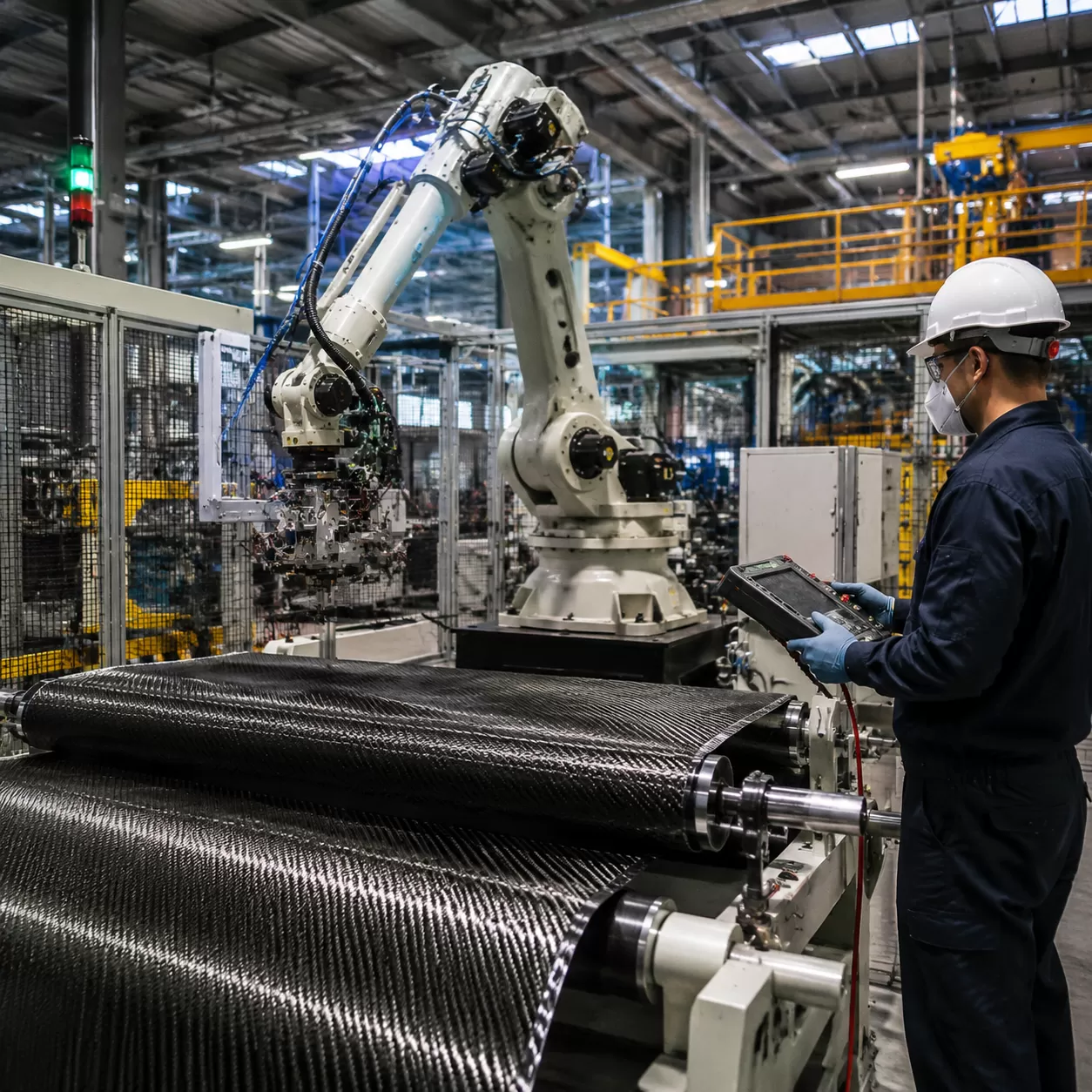
Manual hand-layup is too slow for modern production needs. We are shifting toward high-efficiency automated systems:
- Automated Fiber Placement (AFP): Uses robotic arms to lay down carbon fiber tapes precisely along complex curves, reducing waste to under 5%.
- Automated Resin Transfer Molding (RTM): Injects resin into a closed mold automatically. This shortens cycle times from hours to minutes, making mass production viable.
Industry 4.0 Composite Integration
Digitalization ensures every part we ship meets exact standards. We use smart factory technology to track and optimize production:
- AI Quality Control: Computer vision scans parts in real time during production to catch flaws that human inspectors might miss.
- Digital Twins: We create exact virtual models of our manufacturing lines to simulate production runs, predict tool wear, and prevent downtime.
Sustainable Composites and Advanced Materials
We are expanding our material catalog to offer high-performance, eco-friendly alternatives without sacrificing strength:
- Bio-Based Epoxy Resin: Replaces petroleum-derived chemicals with plant-based sources, cutting the carbon footprint of the matrix material.
- Recycled Carbon Fiber (rCF): Reclaims carbon fibers from manufacturing scrap and end-of-life parts, repurposing them into high-strength intermediate components.
Next-Gen Processes and Future Composite Applications
New forming techniques allow us to design parts that were previously impossible to manufacture:
- 3D Printing Composites: Enables rapid prototyping and complex, hollow geometries without expensive tooling.
- Continuous Fiber Reinforcement: Integrates unbroken strands of carbon fiber into 3D-printed parts, drastically increasing tensile strength compared to chopped fiber alternatives.
Sustainable Composites: Crucial Carbon Fiber Market Trends
Green manufacturing is no longer optional. As we track the composite industry future, sustainability has shifted from a compliance checklist to a core market driver. We are actively adapting our production to meet these environmental demands through clean material alternatives and circular lifecycles.
Bio-Based Epoxy Resin Adoption
We are shifting away from petroleum-dependent inputs by integrating bio-based epoxy resin into our production lines. These resins derive from plant-based byproducts, cutting carbon footprints without compromising the tensile strength or thermal performance required in high-end applications.
Carbon Fiber Recycling and Circularity
Raw carbon fiber production is energy-intensive. To address this, we are investing in reclaimed and recycled carbon fiber technologies.
- Source: Industrial scrap and end-of-life components.
- Process: Advanced pyrolysis that preserves fiber length and structural integrity.
- Result: High-performance, cost-effective intermediate materials perfect for automotive and consumer goods.
Low VOC Resin Systems
Worker safety and air quality drive our switch to low VOC (Volatile Organic Compound) resin formulations. These systems drastically reduce hazardous emissions during curing, creating a safer factory floor and ensuring compliance with tightening global chemical regulations.
Standardizing Green Certifications
We validate our environmental claims through strict, globally recognized frameworks. Our roadmap focuses on two primary milestones:
- Carbon Neutrality: Total lifecycle tracking from raw material sourcing to finished component.
- Eco-Labeling: Securing verifiable certifications to give our international clients clear, auditable proof of their reduced environmental impact.
Regional Insights: Global Carbon Fiber Market Trends
The global carbon fiber market growth is unfolding differently across key regions. Understanding these geographic shifts is essential for aligning with the composite industry future.
Asia-Pacific: The High-Volume Manufacturing Hub
Asia-Pacific currently leads the world in production capacity and raw volume demand. Driven by massive industrial scaling, this region offers unmatched cost advantages and the fastest growth rate.
- Key Drivers: Mass-market electric vehicle (EV) production, wind energy blade manufacturing, and commercial electronics.
- Our Edge: We leverage this regional ecosystem to secure reliable supply chains and cost-effective scaling for high-volume composite manufacturing automation.
Europe: Leading the Sustainable Composites Wave
Europe dictates the technical standards and environmental regulations for the next generation of materials. It is the primary market for high-end applications and green technology.
- Key Drivers: Strict carbon emissions targets, advanced automotive engineering, and early adoption of bio-based epoxy resin.
- Our Edge: We actively align our material pipelines with European circular economy standards, focusing heavily on carbon fiber recycling and eco-certified components.
North America: Innovation-Driven High-Value Applications
North America remains the epicenter for cutting-edge aerospace engineering and disruptive future composite applications. The focus here is on performance breakthroughs and defense-grade validation.
- Key Drivers: Next-gen commercial aviation, space exploration payloads, and Industry 4.0 composite integration.
- Our Edge: Our R&D investments are tailored to meet these strict, high-value technical requirements, bringing aerospace-grade precision to localized production lines.
| Region | Primary Strength | Core Market Focus | Future Composite Applications |
|---|---|---|---|
| Asia-Pacific | Scale & Cost Efficiency | Automotive & Wind Energy | Mass-market EV components, large-scale wind turbines |
| Europe | Green Standards & Tech | Premium Auto & Aerospace | Recycled composites, bio-based structures |
| North America | Advanced R&D & Space | Defense, Aviation & Space | UAVs, satellite structures, automated tape laying |
Future Composite Applications Across Key Industries
The advanced composites landscape shifting rapidly. As we look at the carbon fiber market trends, the next decade will be defined by deep penetration into mass production and high-growth industrial sectors. Here is how the composite industry future is unfolding across four critical pillars.
Electric Vehicles: Mass Market Penetration
Carbon fiber is no longer exclusive to supercars and luxury racing brands. The aggressive push toward electric vehicle lightweighting is driving adoption into high-volume passenger vehicles.
- Battery Enclosures: Lightweight composite structures protect EV battery packs while stripping out dead weight to boost driving range.
- Structural Components: Body-in-white reinforcements, pillars, and roofs now leverage automated composite manufacturing to lower cycle times.
- Cost Reduction: Scaled production and smarter resin systems are finally bringing material costs down to meet mass-market automotive budgets.
Wind Energy: Mega-Turbines and Offshore Expansion
Wind power requires longer, stiffer, and lighter blades to capture more energy efficiently. This has made the renewable energy sector one of the largest volume consumers of advanced composites.
- Spar Caps: Carbon fiber pultrusion is now the industry standard for the structural backbone of blades exceeding 100 meters.
- Offshore Reliability: Superior fatigue resistance protects massive maritime installations from harsh saltwater environments and extreme mechanical stress.
- Aerodynamic Efficiency: Higher stiffness-to-weight ratios allow for thinner, more aerodynamically optimized blade profiles that maximize power output.
Aerospace: Commercial Space and UAVs
While commercial aviation remains a steady consumer, the true disruption in the future composite applications space is happening in emerging aerospace sectors.
- Commercial Space: Private launch vehicles, satellite constellations, and payload fairings rely heavily on carbon fiber to cut launch costs per kilogram.
- Unmanned Aerial Vehicles (UAVs): The explosion of defense, cargo, and inspection drones demands ultra-light, rigid airframes to maximize loiter times and payload capacities.
- Urban Air Mobility (UAM): Developing eVTOL (electric vertical takeoff and landing) aircraft require highly integrated, crashworthy composite structures to meet strict aviation safety certifications.
Infrastructure: Structural Reinforcement and Longevity
Civil engineering is turning to composites to fix aging global infrastructure and build smarter, longer-lasting public works.
- Bridge Rehabilitation: Carbon fiber reinforced polymers (CFRP) wrap concrete columns and reinforce bridge decks, extending service life without adding dead weight.
- High-Pressure Pipelines: Composite overwrapping repairs and strengthens oil, gas, and water transmission lines under high operating pressures.
- Seismic Retrofitting: High-tensile composite fabrics protect vulnerable buildings and historical architecture in earthquake-prone zones globally.
Global Carbon Fiber Market Trends: Shifting Supply Chains
We are witnessing a major restructuring of the composite industry future. To stay competitive, we are actively adapting our operations to four critical shifts in the global carbon fiber supply chain.
Carbon Fiber Capacity Expansion
Global carbon fiber market growth is driving unprecedented production increases.
- Massive Scale: Major global producers are rapidly expanding nameplate capacity to prevent raw material bottlenecks.
- Industrial Focus: New facilities heavily target large-tow industrial grades to feed the high-volume automotive and wind energy sectors.
- Our Move: We are securing long-term volume allocations now to guarantee uninterrupted production for our clients.
Resin Supply Diversification
The future of carbon fiber relies entirely on the matrix holding it together. Relying on a single resin source is no longer viable.
- Matrix Variety: The market is shifting from standard petroleum-based epoxies to advanced thermoplastics and bio-based formulations.
- Risk Mitigation: Spreading raw material sourcing across multiple global chemical suppliers protects production lines from localized logistical shutdowns.
Localization of Composite Manufacturing
The composite industry future is moving away from hyper-centralized production toward regional self-reliance.
| Region | Supply Chain Strategic Focus |
|---|---|
| North America | High-value aerospace sourcing and domestic defense supply security. |
| Europe | Circular economy hubs focused on carbon fiber recycling and low-carbon footprints. |
| Asia-Pacific | High-volume commercial manufacturing and aggressive cost optimization. |
We are aligning our footprint closer to local regional hubs to slash shipping transit times, eliminate import tariff volatility, and cut carbon emissions.
Vertical Integration Strategies
To control quality and capture more margin, top-tier players are consolidating the supply chain. We are actively integrating our processes—from raw carbon fiber precursor sourcing down to final component CNC machining.
By eliminating middle-tier processing steps, we directly reduce manufacturing waste, guarantee strict quality control, and pass the cost savings straight to our global customers.
RW Atelier Strategy: Capitalizing on Carbon Fiber Market Trends
We are aligning our core operations with the shifting composite industry future to maintain our competitive edge. Our roadmap focuses on scaling production, driving smart factory integration, and delivering eco-friendly materials to meet localized global demands.
Scaling Up Carbon Fiber Market Growth
To meet the soaring global carbon fiber demand forecast, we are expanding our manufacturing footprint.
- Capacity Boost: Increasing our heavy-tow and continuous fiber production lines by 40% to prevent supply chain bottlenecks.
- Localized Supply: Expanding regional hubs in Europe and North America to ensure faster delivery and lower logistics emissions for automotive and aerospace clients.
- Equipment Upgrades: Integrating large-scale precision ovens to handle higher volumes without compromising structural integrity.
Investing in Composite Material Innovation
We are pouring capital into composite manufacturing automation and Next-Gen material science to lower production costs and increase yield rates.
- Industry 4.0 Composite Integration: Deploying automated fiber placement (AFP) and automated resin transfer molding (RTM) driven by AI quality control systems.
- 3D Printed Composites: Scaling up continuous fiber-reinforced 3D printing capabilities for rapid prototyping and complex, high-value components.
Our Sustainable Composites Commitment
Environmental performance is no longer optional. We are transforming our product lifecycle to lead the transition toward sustainable composites.
- Bio-Based Materials: Shifting our formulations toward bio-based epoxy resin matrices derived from renewable plant sources.
- Circular Economy: Investing in thermal and chemical carbon fiber recycling setups to reintroduce high-grade reclaimed fibers back into the sports equipment and automotive supply chains.
- Zero-Waste Goals: Target to reduce volatile organic compounds (VOCs) across all curing facilities by 50%.
Expanding Our Global Footprint
We are customizing our market approach to match the specific regulatory and commercial realities of major global regions.
| Region | Strategic Focus | Primary Applications |
|---|---|---|
| Asia-Pacific | Mass production & cost optimization | Electric vehicles, wind energy blades |
| Europe | Circular economy & strict environmental compliance | Recycled composites, green aerospace |
| North America | High-performance engineering & customization | Commercial space, UAVs, defense infrastructure |
Investment Opportunities in the Carbon Fiber Market
The rapid shifts in the composite industry future are opening up high-return entry points for investors. We see clear, high-growth potential across four distinct segments of the supply chain.
Upstream Raw Materials
The foundation of carbon fiber market trends lies in securing precursors, particularly Polyacrylonitrile (PAN). Investing in the development of specialized chemical precursors and bio-based epoxy resin formulas offers a significant moat, as these raw materials dictate the strength and environmental footprint of the final composite.
Midstream Composite Manufacturing Automation
Midstream success is completely tied to scaling production while lowering scrap rates. Capital is flowing heavily into composite manufacturing automation, specifically advanced automated fiber placement (AFP) and high-speed resin transfer molding (RTM). Companies utilizing Industry 4.0 composite software and AI-driven quality inspection present premium investment profiles due to their massive operational efficiency.
Downstream Future Composite Applications
The volume of carbon fiber demand forecast models is driven directly by downstream integration. High-value targets include manufacturers supplying structural components for electric vehicle (EV) chassis, massive offshore wind turbine blades, and commercial aerospace platforms. The focus here is on companies capable of delivering high-volume, lightweight parts that meet strict regulatory standards.
Sustainable Composites and Recycling
Circular economy mandates have turned recycling into a highly profitable sector. We are focusing heavily on companies mastering the reclamation of carbon fiber from manufacturing scrap and end-of-life parts. Scalable pyrolysis and chemical recycling technologies that can reintroduce high-grade recycled fibers back into the supply chain represent the fastest-growing niche in sustainable composites.
Strategic Recommendations and Future Outlook
The evolving carbon fiber market trends and composite industry future present distinct priorities for different stakeholders. To capitalize on these shifts, market participants must align their strategies with automation, cost-efficiency, and sustainability.
Action Plan for Composite Manufacturers
- Upgrade to Automation: Transition from manual layouts to Automated Fiber Placement (AFP) and automated Resin Transfer Molding (RTM) to reduce labor costs and scale up production volume.
- Integrate Digital Twins: Implement AI-driven quality control and digital twin modeling to slash reject rates and optimize manufacturing cycles.
- Adopt Sustainable Formulations: Incorporate bio-based epoxy resins and recycled carbon fiber lines to meet the strict environmental compliance standards demanded by global buyers.
Procurement Strategies for Industrial Buyers
- Lock in Long-Term Supply: Secure multi-year agreements with tier-1 suppliers to safeguard against localized raw material shortages as demand spikes in the EV and wind energy sectors.
- Diversify Material Specs: Validate structural components made from recycled carbon fiber or thermoplastic matrices to lower overall material costs without sacrificing performance.
- Evaluate Localized Sourcing: Prioritize regional manufacturing hubs to minimize logistics risks, bypass tariffs, and reduce the carbon footprint of your supply chain.
High-Yield Tracks for Composite Investors
- Target Recycling and Circularity: Direct capital toward scalable carbon fiber reclamation technologies, as commercializing pyrolysis and solvolysis holds massive growth potential.
- Fund Advanced Software Platforms: Invest in composite-specific design and simulation software that powers Industry 4.0 automated manufacturing.
- Support Next-Gen Downstream Applications: Focus on early-stage developers in commercial aerospace, advanced air mobility (AAM), and deep-water offshore wind infrastructure where high-margin composite material innovation is critical.
Let’s Build the Future of Composites Together
The carbon fiber market trends point to a massive shift toward automation, sustainability, and rapid scaling. If you want to secure your position in the composite industry future, the time to act is now. We are ready to help you navigate these changes and lead the market.
Strategic Partnership Consulting
Don’t navigate the shifting carbon fiber demand forecast alone. We offer hands-on strategic consulting to align your business with the latest composite material innovation and Industry 4.0 composite standards.
- Process Optimization: Integrate composite manufacturing automation into your current production lines.
- Supply Security: Lock down reliable sourcing for high-demand materials like sustainable composites and bio-based epoxy resin.
- Custom Development: Co-develop next-generation components tailored for future composite applications in automotive, aerospace, and wind energy.
Get the Latest Market Analysis Report
Stay ahead of the competition with data-driven insights. Our comprehensive market reports give you a clear view of where the industry is heading.
| Report Focus | Key Takeaways | Target Audience |
|---|---|---|
| Global Demand Forecast | 2026–2033 growth trajectories and regional hot spots. | Investors & Executives |
| Tech & Innovation | Deep dive into 3D printing and automated liquid molding. | R&D Teams |
| Sustainability Roadmap | Lifecycle analysis of recycled carbon fiber and bio-resins. | Supply Chain Managers |
Secure Long-Term Cooperation Agreements
Market volatility requires stable partnerships. We are locking in long-term agreements with forward-thinking companies to guarantee supply, stabilize pricing, and foster joint R&D initiatives.
Partner with Us: Secure your supply chain, reduce your carbon footprint, and scale your production with a trusted leader in advanced composite solutions. Contact our team today to discuss partnership structures.