How Much Heat Can Common Epoxy Resin Withstand Short vs Long Term
You might already know that Common epoxy resin is one of the toughest materials on the market for coatings, casting, and bonding…
But what happens when you turn up the heat?
Whether you are pouring a river table, coating a kitchen countertop, or potting electronics, the biggest question you need to answer is: “How much heat can Common epoxy resin actually handle?”
The truth is, there is no single “magic number.” If you are trying to avoid a catastrophic project failure—like permanent yellowing, structural softening, or complete thermal degradation—you must understand the critical difference between a short-term peak temperature (a temporary thermal spike) and your resin’s long-term continuous service temperature.
In this ultimate guide, we are going to strip away the confusing technical jargon, look at the actual physics behind the glass transition temperature ($Tg$), and break down exactly how much heat different types of resins can tolerate before they fail.
Let’s dive right in.
Common Epoxy Heat Resistance: Short-Term vs. Long-Term Temperature Limits
When clients ask me, “How much temperature can epoxy resin actually withstand? Is it short-term or long-term heat resistance?” they are usually trying to prevent a costly project failure. There is a massive difference between a resin handling a hot coffee mug for a few minutes versus enduring constant industrial heat.
To get the best performance out of your projects, you must understand the two distinct types of thermal thresholds found on a technical data sheet.
Continuous Service Temperature vs. Short-Term Peak Temperature
| Feature | Long-Term (Continuous) Service Temperature | Short-Term (Peak) Thermal Resistance |
|---|---|---|
| Definition | The maximum temperature the epoxy can withstand indefinitely without degrading. | The maximum temperature the epoxy can survive for brief periods (minutes to hours). |
| Material State | Stays rigid, chemically stable, and maintains full load-bearing capacity. | Enters a temporary transition phase; may soften slightly but recovers upon cooling. |
| Risks of Exceeding | Permanent structural failure, severe yellowing, and total loss of adhesion. | Immediate blistering, charring, or permanent scorching if sustained too long. |
Long-Term (Continuous) Service Temperature
This is the baseline thermal stability of Common epoxy for everyday wear and tear. For standard curing setups, this limit usually hovers between 120°F to 150°F (49°C to 65°C). If your cured network is exposed to heat above its continuous limit for extended periods, you will trigger irreversible damage:
- Structural Softening: The cross-linked polymer network loses its rigidity, causing the resin to sag or dent.
- Permanent Yellowing: High heat accelerates polymer degradation, ruining clear coats and aesthetics.
- Loss of Adhesion: The epoxy expands at a different rate than the substrate, leading to delamination and peeling.
Short-Term (Peak) Thermal Resistance
Short-term peak temperature defines how the material handles sudden thermal shocks—like placing a hot pan down or a brief exhaust blast. Many high-temperature epoxy resin formulas can handle brief spikes up to 300°F (149°C) or higher.
During this brief window, the epoxy handles the stress without chemical breakdown, provided the heat source is removed quickly. However, if the short-term peak duration is exceeded, the epoxy cross-links break down permanently, leading to cracking and catastrophic failure.
The Science Behind the Heat: Understanding Epoxy Tg (Glass Transition Temperature)
When determining how much heat an epoxy resin can actually handle, looking for a traditional “melting point” will lead you astray. Because epoxy is a thermoset polymer, its molecular structure behaves entirely differently than everyday plastics.
What is Glass Transition Temperature (Tg)?
The true benchmark for epoxy heat resistance is the Glass Transition Temperature (Tg). This is the specific thermodynamic point where the cured epoxy changes from a rigid, glassy state into a flexible, rubbery state.
- Below Tg: The highly cross-linked polymer network remains locked, dense, and structurally stable.
- Above Tg: The molecular bonds loosen. While the epoxy doesn’t instantly melt into a liquid, it loses its mechanical strength, load-bearing capacity, and scratch resistance.
Why Tg Matters More Than Melting Point
Unlike thermoplastic materials (like hot glue or ice) that cleanly melt and can be re-molded, thermoset plastics do not melt. Once a premium epoxy resin cures, its chemical bonds are permanent.
If you expose a cured epoxy surface to temperatures far exceeding its Tg, it will not turn back into a liquid. Instead, the material will soften, lose its structural adhesion, and eventually char, discolor, or degrade permanently. Understanding the baseline Tg of your specific formulation is the only reliable way to prevent thermal deformation and ensure long-term stability under heat stress.
Temperature Breakdown by Epoxy Resin Type
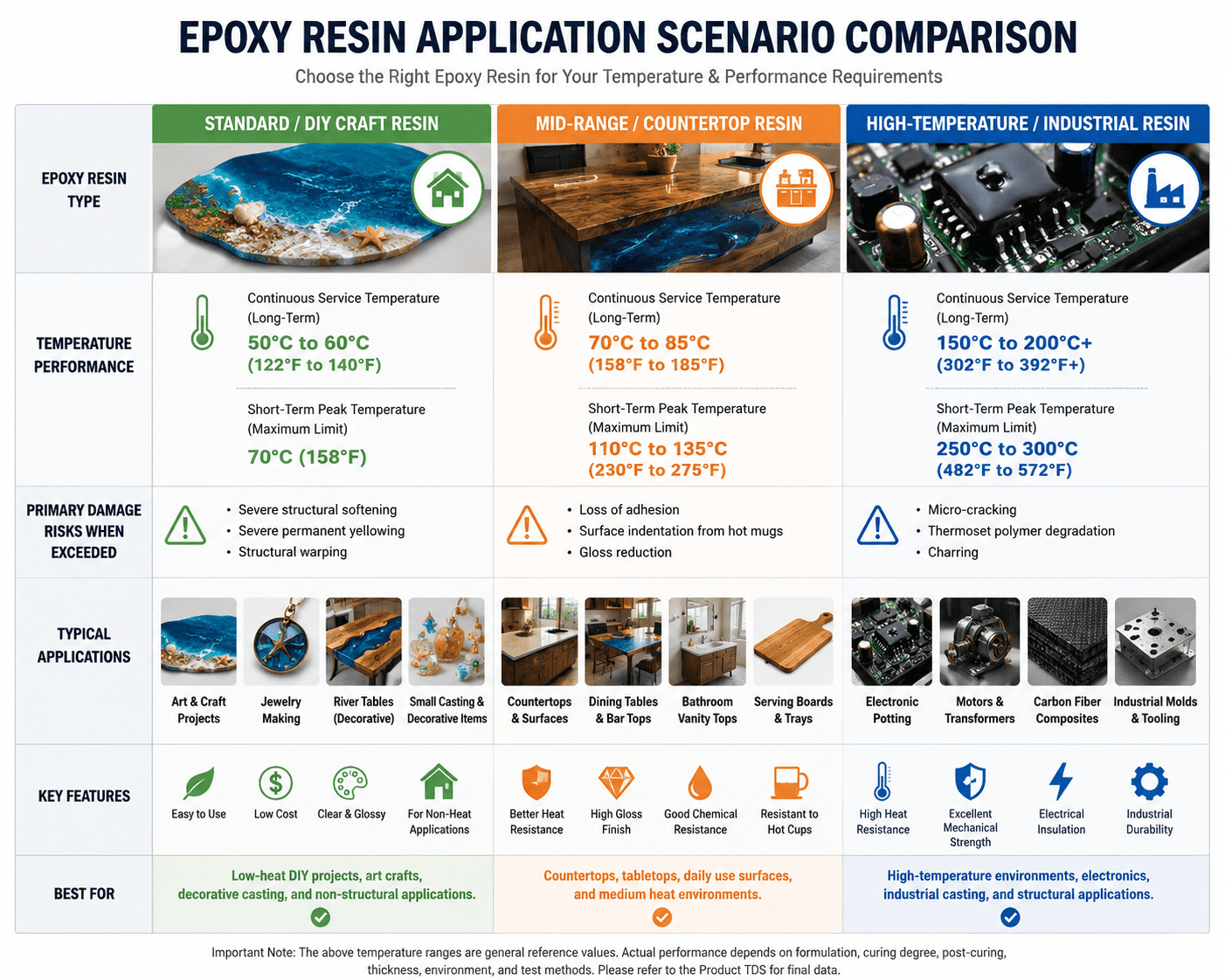
When looking at epoxy heat resistance, different formulations serve entirely different thermal environments. To give you a clear, no-nonsense look at how these materials perform under heat, we have broken down the thermal performance limits of the three main categories you will encounter in the market.
| Epoxy Resin Type | Continuous Service Temperature (Long-Term) | Short-Term Peak Temperature (Maximum Limit) | Primary Damage Risks When Exceeded |
|---|---|---|---|
| Standard / DIY Craft Resin | 50°C to 60°C (122°F to 140°F) | 70°C (158°F) | Severe structural softening, severe permanent yellowing, structural warping |
| Mid-Range / Countertop Resin | 70°C to 85°C (158°F to 185°F) | 110°C to 135°C (230°F to 275°F) | Loss of adhesion, surface indentation from hot mugs, gloss reduction |
| High-Temperature / Industrial Resin | 150°C to 200°C+ (302°F to 392°F+) | 250°C to 300°C (482°F to 572°F) | Micro-cracking, eventual thermoset polymer degradation, charring |
Standard/DIY Craft Resin Thermal Performance Limits
Standard craft and jewelry resins possess the lowest epoxy resin softening point. Designed for easy ambient curing and high clarity rather than thermal endurance, these formulas have a low glass transition temperature.
- Long-Term Limit: 50°C to 60°C (122°F to 140°F). Leaving a craft piece in a hot car or under direct summer sunlight will quickly cause it to become pliable and bend.
- Short-Term Peak: 70°C (158°F). Exposure to hot liquids or warm air beyond this point results in immediate softening and permanent deformation.
Mid-Range / Countertop Resin Thermal Performance Limits
Countertop resins are modified to withstand everyday household items like hot coffee mugs and warm plates. These formulas feature a tighter cross-linked polymer network to prevent indentations from brief thermal contact.
- Continuous Service Temperature: 70°C to 85°C (158°F to 185°F). This baseline handles daily kitchen environments safely without losing structural integrity.
- Short term peak temperature: 110°C to 135°C (230°F to 275°F). While a countertop epoxy temperature limit allows it to survive a briefly misplaced hot dish, leaving a boiling pot directly on the surface will permanently scorch the resin and break down the finish.
High-Temperature / Industrial Resin Thermal Performance Limits
True high temperature epoxy resin formulas rely on specialized chemical structures, such as Novolac baselines or anhydride curing agents. These industrial systems require a dedicated heat-cure cycle to reach their full thermal stability.
- Continuous Service Temperature: 150°C to 200°C+ (302°F to 392°F+). At this level, the cured matrix maintains its full mechanical strength and load-bearing capacity without shifting out of its rigid state.
- Short-Term Peak: 250°C to 300°C (482°F to 572°F). Engineered strictly for aerospace, automotive, and heavy manufacturing components, these resins resist short thermal spikes but will face definitive thermoset polymer degradation if exposed to open flames or sustained extreme heat.
As a dedicated manufacturer, we focus heavily on maximizing these thresholds during development. You can learn more about our commitment to engineering reliable resin formulations on our about us page. Always verify these limits against the specific technical data sheet epoxy manufacturers provide before exposing your project to heat.
Key Factors That Dictate Your Epoxy’s Heat Threshold
An epoxy resin’s final heat resistance isn’t accidental. While a technical data sheet epoxy rating gives you a baseline, the real-world thermal stability of epoxy depends heavily on three critical factors: the raw chemistry, how the product cures, and what you mix into it.
The Chemical Formulation
The molecular backbone of your resin sets its ultimate thermal ceiling. Most standard DIY and countertop epoxies use a Bisphenol-A (BPA) base. These create a reliable cross-linked polymer network for everyday use, but they naturally struggle when exposed to temperatures above 140°F to 180°F (60°C to 82°C).
For true high temperature epoxy resin performance, the formulation must shift to a Novolac base or utilize Anhydride curing agents. Novolac epoxies pack more aromatic rings into their molecular chains, resulting in a much tighter, denser cross-linked network. This structural difference prevents the polymer chains from moving at elevated temperatures, raising the glass transition temperature epoxy threshold significantly—often well beyond 300°F (149°C).
The Curing Environment and Post-Curing
How a resin cures dictates its final cross-linking density. Epoxy relies on an exothermic reaction (generating its own heat) to lock its molecular chains together.
- Cold Weather Impacts: If you apply epoxy in temperatures below 65°F (18°C), the chemical reaction slows down or stalls completely. This leaves you with an unlinked, permanently weakened polymer structure that will soften at a much lower epoxy resin softening point than advertised.
- Thermal Post-Curing: To achieve the maximum continuous service temperature stated on a datasheet, industrial and high-heat resins require post-curing. This involves baking the cured epoxy at graduated, elevated temperatures for several hours. Heat application forces remaining open chemical bonds to find partners, fully locking the cross-linked polymer network and maximizing its heat threshold.
Additives and Solvents
Altering the mix ratio or adding unapproved materials permanently degrades an epoxy’s thermal limits. A common mistake is using unauthorized thinners, alcohol, or acetone to pop bubbles or lower viscosity during application.
Critical Impact: Adding solvents breaks down the chemical chains. As the solvent evaporates, it leaves microscopic voids and permanently disrupts the cross-linked polymer network, causing premature thermoset polymer degradation and a vastly reduced short term peak temperature capacity.
If your project requires flame retardants, color pigments, or metal fillers, they must be factory-formulated or specifically approved by the manufacturer. Homemade additives act as contaminants that lower the overall thermal stability of epoxy.
RWATELIER Pro-Tips: How to Protect and Enhance Epoxy Heat Performance
Getting the most out of your epoxy resin’s thermal stability comes down to smart prevention and the right application choices. Even the highest quality cross-linked polymer network can fail if it is exposed to conditions beyond its design limits. Here is how we protect and maximize epoxy heat resistance on everyday surfaces.
Choose the Right Formulation from the Start
Never expect a standard craft resin to do the job of a high temperature epoxy resin. Matching the specific resin variant to the actual heat environment of the finished piece is the single most important decision in the entire process.
- DIY Craft Resins: Best kept entirely away from heat (art pieces, jewelry).
- Countertop Epoxies: Designed to handle moderate short term peak temperatures like a hot coffee mug.
- Industrial/Novolac Epoxies: Required for extreme environments like automotive parts or manufacturing molds.
Utilize Protective Topcoats
To shield the structural epoxy from direct thermal degradation and permanent yellowing, we highly recommend applying a specialized, heat resistant clear coat. Adding a layer of specialized polyurethane (such as DD Paint) or a UV-stabilized, high-impact clear topcoat acts as a sacrificial thermal barrier. This extra layer absorbs the initial heat shock and prevents the underlying resin from reaching its softening point.
Best Practices for Hot Objects
For furniture pieces, countertops, and deep-pour tables, the best protection is simple physics: keep direct high heat away from the surface.
| Protective Accessory | Best Used For | Primary Benefit |
|---|---|---|
| Trivets | Hot pots, pans, and baking sheets | Elevates objects completely off the resin surface |
| Coasters | Coffee mugs, tea cups, and heated glassware | Prevents localized rings and structural softening |
| Silicone Pads | Small kitchen appliances (air fryers, slow cookers) | Absorbs continuous heat radiation during long cycles |
By combining the correct initial formulation with a tough polyurethane topcoat and daily heat barriers, the continuous service temperature of the installation remains safely uncompromised.