Epoxy Floor Peeling Causes Moisture Issues and Repair Steps
Epoxy Floor Peeling: Failure Phenomenon
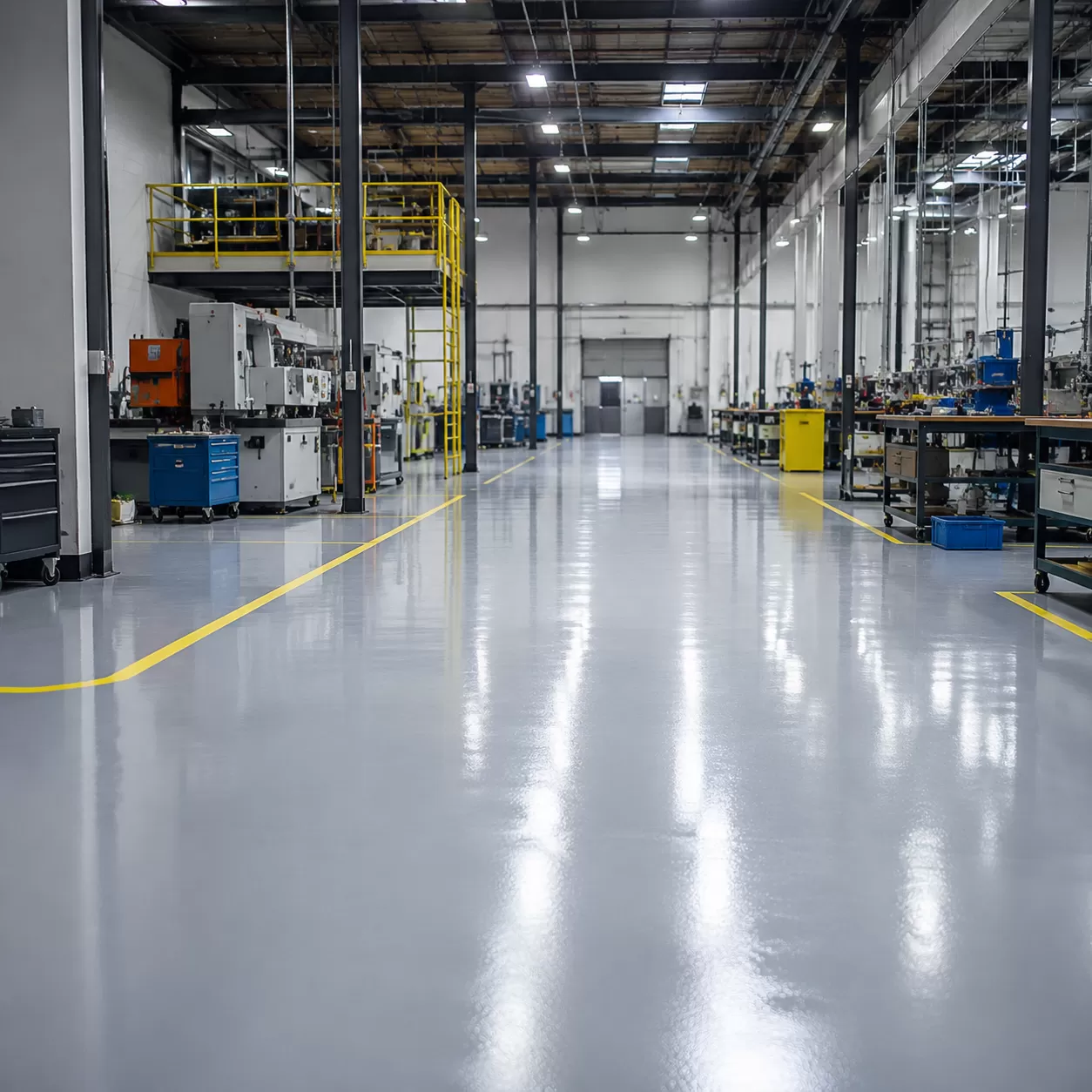
When an industrial or commercial epoxy floor coating begins to fail, it typically manifests as localized or widespread epoxy floor peeling. This lifting of the resin film from the concrete substrate destroys both the aesthetic appeal and the protective capabilities of the surface.
Common Visual Indicators
- Blistering: Bubble-like welts forming beneath the epoxy surface, often filled with trapped air or water.
- Flaking and Chipping: Brittle sections of the coating cracking and breaking away under foot or vehicle traffic.
- Sheet Peeling: Large sections of the floor cleanly separating from the concrete, indicating a total loss of adhesion.
The Root Cause: Substrate Moisture
The primary catalyst for coating detachment is underlying moisture within the concrete slab. Concrete appears solid but acts like a dense sponge, constantly breathing and transferring water vapor upward.
Mechanics of Moisture Delamination
- Hydrostatic Pressure: Upward pressure from groundwater forces water through the concrete pores.
- Osmotic Blistering: Soluble salts within the concrete mix with moisture, drawing water toward the underside of the impermeable epoxy layer.
- Bond Disruption: As moisture accumulates at the interface, it physically forces the resin away from the stone and cement matrix.
The Role of the Primer: Bonding Mechanism
Preventing peel failure relies entirely on establishing a flawless mechanical and chemical bond during the initial installation. A high-performance primer acts as the bridge between raw concrete and the epoxy topcoat.
Critical Adhesion Factors
- Deep Penetration: Low-viscosity primers sink into the open capillary pores of a properly profiled concrete slab.
- Chemical Cross-Linking: The primer creates a high-strength bonding failure barrier that anchors the subsequent thick-build coatings.
- Moisture Mitigation: Specialized epoxy primers resist up to 15–21 lbs of water vapor transmission per 1,000 sq. ft., locking down minor residual moisture.
Systematic Repair Workflow
Fixing a peeling epoxy floor requires a strict, step-by-step restoration process. Patching over a failed area without addressing the root cause will only guarantee future peeling.
| Step | Phase | Key Action |
|---|---|---|
| 1 | Removal | Mechanically scrape and grind away all loose, peeling, and compromised epoxy. |
| 2 | Testing | Conduct a calcium chloride or relative humidity (RH) test to measure concrete moisture levels. |
| 3 | Profiling | Shot-blast or diamond-grind the bare concrete to achieve a concrete surface profile (CSP) of 2 to 3. |
| 4 | Mitigation | Apply a dedicated moisture-vapor barrier primer if testing reveals high RH levels. |
| 5 | Re-Coating | Apply the industrial-grade epoxy basecoat and durable topcoat to restore full floor integrity. |