
Epoxy Resin for Wood Crack Repair Custom Formula
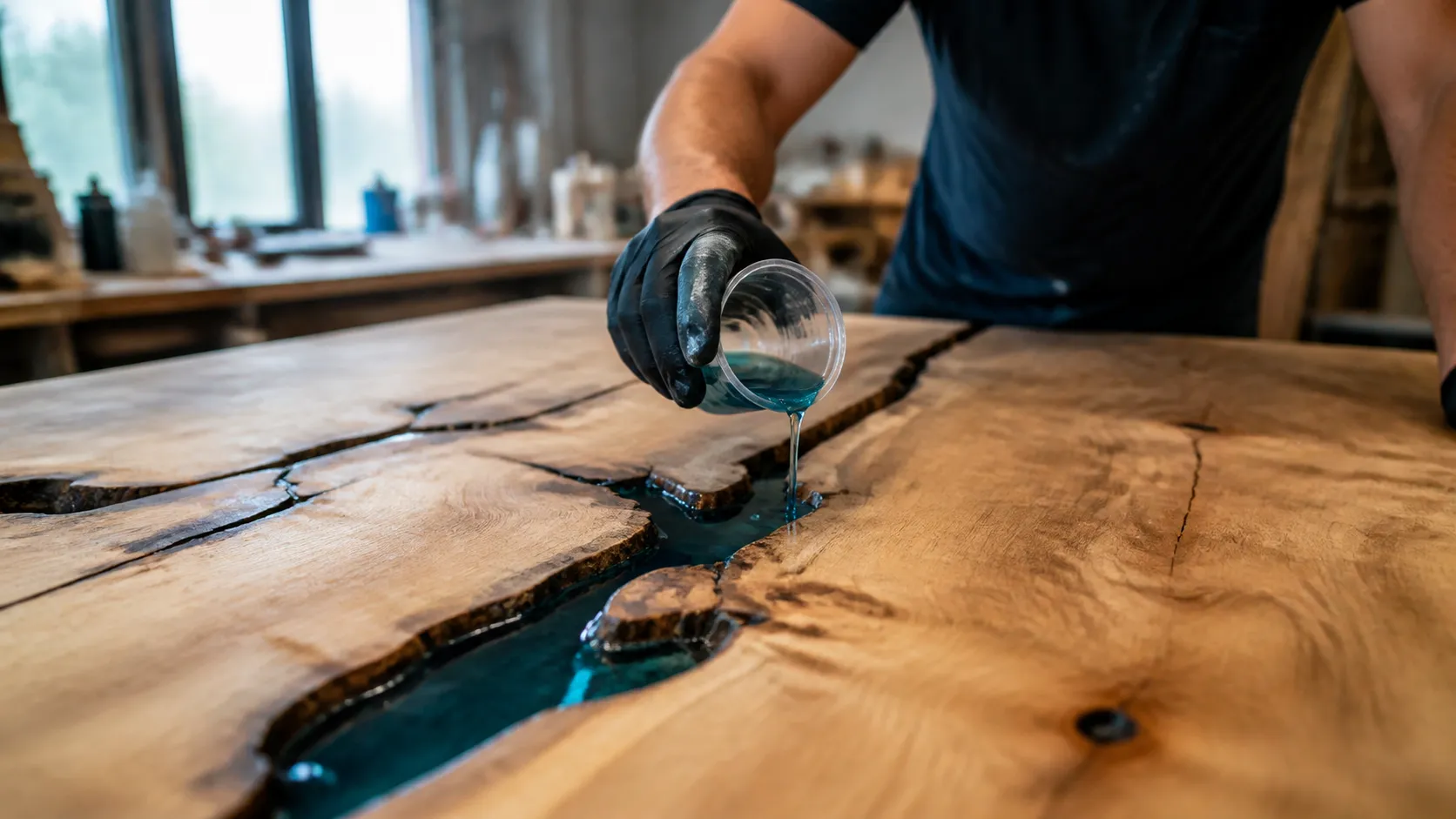
What Is epoxy resin for wood crack repair Used for in Epoxy Adhesives and Repair?
High-performance epoxy resin for wood crack repair serves as an essential structural bonding agent and filler engineered to restore, stabilize, and enhance damaged timber. By deeply penetrating split wood fibers and curing into a dense, solid matrix, it permanently seals voids while preserving the mechanical integrity and natural beauty of the wood.
Main application scenarios
- Furniture & Live-Edge Slabs: Filling knots, checks, and deep fissures in slab tables, countertops, and fine furniture.
- Architectural Flooring & Beams: Repairing fractures in hardwood floors, timber frames, and decorative millwork to restore load-bearing stability.
- Antique Restoration: Preserving vintage wooden artifacts by locking aging fibers without compromising original aesthetics.
- Precision Woodworking: Sealing hairline fissures prior to CNC machining, wood turning, or final surface finishing.
Required material properties
| Property | Key Benefit in Wood Repair |
|---|---|
| Low Viscosity | Maximizes capillary action to penetrate deep into narrow, hairline cracks. |
| High Bond Strength | Mechanically locks wood fibers together to prevent further splitting under stress. |
| Zero Shrinkage | Delivers flush, dimensionally stable fills that remain flat after curing. |
| Crystal Clarity | Acts as a high-clarity clear repair resin that highlights natural wood aesthetics. |
Common user expectations
- Seamless Aesthetic Integration: End-users expect a transparent finish that polishes smoothly and blends with various finishes.
- Rapid Bubble Release: Exceptional self-degassing properties to eliminate trapped air pockets during deep pours or micro-crack fills.
- Dependable Cure Profile: Consistent, non-tacky curing across varying shop temperatures to avoid structural failure.
- Long-Term Resistance: Superior stability against moisture, thermal expansion, and UV-induced yellowing over time.
Executive summary of performance metrics for high-grade repair formulations:
Performance Requirements for Epoxy Adhesives and Repair
Choosing the right epoxy resin for wood crack repair comes down to uncompromised performance. We engineer our formulas to ensure every repair holds strong while looking completely seamless.
Clarity, gloss, and appearance
A high-grade clear repair resin must either disappear into the natural grain or create a crystal-clear deep fill.
- Optical Clarity: Maximum light transmission keeps fills perfectly transparent without cloudy haze.
- High-Gloss Finish: Cures to a self-leveling, glass-like surface that sands and polishes effortlessly.
- UV Resistance: Integrated light stabilizers protect the resin against yellowing when exposed to ambient sunlight.
Adhesion and durability
Wood naturally expands and contracts with humidity. To prevent bond failure, our epoxy deeply penetrates timber pores rather than just sitting on top.
- Fiber-Locking Adhesion: Forms a permanent mechanical bond with bare wood fibers to eliminate delamination.
- Impact & Flex Strength: Flexes with natural wood movement to prevent recracking under load or temperature swings.
- Zero Shrinkage: Maintains 100% solid volume during cure so filled cracks remain flush without sunken spots.
Temperature, moisture, and chemical resistance
Real-world use demands that every wood repair withstands tough environmental exposure without softening or clouding.
| Performance Area | Engineering Standard | Practical Wood Repair Benefit |
|---|---|---|
| Moisture Protection | 100% Waterproof | Prevents wood rot and swelling around indoor/outdoor joints |
| Heat Resistance | Up to 180°F (82°C) | Prevents ring marks from hot coffee mugs on repaired tables |
| Chemical Resistance | Household Solvents & Alcohol | Resists clouding or damage from daily cleaning chemicals |
How to Select the Right epoxy resin for wood crack repair
Choosing the right epoxy resin for wood crack repair comes down to matching your project depth, repair speed, and production workflow. Picking the wrong formulation can lead to poor penetration, excessive heat buildup, or a cloudy finish.
Recommended formula type
Not all wood repairs are the same. I always recommend matching the viscosity and cure speed of your clear repair resin to the specific defect you are fixing:
| Repair Type | Recommended Formula | Key Advantage |
|---|---|---|
| Hairline Cracks & Surface Checks | Low-viscosity clear resin or UV resin | Deep penetration, instant cure under UV light |
| Deep Fissures & Live Edge Voids | Deep-pour 2:1 or 3:1 slow-cure epoxy | Low heat buildup, zero bubble retention |
| Vertical Cracks & Knot Holes | Thixotropic paste or thick 1:1 epoxy | Non-sagging, stays exactly where you apply it |
Mixing ratio and curing conditions
Getting the mixing ratio and environment right is the single best way to prevent curing failure, sticky surfaces, or soft spots.
- Standard 1:1 Formulas: Easiest to measure by volume. Ideal for quick surface fills and minor touch-up jobs.
- Low-Exotherm 2:1 / 3:1 Formulas: Essential for deep cracks. They cure slower, allowing bubbles to escape naturally without scorching the surrounding timber.
- Temperature & Humidity: Maintain a working environment between 20°C–25°C (68°F–77°F) with relative humidity under 60%. Cold conditions slow down cross-linking, while high moisture causes surface blush.
Packaging and bulk order options
We support woodworkers, commercial furniture makers, and retail brands with flexible OEM/ODM manufacturing options tailored to your supply chain:
- Retail Repair Kits: Precision squeeze bottles or dual-syringe sets (8 oz to 1 gallon) for easy distribution.
- Industrial Bulk Supply: 5-gallon pails and 55-gallon drums for high-volume furniture shops and millwork plants.
- Custom OEM/ODM Solutions: Custom viscosities, cure speeds, UV inhibitors, and private-label packaging built to your exact specs.
Common Problems and Solutions
Working with epoxy resin for wood crack repair can occasionally present challenges during application. Here is how we troubleshoot the most frequent issues to ensure flawless results every time.
Bubbles, yellowing, or soft curing
Sub-optimal ambient conditions or improper mixing ratios are the main culprits behind resin defects:
- Trapped Air Bubbles: Mixing too quickly introduces air into the pour. Pass a heat gun lightly over the surface, or switch to a low-viscosity clear repair resin that releases air automatically.
- Yellowing Over Time: Direct sunlight breaks down low-grade formulas. We integrate specialized UV inhibitors—similar to those in high-grade UV resin products—to maintain crystal clarity.
- Soft Curing or Curing Failure: Incorrect mixing ratios or working in temperatures below 20°C (68°F) stall the chemical reaction. Always weigh components precisely to avoid a full curing failure.
Surface defects and poor leveling
When epoxy resin for wood crack repair fails to level smoothly or leaves surface craters, improper prep work is usually the issue:
| Defect | Root Cause | Direct Solution |
|---|---|---|
| Fish Eyes & Craters | Surface contamination (oil, silicone, dust) | Clean the wood thoroughly with isopropyl alcohol before pouring. |
| Uneven Leveling | High viscosity or unlevel workspace | Warm the resin containers in warm water prior to mixing; level the wood. |
| Outgassing Craters | Raw wood absorbing resin and pushing air out | Apply a thin seal coat on the raw wood edges before filling deep cracks. |
How to test before mass production
Before committing to large project runs or volume manufacturing, a structured testing process prevents costly downtime:
- Run Small-Batch Tests: Mix a 100g sample to verify pot life, exotherm temperature, and cure speed under your actual shop conditions.
- Test Substrate Adhesion: Apply the formula to scrap pieces of your specific wood species to evaluate depth penetration and bond strength.
- Perform Stress Checks: Expose cured samples to heat, humidity, and direct light to ensure long-term stability.
- Formulate to Spec: If standard mixes fall short, utilize our OEM/ODM capabilities to adjust viscosity, cure speed, or hardness for your exact workflow.
Custom Manufacturing Support for Epoxy Resin for Wood Crack Repair
We partner directly with global distributors, brand owners, and industrial clients to deliver tailor-made repair solutions. Our full-service manufacturing ensures your product lines stand out in performance, quality, and market appeal.
Formula Adjustment
Every woodworking and manufacturing application has unique requirements. We adjust our chemical formulations to hit your precise performance specs:
- Viscosity & Flow: Tailored for deep hairline crack penetration or thick gap-filling tasks.
- Cure Speed: Modified cure cycles to eliminate curing failure under specific job site conditions.
- Hybrid Systems: Option to integrate fast-setting UV resin technology for rapid surface curing.
- Visual Clarity: Fine-tuned to create a crystal-clear repair resin that resists yellowing over time.
Private Label Packaging
Our flexible OEM/ODM capabilities allow you to bring market-ready products to shelf quickly under your own brand identity.
| Service Feature | Custom Options |
|---|---|
| Container Types | Precision squeeze bottles, dual-dispensing cartridges, and bulk pails |
| Branding & Design | Custom labels, screen printing, and retail-ready packaging |
| Complete Kitting | Ready-to-use kits paired with stir sticks, gloves, and measuring cups |
Sample and Bulk Quotation
We make scaling your inventory straightforward and risk-free:
- Sample Testing: Receive custom lab samples to verify bonding strength, flow, and clarity before committing to mass production.
- Tiered Pricing: Direct factory pricing structured to maximize your profit margins at scale.
- Global Supply Chain: Dependable shipping compliance and consistent lead times for all bulk orders of epoxy resin for wood crack repair.
