
Epoxy Floor Peeling Causes and UV Yellowing Solutions
Quick Answer
What Buyers Need to Know First
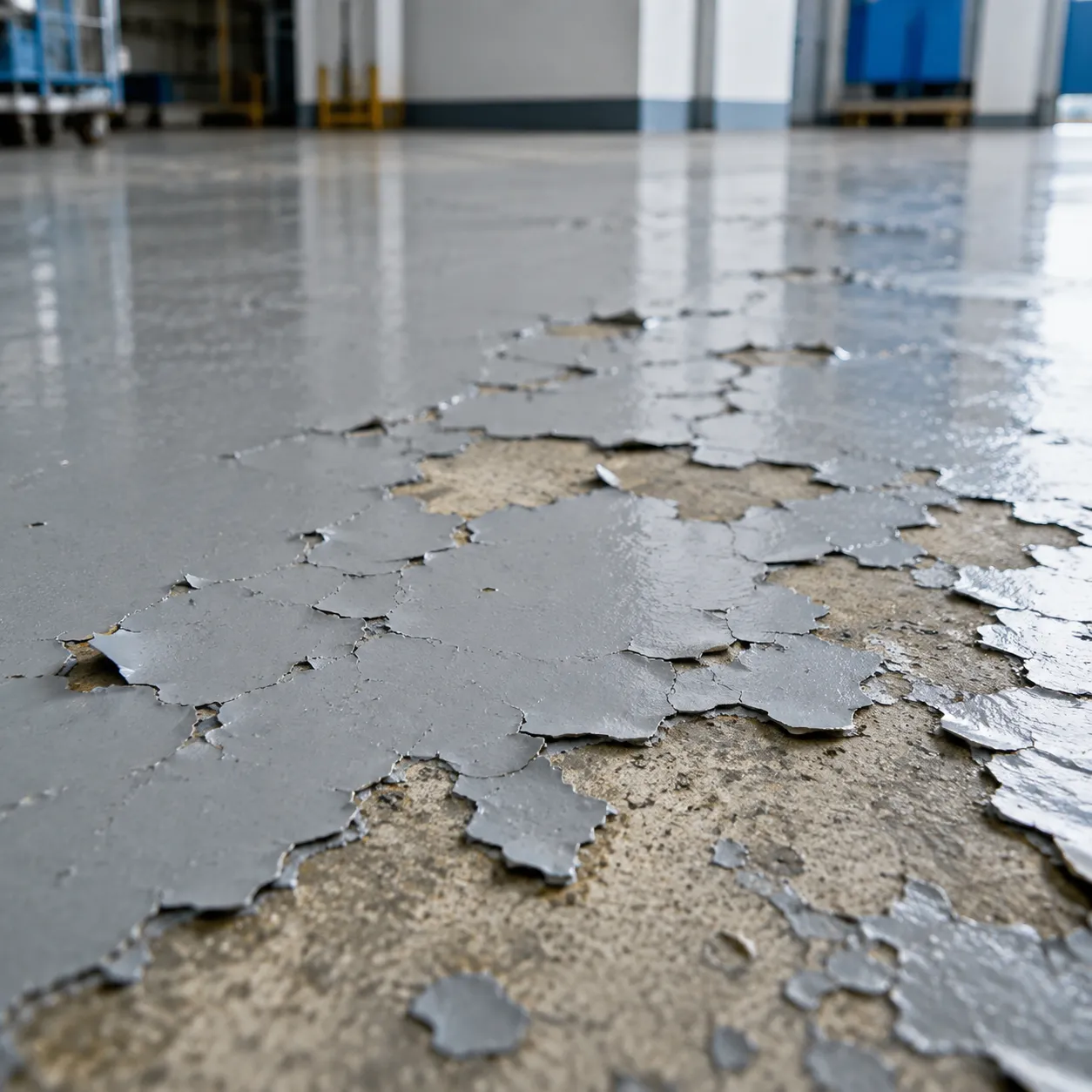
An epoxy floor peeling issue stems directly from coating delamination, which is almost always caused by improper surface prep or moisture vapor transmission. If you are investigating why is my epoxy floor peeling from the concrete, the root causes usually boil down to three primary failure points:
- Floor Preparation Failure: Smooth, unetched concrete lacks mechanical profile. Without diamond grinding or shot-blasting to achieve a CSP 2–3 profile, the concrete floor epoxy system cannot form a mechanical bond.
- Concrete Moisture Pressure: High moisture vapor emissions rising through the porous slab create hydrostatic pressure, driving the coating away from the surface and causing epoxy floor adhesion failure.
- Substrate Contamination: Residual grease, oil, dust, or unreacted surface densifiers create a physical barrier between the concrete and the resin base.
Preventing peeling requires testing slab moisture levels before application, thoroughly decontaminating the substrate, and using high-penetration priming coats designed to anchor deep into the concrete matrix.
Is any epoxy completely UV-proof?
Direct Answer
No epoxy resin is 100% UV-proof. Standard epoxy chemistry inherently degrades under ultraviolet light, resulting in yellowing, loss of gloss, and surface chalking over time. Sunlight breaks down the resin’s chemical bonds at the surface level, which weakens the bond structure and accelerates epoxy floor peeling in sun-lit spaces.
Key Selection Factors or Failure Risks
Understanding how sunlight impacts epoxy systems helps prevent surface failure and keeps your installations intact:
- Aromatic Molecular Structure: Standard epoxies use aromatic resins that absorb UV radiation and yellow naturally. UV inhibitors and HALS (Hindered Amine Light Stabilizers) slow down this process, but they cannot stop it completely.
- Surface Chalking: UV rays degrade the top layer of resin into a loose powder. This structural decay weakens the top layer and is often mistaken for general floor preparation failure.
- Thermal Stress & Delamination: Direct sunlight creates extreme temperature swings. When the top surface expands faster than the base coat, it triggers coating delamination and severe epoxy floor adhesion failure.
- Topcoat System Design: For areas exposed to direct sun, apply a clear aliphatic polyurethane or polyaspartic topcoat over your base coat to block UV radiation and prevent peeling.
Why does overheating increase discoloration?
Direct Answer
Heat accelerates oxidation inside the cured resin matrix. When high temperatures hit a standard coating, the polymer chains break down faster, causing rapid yellowing, darkening, and surface brittleness. This thermal stress doesn’t just ruin the color—it breaks down the binder strength, which directly contributes to severe coating delamination and unexpected epoxy floor peeling over time.
Key Selection Factors or Failure Risks
High heat during curing or daily operations creates distinct vulnerabilities in any concrete floor epoxy system:
- Exothermic Burn: Mixing bulk resin in hot ambient temperatures triggers a rapid exothermic reaction. This traps intense heat inside the bucket, scorching the resin before application.
- Thermal Shock: Rapid temperature fluctuations cause the epoxy layer to expand and contract at a different rate than the underlying slab, causing epoxy floor adhesion failure.
- Binder Degradation: Heat breaks down standard aromatic epoxy resins rapidly. Without heat-stabilizing additives, thermal stress bakes the floor, making it yellow, chalk, and lose flexural strength.
- System Layering: Applying a high-heat or UV-resistant topcoat over the base coat shields the system from thermal discoloration and surface breakdown.
Do pigments hide or worsen yellowing?
Direct Answer
Pigments do not stop resin yellowing, but they heavily influence how visible it becomes. Darker pigments like charcoal, black, and deep blue mask yellowing effectively, while white, beige, and light gray make UV discoloration instantly obvious. However, using low-grade pigment pastes or unstable colorants actually accelerates chalking and surface breakdown. This chemical imbalance compromises matrix integrity, causing severe epoxy floor peeling and top-layer breakdown over time.
Key Selection Factors or Failure Risks
Selecting the wrong pigment type or mismanaging tint ratios introduces major structural risks to your concrete floor epoxy system:
- Pigment Quality: Low-cost organic pigments degrade quickly under light, accelerating color shifts and triggering early coating delamination. High-grade, inorganic UV-stable colorants must be used to preserve integrity.
- Over-Pigmentation: Adding excessive pigment paste alters the resin binder ratio. This lowers mechanical bond strength, leading directly to epoxy floor adhesion failure under heavy load traffic.
- False Security from Dark Colors: Dark pigments disguise yellowing, but they do not stop UV degradation. The epoxy underneath continues to weaken, leaving facility managers asking why is my epoxy floor peeling from the concrete months later.
- Moisture Interlock Risks: Improperly dispersed tint pastes create micro-porosity within the film, making the cured coating vulnerable to hydrostatic pressure and surface flaking.
How should yellowing resistance be compared?
Direct Answer
We compare yellowing resistance by evaluating the Yellowness Index (YI) through standardized QUV accelerated weathering tests (ASTM G154) rather than relying on initial visual clarity. Standard epoxies naturally turn amber when exposed to UV light and heat over time. While yellowing is primarily an aesthetic issue, severe resin degradation breaks down the binder at the surface, leading to chalking, micro-cracking, and eventual coating delamination. To avoid premature epoxy floor peeling, always evaluate technical data sheets for UV stability ratings rather than judging raw resin transparency out of the container.
Key Selection Factors or Failure Risks
- ASTM Yellowness Index (YI) Ratings: Compare lab results showing YI values after 500 to 1,000 hours of QUV exposure to measure real-world performance.
- Base Coat vs. Topcoat Chemistry: Epoxy resins work best as high-build structural base coats. Pair them with aliphatic polyaspartic or polyurethane topcoats to block UV rays completely.
- Surface Breakdown & Adhesion Risks: Heavy UV degradation weakens the binder matrix. When top layers break down, environmental stress and traffic quickly cause severe epoxy floor adhesion failure.
- Combined System Pressures: UV degradation paired with floor preparation failure or trapped concrete moisture epoxy issues will cause the top layers to flake off rapidly.
Can a topcoat improve outdoor durability?
Direct Answer
Yes, applying a UV-stable clear topcoat—specifically an aliphatic polyurethane or polyaspartic—dramatically boosts outdoor durability and stops epoxy floor peeling before it starts. Standard epoxies naturally chalk, yellow, and break down under direct sunlight. We formulate topcoats to act as a sacrificial UV shield, preserving the physical strength and color of your base concrete floor epoxy system.
Key Selection Factors or Failure Risks
- Recoat Windows: Applying a topcoat outside the strict cure window leads to poor chemical bonding, resulting in widespread coating delamination where the topcoat peels off the base layer.
- Topcoat Resin Chemistry: Standard epoxies fail outdoors regardless of thickness. Only aliphatic polyurethanes or polyaspartics provide genuine long-term UV resistance.
- Concrete Moisture Trapping: Topcoat UV protection cannot fix an improper base setup. High subterranean moisture pressure will still cause full epoxy floor adhesion failure from beneath the slab.
- Film Thickness Control: Applying the topcoat too thick causes micro-cracking and solvent entrapment, while applying it too thin exposes the underlying base coat to UV degradation.
What Information Should You Send to the Manufacturer?
Application, Substrate and Process Details
To prevent an epoxy floor peeling issue and ensure a rock-solid bond, I need precise details about your job site before recommending a formulation. When you reach out to our team, please share the exact environmental conditions and substrate characteristics.
- Substrate Condition: Age, strength, and porosity of the concrete floor.
- Moisture Levels: Results from any concrete moisture testing or vapor emission rates.
- Surface Preparation: The mechanical method used, such as shot-blasting or diamond grinding, to address potential floor preparation failure.
- Environment: Indoor versus outdoor exposure, temperature fluctuations, and potential chemical or heavy traffic loads.
Providing these specifics helps us diagnose or prevent risks like coating delamination and epoxy floor adhesion failure right from the start.
Performance, Packaging and Estimated Quantity
Getting the right product specs and volume ensures your project stays on schedule and within budget. Sharing your target performance metrics allows us to match you with the ideal concrete floor epoxy system or customize a solution through our epoxy resin factory direct supply chain.
- Performance Requirements: Expected wear resistance, UV stability, slip resistance, and chemical protection.
- Volume and Coverage: Total square footage and estimated total quantity needed in gallons or kilograms.
- Packaging Preferences: Standard pails, drums, or custom private label epoxy resin packaging for retail or contracting brands.
- Fulfillment Needs: Whether you require bulk epoxy resin supplier logistics or standard wholesale epoxy resin manufacturer distribution channels.
How Can Rongwei Support This Project?
We tackle epoxy floor peeling right at the manufacturing level. As a direct wholesale epoxy resin manufacturer, we work alongside distributors, brands, and large-scale contractors to eliminate coating delamination before materials ever reach the job site. Whether your past projects suffered from high concrete moisture epoxy issues or severe floor preparation failure, we tailor every formulation to lock onto substrates permanently.
Sample Matching and Formula Adjustment
If you are trying to figure out why is my epoxy floor peeling from the concrete on recent jobs, standard off-the-shelf resins are usually to blame. We engineer custom formulations designed for challenging environments:
- Lab Sample Analysis: Send us your current product or job site samples. Our chemical lab analyzes the resin structure to pinpoint weak links.
- Adhesion-Promoting Formulas: We fine-tune cross-linking density and flexibility to eliminate epoxy floor adhesion failure under heavy mechanical loads or thermal swings.
- Moisture-Barrier Customization: We adjust primer formulas specifically for damp substrates, ensuring your concrete floor epoxy system stays bonded despite vapor drive.
OEM / Private Label Packaging and Bulk Supply
As your epoxy resin factory direct partner, we make scaling your supply chain simple, reliable, and cost-effective:
- Private Label Epoxy Resin: Complete custom branding, custom drum/tote sizes, and compliant safety data sheets tailored to your local market.
- Bulk Epoxy Resin Supplier: High-volume capacity ensures batch-to-batch consistency and fast order fulfillment for large commercial projects.
- Strict Quality Control: Every shipment undergoes rigid viscosity, clarity, and pull-off strength testing before leaving our facility.
Buyer Checklist: Stop Epoxy Floor Peeling
Questions to Confirm Before Placing an Order
Before securing a bulk order for your concrete floor epoxy system, verifying technical details prevents costly coating delamination and job site failures. Ask your wholesale epoxy resin manufacturer these core questions to guarantee long-term performance:
- Moisture Thresholds: What is the maximum concrete moisture epoxy rating for this formula to avoid future moisture-driven epoxy floor adhesion failure?
- Surface Prep Requirements: Which concrete surface profile (CSP) is mandatory to eliminate floor preparation failure and keep the coating bonded?
- Batch-to-Batch Consistency: Does your bulk epoxy resin supplier provide a lot-specific Certificate of Analysis (COA) for private label epoxy resin shipments?
- System Compatibility: Is a specialized primer required for porous concrete before applying the main body coat to prevent epoxy floor peeling?
- Cure Time & Pot Life: How do temperature swings on site impact working time, re-coat windows, and full chemical cure?
| Verification Point | Key Confirmation Standard | Goal |
|---|---|---|
| Moisture Testing | MVER / Relative Humidity within product limit | Prevent coating delamination |
| Mechanical Profile | CSP 2–3 achieved via grinding or blasting | Eliminate epoxy floor adhesion failure |
| Direct Quality Control | Epoxy resin factory direct batch testing | Guarantee zero batch variation |
Confirming these exact specifications with us before production protects your installation quality, secures product reliability, and ensures clean, durable results every single time.
Related Sources
- https://theepoxyexperts.com/shop/coatings/non-yellowing/max-seal/max-seal-1-gallon-protective-clear-coat-aliphatic-polyurethane-none-yellowing-uv-topcoat/
- https://theepoxyexperts.com/shop/coatings/non-yellowing/max-seal/max-seal-1-gallon-protective
- https://www.mdpi.com/2073-4360/17/8/1064
- https://pmc.ncbi.nlm.nih.gov/articles/PMC6403735/
