
Epoxy Curing Time Issue Causes and Control Methods
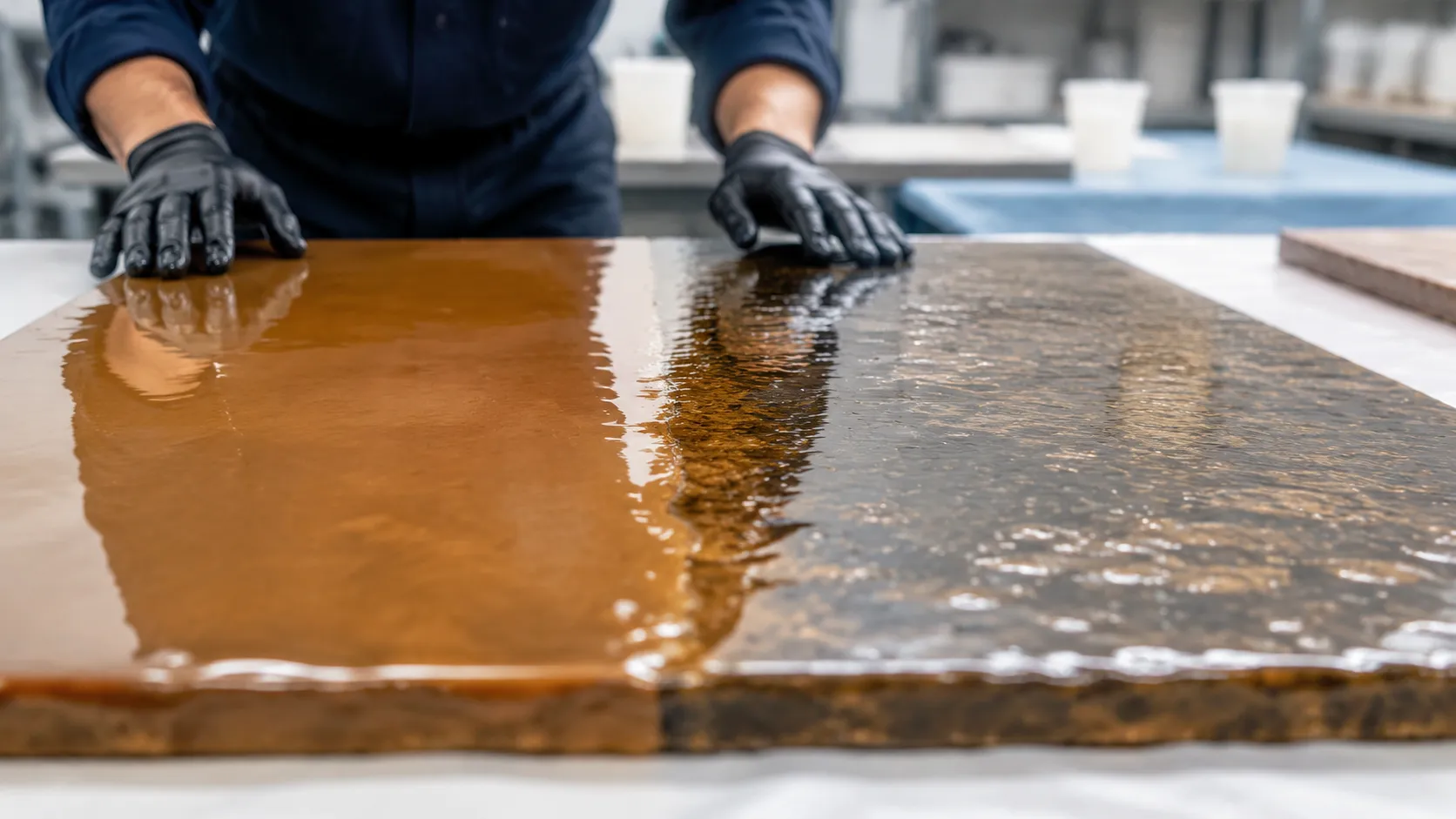
Temperature Impact on Epoxy Curing Time
Fluctuating ambient and substrate temperatures are the primary drivers behind an inconsistent epoxy curing time issue. Because the reaction between epoxy resin and hardener is exothermic, thermal conditions directly dictate the cross-linking speed.
How Temperature Shifts Disrupt the Cure
- High-Temperature Acceleration: Elevated temperatures speed up the chemical reaction, drastically shortening the pot life and working time. This often leads to premature gelling, flash curing, or thermal stress cracks.
- Low-Temperature Retardation: When temperatures drop below the manufacturer’s recommended threshold, the reaction slows down significantly. In severe cases, the cure may halt entirely, leaving a sticky, under-cured surface.
- Fluctuating Environments: Day-to-night temperature swings disrupt the molecular bonding process, resulting in uneven hardness, surface blushing, and compromised structural integrity across the global supply chain.
| Temperature Condition | Impact on Curing Speed | Potential Quality Risks |
|---|---|---|
| Above Optimal (>85°F / 29°C) | Critically Fast | Flash cure, shrinkage, bubbling |
| Optimal Range (70°F–80°F / 21°C–27°C) | Standard / Predictable | None (Baseline performance) |
| Below Optimal (<60°F / 15°C) | Extremely Slow | Incomplete cure, tacky finish, blushing |
To eliminate this temperature effect and ensure a reliable, high-performance finish, strict climate control over both the materials and the application environment is mandatory.
The Chemical Reaction Behind Your Epoxy Curing Time Issue
When your resin doesn’t set on schedule, the root cause usually boils down to the chemical reaction itself. Epoxy curing isn’t a simple drying process like water evaporating from glue. It is an exothermic chemical reaction where a resin and a hardener cross-link to form a solid polymer chain.
If this molecular handshake gets disrupted, you run straight into an unpredictable epoxy curing time issue.
How the Mixing Ratio Disrupts the Chain Reaction
The reaction mechanism relies on strict stoichiometry—a precise 1:1 or 2:1 molecular match between the resin and the hardener.
- Too much resin: Leftover molecules remain unlinked, resulting in a soft, tacky surface that never fully cures.
- Too much hardener: The excess curing agent disrupts the polymer matrix, leading to brittleness or a sticky film known as amine blush.
- Incomplete mixing: If the components aren’t blended thoroughly, you get localized hot spots and sticky patches in the same batch.
| Variable | Chemical Impact on Curing | Result |
|---|---|---|
| Off-Ratio Measuring | Unreacted molecules left in the matrix | Permanent stickiness or structural failure |
| Under-Mixing | Uneven distribution of hardener molecules | Alternating hard and soft spots |
| Mass Effect | Rapid heat buildup in thick pours | Flash curing, cracking, or shrinkage |
The Mass Effect and Heat Generation
Because this reaction creates its own heat, the physical volume of your mix changes how the reaction behaves. A large mass of epoxy confined in a mixing cup traps heat, accelerating the chemical reaction exponentially. Conversely, spreading that same amount of material into a thin layer allows the heat to escape, significantly lengthening the open time. Understanding this balance is the key to maintaining a predictable workflow and keeping your production schedules on track.
3. Controlling the Epoxy Curing Time Issue
Managing an unstable epoxy curing time issue comes down to controlling your environment and mixing precision. If your resin cures too fast or stays tacky, implementing strict shop-floor protocols will stabilize the chemical reaction.
Key Stabilization Techniques
- Climate Control: Maintain a consistent room temperature between 21°C–24°C (70°F–75°F). Fluctuations are the primary cause of a fluctuating temperature effect on your cure cycle.
- Mass Management: Epoxy generates its own heat while curing. Mix smaller batches or pour the mixture into a wide, shallow tray immediately after mixing to dissipate heat and extend the working time.
- Precision Ratio Mixing: Always use digital scales for weight-based ratios or graduated cylinders for volume-based ratios. Guesswork or adjusting the hardener amount to alter speed will ruin the polymer structure.
| Control Variable | Action Required | Expected Outcome |
|---|---|---|
| Ambient Temperature | Install thermal regulators | Eliminates unexpected temperature effect spikes |
| Mixing Volume | Limit batch sizes | Prevents thermal runaway and premature gelling |
| Component Ratio | Use calibrated dispensing pumps | Ensures consistent cross-linking and predictable cure |
Pre-Heating and Post-Curing
To achieve peak mechanical properties when facing a stubborn epoxy curing time issue, utilize a dual-temperature approach. Pre-heating the resin components separately to 25°C lowers viscosity for better degassing and predictable initial cross-linking. Following the initial set, applying a controlled post-cure cycle in a dedicated oven locks in the material strength and standardizes total production turnaround times.
Related Sources
- https://scholarsmine.mst.edu/cgi/viewcontent.cgi?article=2803&context=che_bioeng_facwork
- https://www.frontiersin.org/journals/chemistry/articles/10.3389/fchem.2019.00380/full
- https://www.plantnutrifert.org/cn/article/pdf/preview/10.11674/zwyf.2024050.pdf
- https://www.frontiersin
- https://pmc.ncbi.nlm.nih.gov/articles/PMC7516423/
