
Epoxy Resin Drum vs Gallon Kit Cost Packaging and Shelf Life
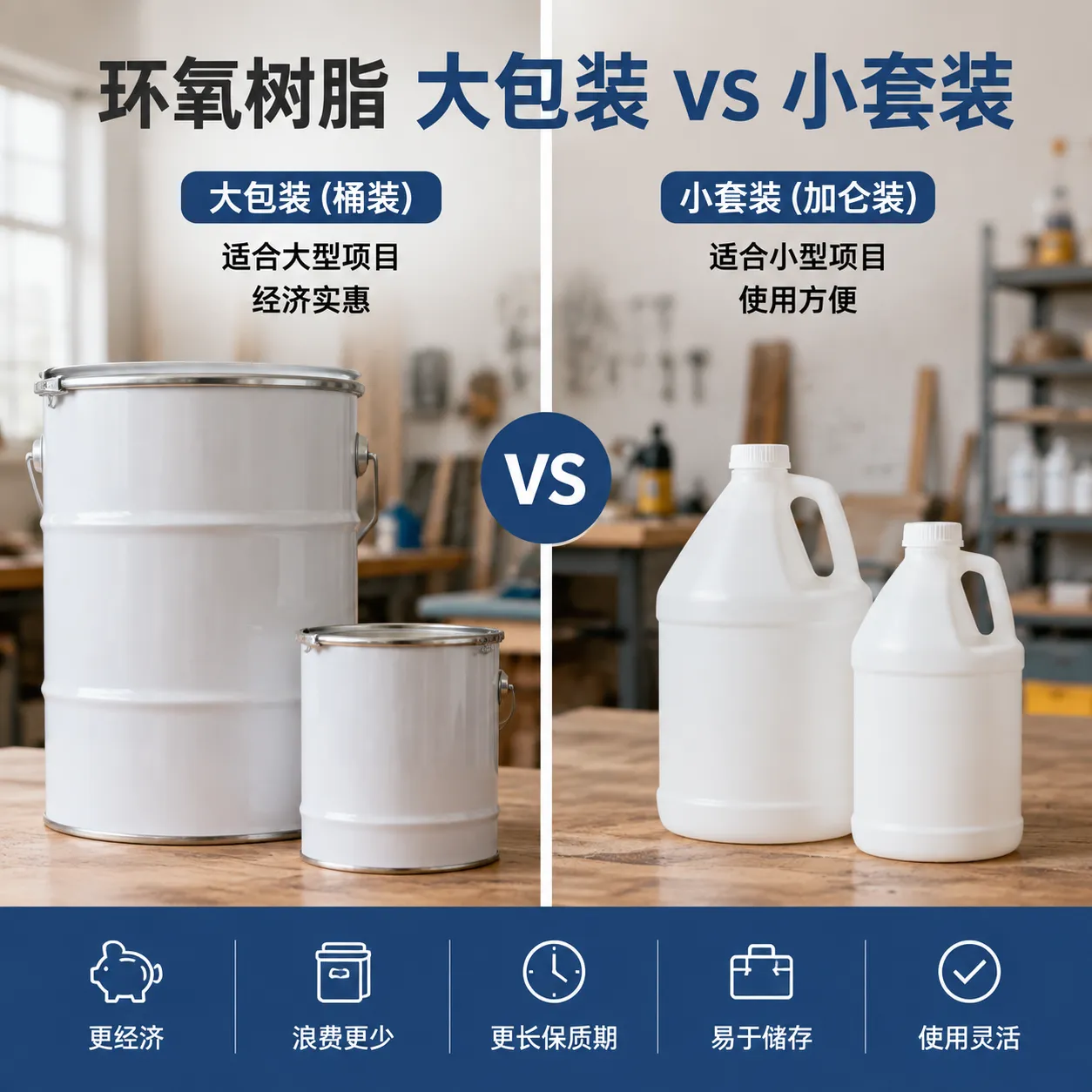
Are you struggling to decide between an epoxy resin drum vs gallon kit for your manufacturing line? Making the wrong packaging choice can either drain your margins through high unit pricing or lead to ruined batches from incorrect manual mixing and compromised shelf life.
In this guide, you’re going to learn the key selection factors every buyer needs to know—from slashing your cost per kilogram to choosing the right packaging for your application process. Plus, we’ll cover how Rongwei supports your project with custom sample matching, formula adjustment, and dependable bulk supply.
If you want to optimize your procurement and avoid expensive application failures, this guide is for you. Let’s dive right in!
Quick Answer
What Buyers Need to Know First
Choosing between an epoxy resin drum vs gallon kit depends on your production scale, labor workflow, dispensing setup, and target material costs.
- Epoxy resin drums (typically 200 kg / 55-gallon capacity) deliver the lowest unit price per kilogram, significantly reducing freight and material costs for high-volume manufacturing, automated potting, and industrial casting.
- Gallon epoxy kits (such as 1-gallon or 2-gallon paired sets) offer maximum operational flexibility, eliminating the need for specialized drum pumps while ensuring pre-measured ratio precision for manual mixing, smaller projects, or direct commercial resale.
| Packaging Option | Ideal Application | Core Benefit | Material Handling |
|---|---|---|---|
| Epoxy Resin Drums | High-volume factory production & bulk blending | Maximum cost savings per kg | Requires forklifts & automated dosing pumps |
| Gallon Epoxy Kits | On-site application, retail distribution, small batches | Ready-to-use ratio convenience | Manual pouring & standard handheld mixing |
Evaluating your daily consumption rate and facility equipment ensures you select the packaging format that maximizes operational efficiency while eliminating unnecessary unit markups.
Which option has the lower cost per kilogram?
Direct Answer
In our experience as a factory-direct manufacturer, buying epoxy resin drums consistently yields a significantly lower cost per kilogram compared to purchasing gallon epoxy kits. Sourcing bulk epoxy packaging eliminates excess container costs, individual line-filling labor, and retail markup. On average, moving from gallon-sized sets to standard 200-liter drums drops raw material unit costs by 15% to 35%.
Key Selection Factors or Failure Risks
While drum packaging offers the lowest unit price, calculating true cost efficiency requires looking at your operational setup:
- Handling & Dispensing Equipment: Standard drums weigh over 200 kg (440 lbs). Moving and dispensing material safely requires forklifts, drum dollies, and drum pumps. Attempting manual pours without proper gear leads to spills and wasted product.
- Moisture Exposure & Batch Ruin: Opening a full drum exposes a massive volume of material to humidity and air. If your production rate is slow, ambient moisture can degrade the resin, quickly turning upfront savings into lost inventory.
- Freight & Storage Density: Drums maximize pallet space and minimize dead air during transport, significantly lowering per-kilogram shipping costs for larger production runs.
- Capital Outlay: Buying in drum quantities requires a higher upfront cash commitment per order. If cash flow flexibility or short-term shelf life is your priority, gallon epoxy kits may still be the safer operational choice despite the higher per-kilo price tag.
Are drums suitable for manual mixing?
Direct Answer
No, epoxy resin drums are not practical or safe for direct manual mixing. Attempting to pour or scoop material from a 55-gallon drum by hand almost always leads to inaccurate mix ratios, material contamination, and worker fatigue. If your workshop or line relies on hand-mixing, gallon epoxy kits are much easier to handle, measure, and pour without specialized dispensing equipment.
Key Selection Factors or Failure Risks
When weighing an epoxy resin drum vs gallon kit for manual operations, consider these key failure risks:
- Off-Ratio Curing Failures: Pouring heavy liquids directly from drums makes precise weight or volume measurement nearly impossible, leading to sticky, uncured epoxy.
- Moisture Exposure: Repeatedly opening large bulk epoxy packaging exposes the resin to ambient humidity, which can trigger amine blush, foam, or surface cloudiness.
- Resin Settling: Formulated resins can settle over time. Drums require industrial drum mixers to restore homogeneity, whereas gallon containers can be shaken or stirred easily.
- Safety & Labor Strain: Handling 200 kg (55-gallon) drums manually creates severe ergonomic hazards, whereas gallon units offer controlled, hassle-free handling.
How should A and B components be packed?
Direct Answer
We always package Part A (resin) and Part B (hardener) based strictly on your formulation’s exact mix ratio—whether by volume or weight. For quick turnarounds and flexible job sites, paired gallon epoxy kits pre-measured at 1:1 or 2:1 eliminate off-ratio measuring mistakes. For industrial production, matched bulk epoxy packaging using 55-gallon epoxy resin drums or IBC totes ensures a continuous supply directly into your meter-mix equipment.
Key Selection Factors or Failure Risks
- Mix Ratio Mismatches: Ordering unmatched container sizes leaves you with useless leftover resin or hardener. As a custom epoxy resin manufacturer, we pre-calculate component sets so both parts run out at the exact same time.
- Density Differences: Part A resins and Part B hardeners rarely weigh the same per gallon. Packing by weight without adjusting liquid volume leads to container overflow or improper fills.
- Moisture & Oxidation Risks: Part B hardeners react aggressively with air humidity. Keeping Part B in oversized, partially filled drums triggers chemical degradation, premature yellowing, and curing failure.
- Dispensing Logistics: Deciding between an epoxy resin drum vs gallon kit comes down to your setup. Gallons allow easy manual pouring, whereas bulk drums demand specialized drum pumps, desiccant breathers, or nitrogen capping.
Does package size affect shelf life after opening?
Direct Answer
Yes, package size directly affects shelf life once you break the seal. Opening a large epoxy resin drum repeatedly exposes a large surface area to ambient air and humidity, leading to faster chemical degradation. If your daily consumption isn’t high enough to use up a drum quickly, smaller gallon epoxy kits protect unused material far better and extend product viability.
Key Selection Factors or Failure Risks
- Moisture Absorption: Hardener (Component B) absorbs atmospheric moisture every time a container opens. In partially filled drums, this causes surface amine blush, soft cures, or sticky finishes.
- Headspace Oxidation: As you drain liquid from bulk epoxy packaging, air replaces the empty space. This trapped air continuously oxidizes the remaining liquid, accelerating yellowing over time.
- Crystallization Triggers: Resin (Component A) stored in partially empty drums experiences greater temperature fluctuation, which speeds up crystallization during cold weather.
- Usage Pace: Choose epoxy resin drums only if your process clears the container within 30 to 60 days of opening. For slower-paced projects, sealed gallon epoxy kits eliminate batch spoilage and material waste.
Can one shipment include multiple packaging sizes?
Direct Answer
Yes, absolutely. You can freely combine epoxy resin drums and gallon epoxy kits within a single shipment. Mixing wholesale resin packaging options in one pallet or full container shipment allows you to secure bulk pricing for high-volume jobs while keeping portable gallon sets on hand for quick field repairs, smaller tasks, or direct resale.
Key Selection Factors or Failure Risks
When ordering a mixed shipment, pay attention to these logistics and safety factors to avoid freight damage or shipping delays:
- Palletizing & Stacking Rules: Epoxy resin drums must sit on reinforced pallets at the bottom of a load. Boxed gallon epoxy kits need to be palletized separately or top-loaded on secured decking to prevent crushed cartons.
- Container Space Efficiency: Combining heavy steel drums with lighter, boxed gallon sets lets you optimize both the weight limit and cubic volume of your ocean or truck freight.
- Customs & Documentation Clarity: Mixed packaging requires an itemized packing list that breaks down exact drum counts, kit counts, and net chemical weights. Inaccurate labeling causes unnecessary customs holds.
- Leak Prevention: Liquid components must be strapped and shrink-wrapped tightly. A single leaking drum can ruin entire stacks of paperboard gallon kit boxes if the pallet layout isn’t planned correctly.
What Information Should You Send to the Manufacturer?
To get an accurate quote and custom formulation from an OEM epoxy resin factory, you need to share clear specs right from the start. Giving detailed operational requirements speeds up sample matching and prevents costly reformulations down the line.
Application, Substrate and Process Details
- End-Use Application: Specify whether you are producing industrial coatings, art casts, flooring, or composite laminates.
- Target Substrate: List the materials being bonded or coated, such as wood, concrete, steel, carbon fiber, or silicone molds.
- Processing Setup: Detail your mixing and dispensing method. Mention if you use automated meter-mix machines or manual batch mixing.
- Working Window: Define your required pot life, gel time, and full cure timeline at ambient or elevated temperatures.
Performance, Packaging and Estimated Quantity
- Performance Metrics: State essential physical properties including clarity, UV stability, shore hardness, thermal resistance, and chemical exposure levels.
- Packaging Selection: Indicate whether your operation requires epoxy resin drum packaging for automated dispensing or a gallon kit layout for manual shop use and retail distribution.
- Order Volume: Provide your estimated initial trial quantity and projected annual demand so the supplier can optimize shipping logistics and unit pricing.
How Can Rongwei Support This Project?
As a direct custom epoxy resin manufacturer, we eliminate the guesswork when choosing between an epoxy resin drum vs gallon kit. We tailor both the chemical formulation and the packaging format to match your exact production scale, budget, and distribution goals.
Sample Matching and Formula Adjustment
- Precision Sample Matching: Send us your target product or target specs, and our lab provides exact epoxy resin sample matching to duplicate or upgrade your current performance.
- Custom Epoxy Resin Formulation: We adjust viscosity, pot life, clarity, UV resistance, and heat deflection to fit your specific manufacturing process.
- Batch Consistency: Every custom blend is tested under strict quality controls, ensuring seamless repeatability whether you order pilot batches or full container loads.
OEM / Private Label Packaging and Bulk Supply
As a turnkey OEM epoxy resin factory, we provide flexible wholesale resin packaging designed around your operational logistics and sales channels:
| Packaging Option | Best For | Key Advantage |
|---|---|---|
| Gallon Epoxy Kits | Retail, private label, & manual field work | Pre-measured ratios, easy handling, custom branded labels |
| Epoxy Resin Drums & Totes | High-volume production & automated lines | Lowest price per kilogram, maximum transport efficiency |
We deliver epoxy resin factory direct with full private labeling, customized box printing, and global compliance documentation ready for international shipping.
Buyer Checklist
Questions to Confirm Before Placing an Order
When deciding between an epoxy resin drum vs gallon kit, running through a quick operational check prevents material waste and costly production delays. Confirm these key points before placing your order with a custom epoxy resin manufacturer:
- What is your actual consumption volume?
If your operation runs high, continuous volume, epoxy resin drums offer the best price per kilogram. For lower volume, intermittent jobs, or multi-location sites, gallon epoxy kits are much easier to manage. - Does your facility have fluid handling gear?
Moving and dispensing drums requires forklifts, drum pumps, or automated metering units. Gallon kits only require basic manual pouring tools. - How fast will you clear opened inventory?
Unsealed bulk epoxy packaging can absorb moisture over time. Make sure your team can use a full drum quickly enough to avoid degrading the hardener component. - Do you require custom testing or adjustments?
If your project requires a custom epoxy resin formulation, request epoxy resin sample matching to verify pot life, cure speed, and viscosity before locking in large-scale wholesale resin packaging. - What are your delivery and storage constraints?
Verify that your receiving area has loading docks or liftgate access for drum pallets, along with temperature-controlled storage space.
- What is your actual consumption volume?
