
Epoxy Resin for Wood Crack Repair Features and Uses
Are you dealing with persistent bubbles, yellowing, or poor adhesion on your resin projects?
Choosing the right formula isn’t just a minor detail—it’s the difference between a ruined batch and a flawless finish. As a custom manufacturing specialist, I know that getting your resin specs right is everything for your business.
In this guide, you’ll learn how to choose the ideal epoxy resin for wood crack repair for rock-solid strength and seamless leveling. We’ll also dive into selecting high-clarity nameplate epoxy resin engineered for ultra-glossy 3D dome stickers that withstand heat, moisture, and daily wear.
Let’s dive right in!
What Is Epoxy Resin for Wood Crack Repair Used for in Epoxy Adhesives and Repair?
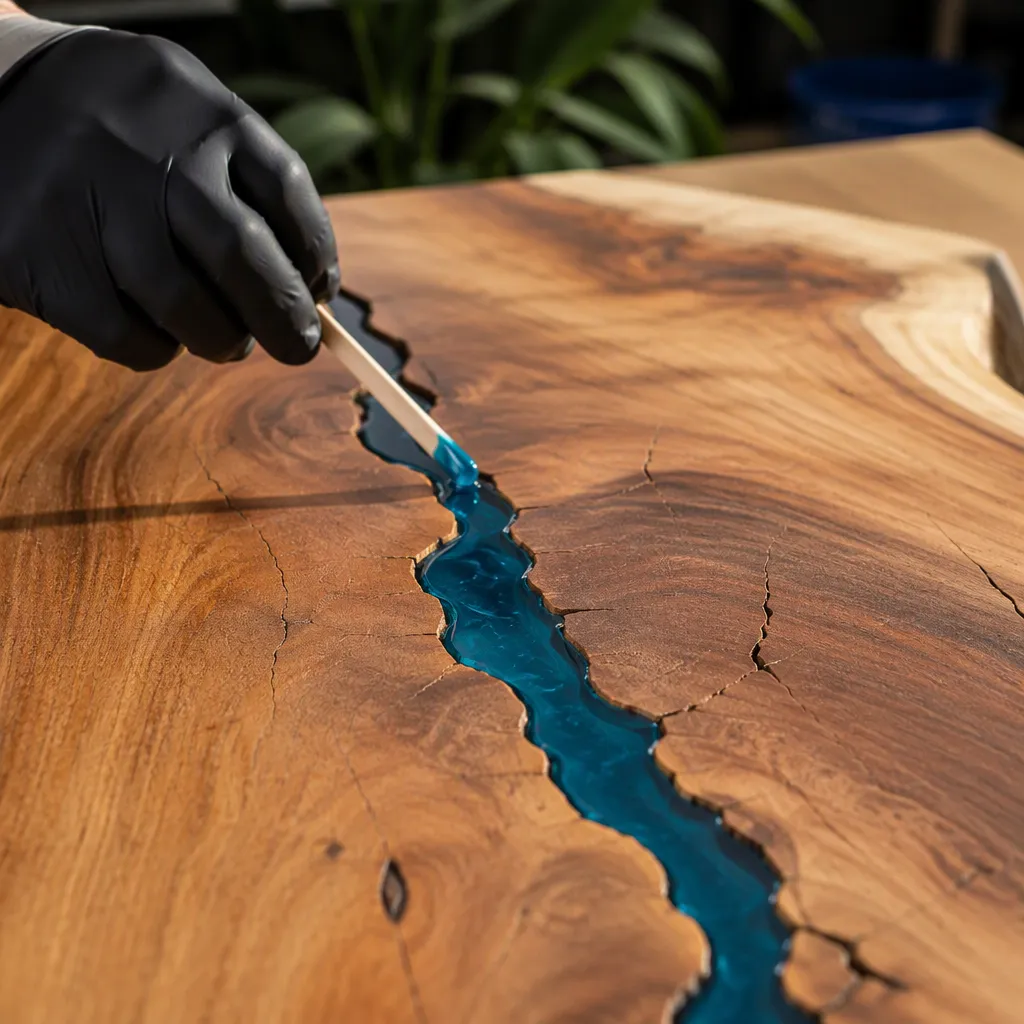
Epoxy resin for wood crack repair is a specialized two-component polymer system engineered to restore structural integrity and fill voids in damaged timber. Unlike standard wood putties that only sit on the surface, high-performance epoxy AB glue penetrates deeply into wood fibers, forming an unbreakable bond that permanently stabilizes cracked, split, or decayed wood.
Main application scenarios
- Furniture Restoration & Repair: Filling deep splits, knots, and stress cracks in live-edge slab tables, countertops, chairs, and heirloom cabinetry.
- Architectural & Structural Timbers: Repairing cracked wooden beams, deck posts, window sills, and hardwood flooring without requiring full lumber replacement.
- Wood-Resin Hybrid Crafts: Sealing voids and embedding decorative elements in river tables, cutting boards, and custom woodworking art.
- Rot Stabilization: Saturating dry-rotted or weathered wood to rebuild a dense, solid core before final finishing.
Required material properties
| Property | Benefit for Wood Repair |
|---|---|
| Ultra-Low Viscosity | Flows effortlessly into hairline cracks and deep micro-fissures without trapping air. |
| High Shear & Tensile Strength | Creates a bond stronger than the wood itself, preventing further splitting along the grain. |
| Zero Shrinkage | Ensures a perfectly flush, flat surface that does not sink or warp as it cures. |
| UV & Moisture Resistance | Prevents ambering and protects the repair against humidity, preventing wood expansion stress. |
Common user expectations
Woodworking professionals and industrial manufacturers demand a wood crack filler epoxy that delivers both flawless aesthetics and effortless processing.
- Flawless Machining: The cured clear repair resin must sand down smoothly, plane cleanly, and accept routing or drilling without chipping or cracking.
- Pigment Compatibility: Users expect the resin to mix seamlessly with alcohol inks, mica powders, and wood stains to match various natural timber tones.
- Reliable Curing: Eliminating risks of curing failure, soft spots, or surface cloudiness under standard room temperatures.
Performance Requirements for Epoxy Adhesives and Repair
To deliver professional results, any epoxy resin for wood crack repair must meet high physical and aesthetic standards. We engineer our formulas to ensure long-term structural integrity while maintaining a flawless finish.
| Performance Metric | Key Specification | Primary Benefit |
|---|---|---|
| Optical Clarity | High light transmission & UV stability | Blends seamlessly into wood grain |
| Bond Strength | Deep wood fiber penetration | Restores structural strength permanently |
| Environmental Protection | Waterproof & thermal resistant | Long-lasting indoor and outdoor durability |
Clarity, gloss, and appearance
A premium wood crack filler epoxy must complement the natural timber rather than obscure it.
- Crystal-clear transparency: Our clear repair resin cures with high optical clarity, highlighting wood grain without cloudiness.
- High-gloss finish: Excellent self-leveling properties produce a glass-like surface that minimizes sanding time.
- UV resistance: Integrated anti-yellowing additives protect the resin from turning amber under sunlight.
Adhesion and durability
A lasting repair requires superior adhesion to hold wood fibers together under stress.
- High-strength bonding: Formulated as a high-performance Epoxy AB glue, it penetrates deep into hairline cracks and voids.
- Zero shrinkage: The material cures at 100% solids, ensuring it won’t shrink, sink, or create hollow gaps.
- Flexibility: It absorbs the natural expansion and contraction of timber, eliminating bond separation and structural curing failure.
Temperature, moisture, and chemical resistance
Repaired wooden furniture, countertops, and structures face constant environmental exposure.
- 100% Waterproof: Completely seals damaged areas to stop water penetration, mold, and wood rot.
- Heat resistance: Holds up against warm items and ambient temperature fluctuations without softening.
- Chemical defense: Holds firm against household cleaners, oils, and accidental spills.
How to Select the Right epoxy resin for wood crack repair
Selecting the right epoxy resin for wood crack repair requires matching the liquid chemistry to your specific woodworking application. We manufacture high-performance systems designed to deliver maximum structural strength, crystal-clear clarity, and long-lasting wood adhesion.
Recommended formula type
Different wood defects require distinct viscosity levels. Choosing the right wood crack filler epoxy ensures full penetration without slumping or air entrapment:
- Low-Viscosity Liquid (Epoxy AB Glue): Best for fine hairline cracks, deep knots, and tight grain voids. It penetrates deep into wood fibers to seal completely from within.
- Thixotropic Epoxy Paste: Ideal for vertical edges, open side-grain fills, or large gaps where you need the material to stay in place without running off.
- UV-Stabilized Clear Repair Resin: Formulated specifically to resist yellowing on premium furniture, countertops, and exposed live-edge slabs.
Mixing ratio and curing conditions
To avoid curing failure, precise mixing ratios and environmental control are essential. Use this quick reference guide to set up your workflow:
| Parameter | 1:1 Fast-Cure Repair System | 2:1 / 3:1 Deep Fill System |
|---|---|---|
| Primary Application | Surface cracks, quick spot fixes | Deep voids, thick fills, large knots |
| Viscosity | Medium to low | Very low (high fluidity) |
| Pot Life (25°C) | 15–30 minutes | 45–90 minutes |
| Full Cure Time | 12–24 hours | 48–72 hours |
| Optimal Working Temp | 20°C–25°C (68°F–77°F) | 20°C–25°C (68°F–77°F) |
Always mix hardener and resin thoroughly for at least 3 minutes, scraping the container sides and bottom to guarantee a complete chemical reaction.
Packaging and bulk order options
As a direct custom epoxy resin manufacturer, we support businesses with flexible packaging tailored to your application scale and retail branding:
- Dual Cartridges (50ml / 200ml / 400ml): Pre-measured for fast, zero-mess dispensing with static mixing nozzles.
- Standard Container Sets (1L / 5L / 20L): Scaled for woodworking shops, furniture builders, and contractors.
- Industrial Bulk Drums & IBC Totes: High-volume supply for large-scale manufacturing lines and private label distributor brands.
Common Problems and Solutions
Bubbles, yellowing, or soft curing
Working with epoxy resin for wood crack repair can present a few hurdles if environmental factors or mixing steps are off target. Here is how we fix the most common issues:
- Bubbles: Caused by rapid mixing or pouring too thick. Pass a heat gun quickly over the surface, or choose a low-viscosity clear repair resin that allows air to vent naturally.
- Yellowing: Direct UV light and high thermal reaction cause amber discoloration. We build strong UV stabilizers directly into our formulas to preserve long-term clarity.
- Soft Curing: This curing failure happens due to incorrect mixing ratios, low working temperatures, or under-mixing your Epoxy AB glue. Always measure accurately by weight or volume and scrape the container sides thoroughly while mixing.
Surface defects and poor leveling
Achieving a seamless finish with wood crack filler epoxy requires proper surface preparation and environment control.
- Cratering and Fish Eyes: Surface oils, dust, or moisture repel the liquid resin. Clean, dry, and thoroughly degrease the wood substrate before pouring.
- Poor Self-Leveling: High viscosity or cold workspace temperatures prevent smooth flow. Maintain room temperatures between 20–25°C (68–77°F) for optimal flow.
- Wood Outgassing: Porous wood releases trapped air into curing epoxy. Apply a thin seal coat on the raw wood edges and let it tack up before making the final pour.
How to test before mass production
Before committing to large volume production runs, always perform a small-scale trial to validate performance:
- Conduct a Pilot Pour: Prepare a small sample mix using your actual shop conditions and wood species.
- Evaluate Cure Time & Hardness: Test for full hardness (Shore D rating) and tack-free drying after 24 to 48 hours.
- Inspect Optical Clarity & Bond Strength: Verify that there is no shrinkage, surface haze, or delamination along the wood joints.
As a custom epoxy resin manufacturer, we supply batch test samples and refine formulas to ensure your exact shop conditions yield perfect results every time.
RW Atelier Custom Manufacturing Support
As a custom epoxy resin manufacturer, we provide tailored solutions designed for your exact market needs. Whether you require high-penetration epoxy resin for wood crack repair or specialized industrial coatings, our OEM and ODM services give you full control over product performance, branding, and packaging.
Formula adjustment
We modify physical and chemical properties to match your application process and performance standards:
- Viscosity Control: Adjust flow rates from ultra-thin formulations for deep wood crack filler epoxy penetration to thick pastes for gap filling.
- Cure Timing: Fine-tune pot life and cure speeds to avoid curing failure on tight production schedules.
- Resin Chemistry: Customize hardness, UV resistance, and flexibility across Epoxy AB glue and PU glue formulations.
Private label packaging
We turn our proven formulas into your branded product line with complete packaging support:
- Flexible Form Factors: Options include dual syringes, squeeze bottles, twin-can kits, and bulk drums.
- Custom Branding: Full-bleed custom labeling, branded boxes, and specialized instruction inserts.
- Market-Ready Kits: Complete retail assembly ready for direct distribution.
Sample and bulk quotation
We make testing and scaling straightforward with transparent pricing and fast turnaround times:
| Phase | Service Provided |
|---|---|
| Rapid Sampling | Custom lab samples formulated and shipped for performance verification. |
| Quality Testing | Technical guidance to test batch adhesion, clarity, and mechanical strength. |
| Bulk Quotation | Competitive, tiered pricing structures tailored to your annual volume. |
What Is nameplate epoxy resin Used for in Dome Sticker Epoxy Resin?
We manufacture high-performance nameplate epoxy resin specifically formulated to create durable, eye-catching 3D clear domes over printed labels, badges, and decals. By combining excellent self-leveling capabilities with crystal-clear transparency, our clear resins turn ordinary flat graphics into premium, tactile brand emblems that stand out on any product.
Main application scenarios
Nameplate epoxy resin is ideal for high-impact branding across multiple industries:
- Brand Nameplates & Metallic Badges: Adding a crystal-clear protective lens to corporate logos, appliance badges, and industrial machinery tags.
- Promotional Dome Stickers: Transforming standard vinyl decals into 3D domed stickers for trade shows, giveaways, and retail products.
- Automotive Emblems & Decals: Crafting weather-resistant graphic overlays for cars, motorcycles, and marine equipment.
- Electronics & Keychains: Elevating control panel labels, key fobs, and custom branded accessories.
Required material properties
Achieving a flawless 3D dome requires precise physical and chemical traits. Our custom formulations deliver:
- High Surface Tension & Self-Leveling: Flows smoothly to the edges of the label without overflowing, forming a uniform dome shape.
- Optical Clarity & Gloss: Provides exceptional transparency that sharpens underlying colors and graphic details.
- UV & Weather Resistance: Prevents premature yellowing, chalking, or cracking when exposed to sunlight and moisture.
- Balanced Flexibility: Offers excellent impact absorption so the domed surface resists denting, scratching, and bending.
Common user expectations
When clients source resin for doming applications, they demand consistency and high production yield. Key expectations include:
- Bubble-Free Curing: A formula that releases trapped air rapidly during dispensing to minimize surface defects.
- Strong Substrate Adhesion: Perfect bonding with vinyl, aluminum, polyester, and various printed inks without edge lifting.
- Reliable Processing: Predictable viscosity, pot life, and curing times that fit seamlessly into automated dispensing systems or manual production lines.
Performance Requirements for Dome Sticker Epoxy Resin
Creating high-impact domed decals requires a coating that balances optical perfection with rugged durability. While epoxy resin for wood crack repair focuses on deep penetration and gap-filling strength, nameplate epoxy resin demands superior surface tension and crystal-clear aesthetics. We engineer our dome coatings to deliver high 3D depth without sacrificing long-term protection.
Clarity, gloss, and appearance
A premium nameplate epoxy resin must produce a smooth, high-gloss 3D lens effect that makes underlying graphics pop. We design our formulas for optimal viscosity, ensuring effortless self-leveling across printed vinyl, aluminum, and plastic substrates.
- Optical Clarity: High light transmittance for crystal-clear depth over printed logos.
- Self-Healing Surface: Resists minor scratches and bounces back from pressure marks.
- Bubble Release: Low surface tension allows trapped air to escape rapidly during dispensing.
Adhesion and durability
Strong bonding prevents edge peeling and delamination on various label materials. As a custom epoxy resin manufacturer, we balance flexibility and surface hardness to handle thermal expansion without lifting or cracking.
- Substrate Compatibility: Sticks firmly to PVC, PET, polycarbonate, and brushed metal.
- Flexible Cushioning: Maintains a soft, tactile dome feel without shrinking or pulling label edges.
- Long-Term Toughness: Withstands daily handling, bending, and mechanical abrasion.
Temperature, moisture, and chemical resistance
Dome stickers frequently encounter outdoor weather, moisture, and household cleaning chemicals. Choosing between standard Epoxy AB glue and PU glue systems depends directly on your environmental exposure requirements:
| Performance Metric | Standard Epoxy AB Glue | Polyurethane (PU Glue) |
|---|---|---|
| UV & Weather Resistance | Good (Best for indoor use) | Outstanding (10+ year outdoor rating) |
| Flexibility | Semi-rigid to flexible | Highly elastic & permanent flexibility |
| Moisture Resistance | High resistance to humidity | Exceptional waterproof barrier |
| Chemical Tolerance | Handles mild alcohol & detergent wipe-downs | Superior solvent & oil resistance |
| Best Application | Indoor nameplates, badge labels, promotional items | Automotive emblems, outdoor gear, harsh environments |
How to Select the Right nameplate epoxy resin
Selecting the ideal nameplate epoxy resin ensures your high-gloss dome stickers and brand badges stay crystal-clear, durable, and bubble-free. We design our formulations specifically for automated dispensing and high-volume production without sacrificing finish quality.
Recommended formula type
Depending on your substrate and flexibility needs, we supply two primary formulations for doming applications:
- Epoxy AB Glue (Rigid to Semi-Flexible): Perfect for metal, acrylic, and rigid plastic badges. It creates a high-build, glass-like dome with superior impact and scratch resistance.
- PU Glue (Polyurethane Coating): Recommended for flexible vinyl labels, curved surfaces, and harsh outdoor environments requiring long-term non-yellowing UV resistance.
Mixing ratio and curing conditions
Getting a flawless, defect-free dome depends on using the correct mix ratio and environmental controls to eliminate bubbles and prevent curing failure.
| Parameter | Standard Epoxy AB Glue | Flexible PU Resin |
|---|---|---|
| Mixing Ratio (by Weight) | 3:1 or 2:1 | 1:1 |
| Pot Life (25°C) | 30–45 minutes | 15–20 minutes |
| Room Cure Time | 12–24 hours | 8–12 hours |
| Thermal Cure (Fast) | 2 hours @ 60°C | 1 hour @ 60°C |
| Finish | High gloss, hard dome | Soft/flexible, UV-stable |
Packaging and bulk order options
As a direct custom epoxy resin manufacturer, we support your operation with scalable packaging solutions suited for manual work or automated line integration:
- Trial Kits: 1 kg to 5 kg sets for sample testing and dispensing calibration.
- Bulk Containers: 20 kg pails and 200 kg steel drums for high-volume commercial runs.
- Custom Packaging: Pre-filled dual cartridges and private-label options built to match your equipment specs.
