Industrial Epoxy Flooring for Factories Durable Chemical Resistant
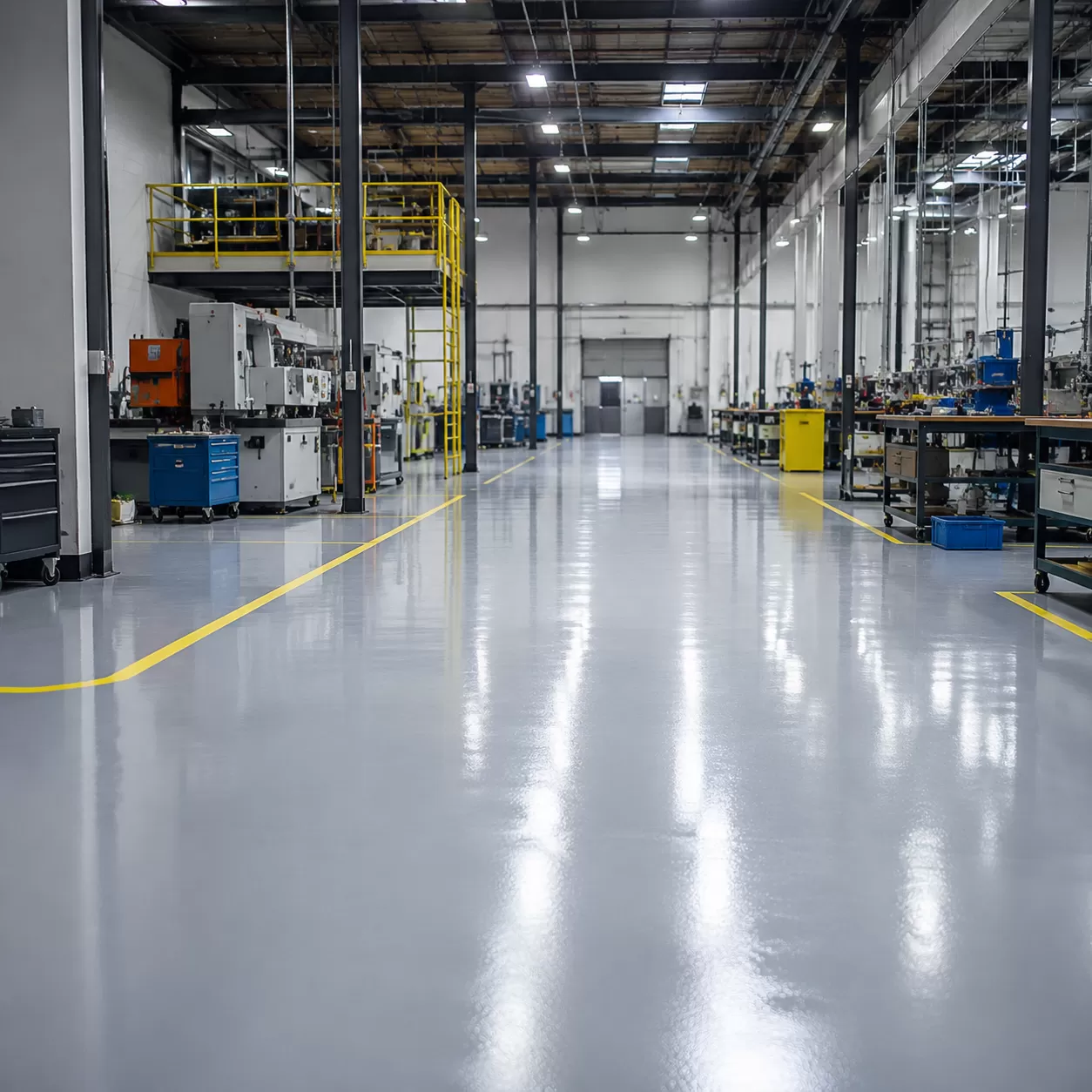
Industrial Flooring Challenges: Chemical Corrosion, Wear, and Cleaning Needs
In high-traffic manufacturing environments, your facility’s foundation is constantly under siege. Unprotected concrete is naturally porous, making it vulnerable to the daily rigors of heavy production. To maintain a safe and efficient workspace, facility managers must address three critical stressors that compromise industrial epoxy flooring and structural integrity.
1. Severe Chemical Corrosion
Factories often deal with harsh substances that can lead to rapid floor degradation. Without a high-performance chemical-resistant floor coating, spilled acids, alkalis, and industrial solvents penetrate the concrete substrate. This leads to:
- Subsurface weakening and structural crumbling.
- Permanent staining and unsightly surface erosion.
- Hazardous environmental leaching.
2. Extreme Mechanical Wear and Tear
Heavy-duty industrial flooring must withstand the relentless pressure of logistical operations. Bare concrete eventually fails under the stress of:
- Forklift Traffic: Constant pivoting and heavy loads create “dusting” and surface pitting.
- Impact Damage: Dropped tools or heavy machinery installation cause cracks and spalling.
- Abrasive Friction: High-volume foot traffic and equipment movement wear down the floor’s profile.
3. Stringent Hygiene and Cleaning Requirements
Porous, damaged floors are a liability for sanitation. Dust generated by deteriorating concrete contaminates sensitive machinery and products. An effective epoxy floor coating for factories solves these issues by providing:
- Seamless Surfaces: Eliminating cracks and joints where bacteria and grime accumulate.
- Simplified Maintenance: A non-porous finish allows for rapid wash-downs and chemical cleaning.
- Dust Suppression: Sealing the concrete to prevent fine particulates from entering the facility’s airflow.
Why Choose Industrial Epoxy Flooring: Comparing Coating Materials
When you’re managing a facility, you need a surface that handles more than just foot traffic. We’ve found that while options like polished concrete or standard floor paint seem cheaper upfront, they rarely survive the rigors of a high-output environment. Industrial epoxy flooring stands out because it isn’t just a layer of paint; it’s a chemical bond that transforms your slab into a powerhouse.
Compared to traditional materials, a professional epoxy floor coating for factories offers superior resilience. While bare concrete is porous and absorbs oils, our high-grade epoxy resin creates a completely seamless, non-porous barrier.
Epoxy vs. The Alternatives
| Feature | Epoxy Coating | Standard Floor Paint | Polished Concrete |
|---|---|---|---|
| Durability | Heavy-duty | Low (Peels easily) | Medium |
| Chemical Resistance | Excellent | Poor | Low |
| Dust-proofing | 100% Sealed | Temporary | Moderate |
| Impact Strength | High | Minimal | High |
We recommend a concrete epoxy coating over simple sealers because it provides a much thicker wear layer. This is essential for heavy-duty industrial flooring where forklifts and heavy machinery are the daily norm. If you are looking for specific high-performance finishes, you can find our specialized surface batch coating designed to withstand the toughest industrial abuse.
- Long-term Savings: Stop paying for floor repairs every two years.
- Safety: Integrated anti-slip epoxy floor textures keep your crew safe.
- Hygiene: Unlike tile or bare concrete, there are no grout lines or pores for bacteria to hide.
Industry-Specific Needs for Industrial Epoxy Flooring
Every facility has its own set of “floor killers.” Whether it’s corrosive acids or heavy forklift traffic, a one-size-fits-all approach doesn’t work. We tailor our epoxy floor coating for factories to meet the specific rigors of your business sector.
Chemical Processing (Superior Chemical Resistance)
In environments dealing with harsh reagents, a standard finish will fail in weeks. We install a high-performance chemical-resistant floor coating designed to withstand:
- Concentrated acids and alkalis.
- Aggressive solvents and fuels.
- Extreme pH fluctuations during washdowns.
Food and Beverage (Hygiene and Compliance)
Sanitation is the top priority in US food production. Our food-grade epoxy coating creates a seamless, non-porous barrier that prevents bacteria, mold, and pathogens from hiding in cracks.
- USDA/FDA Compliant: Surfaces that pass strict health inspections.
- Thermal Shock Resistance: Handles high-temperature steam cleaning.
- Anti-Slip Epoxy Floor: Textured finishes to prevent workplace injuries in wet processing areas.
Electronics and Tech (ESD Protection)
Static electricity can destroy sensitive components and cost your company thousands in “dead on arrival” parts. For these environments, we deploy specialized heavy-duty industrial flooring with Electrostatic Discharge (ESD) properties.
- Safely drains static charges to the ground.
- Protects microchips and delicate circuitry.
- Dust-proof surface to maintain cleanroom standards.
Automotive and Heavy Manufacturing (Oil and Impact Resistance)
Auto shops and assembly lines deal with constant fluid leaks and dropped tools. Our concrete epoxy coating for the automotive sector is built for “garage-tough” performance:
- Oil and Grease Resistance: Prevents staining and makes cleanup effortless.
- Impact Durability: Stands up to floor jacks, heavy machinery, and dropped parts.
- Tire Mark Resistance: Formulated to resist hot-tire pickup and scuffing.
RW Atelier’s Flooring Solutions: High-Performance Industrial Epoxy
We’ve spent years perfecting our industrial epoxy flooring systems to handle the toughest environments in the US. At RW Atelier, we focus on delivering a concrete epoxy coating that doesn’t just look good—it performs under pressure. Our solutions are engineered to meet the specific demands of American manufacturing and logistics.
Our Specialized Product Systems
- High-Build Coatings: The go-to for heavy-duty industrial flooring. It creates a thick, protective barrier against heavy machinery and constant foot traffic.
- Self-Leveling Systems: Perfect for achieving a seamless, mirror-like finish that’s easy to sanitize and maintain.
- ESD/Anti-Static Epoxy: Essential for electronics plants and cleanrooms to prevent static discharge from damaging sensitive components.
- Chemical-Resistant Barriers: A specialized chemical-resistant floor coating designed to withstand harsh spills, acids, and solvents without degrading.
Performance Specs You Can Count On
We measure our success by the numbers. Every epoxy floor coating for factories we install meets or exceeds standard US industrial requirements for safety and durability:
| Feature | Performance Metric | Practical Benefit |
|---|---|---|
| Compressive Strength | 10,000 – 12,500 PSI | Stronger than the base concrete; resists cracking |
| Adhesion Strength | 400+ PSI | Eliminates peeling or delamination under load |
| Safety Finish | Anti-slip epoxy floor textures | Reduces workplace accidents and slip hazards |
| Regulatory Compliance | USDA/FDA & Low VOC | Safe for food-grade and pharmaceutical facilities |
Every system we offer is tailored to your specific facility needs. Whether you need an anti-slip epoxy floor for a wet production line or a warehouse epoxy flooring setup for high-speed forklift traffic, our solutions are built to last and designed to maximize your uptime.
Our Construction Process: Delivering High-Performance Industrial Epoxy Flooring
A great floor is only as good as the installation. We don’t just “paint” a surface; we engineer a bond. To ensure your epoxy floor coating for factories stands up to heavy machinery and chemical spills, we follow a rigorous, four-step professional protocol.
1. Precision Surface Preparation
This is the most critical step. We use diamond grinding or shot blasting to remove the “laitance” (the weak top layer of concrete) and open up the pores. Without this mechanical profiling, a concrete epoxy coating will eventually peel. We make sure the slab is clean, dry, and textured for a permanent bond.
2. High-Bond Primer Application
We apply a specialized low-viscosity primer that sinks deep into the concrete capillaries. This creates a powerful chemical fuse between the substrate and the heavy-duty industrial flooring system, preventing delamination even under intense forklift traffic.
3. Body Coat and Leveling
The “meat” of the system is the middle layer. This is where we build the floor’s thickness to handle impact. During this stage, we:
- Fill and Patch: Seal all cracks and joints with industrial epoxy fillers.
- Leveling: Smooth out imperfections in the concrete slab.
- Safety Texture: If you need an anti-slip epoxy floor, we broadcast high-quality aggregates into this layer for maximum traction.
4. Durable Topcoat Finish
The final layer provides the “shield.” We apply a high-performance topcoat tailored to your specific environment. This layer provides:
- Chemical Resistance: Protection against oils, acids, and solvents.
- UV Stability: Ensuring the floor doesn’t yellow over time.
- Aesthetic Quality: A seamless, professional finish that makes your facility look world-class.
Industrial Epoxy Flooring Cost: Initial Investment vs. Long-Term Savings
When I talk to facility managers about industrial epoxy flooring, the conversation usually starts with the “sticker price.” I understand the hesitation—a professional epoxy floor coating for factories requires a higher upfront investment than basic concrete sealers or DIY paints. However, if you look at the total cost of ownership over a 5 to 10-year period, the high-performance option is almost always the cheaper route.
Why the Initial Investment Varies
The cost of heavy-duty industrial flooring isn’t just about the liquid in the bucket. It covers the precision engineering required to make the floor last under 24/7 operations.
- Mechanical Prep: We use diamond grinding or shot blasting to ensure the coating actually bites into the concrete.
- Material Quality: We prioritize high-solids resins over cheap, water-based alternatives that flake under forklift traffic.
- System Depth: A multi-layer concrete epoxy coating provides the thickness needed to absorb impacts that would shatter thinner finishes.
Breaking Down the ROI
Investing in a quality warehouse epoxy flooring system pays for itself by eliminating the hidden “drain” on your budget.
| Expense Category | Bare Concrete / Cheap Sealer | Professional Industrial Epoxy |
|---|---|---|
| Cleaning Labor | High (porous surfaces trap oil/dirt) | Low (seamless, wipeable surface) |
| Equipment Maintenance | Frequent (concrete dust kills bearings) | Minimal (dust-free environment) |
| Floor Lifespan | 1–2 years before failing | 7–10+ years with basic care |
| Safety Costs | High risk of slips and trips | Reduced (integrated anti-slip texture) |
Choosing a chemical-resistant floor coating is a strategic move. You aren’t just buying a floor; you are buying the insurance that your production won’t grind to a halt for emergency repairs three years down the road. In the U.S. market, where labor and downtime costs are at an all-time high, the “expensive” floor is actually the one that saves your bottom line.
Maintenance and Care: Extending the Life of Your Industrial Epoxy Flooring
We don’t just install your epoxy floor coating for factories and leave you to figure it out. While our heavy-duty industrial flooring is built to take a beating, a simple maintenance routine ensures your facility stays safe and looks professional for years.
Follow these practical steps to protect your concrete epoxy coating:
- Daily Sweeping: Use a soft-bristle broom or a commercial dust mop. Removing sand and grit is the easiest way to prevent micro-scratches on your industrial epoxy flooring.
- Weekly Mopping: Use warm water mixed with a pH-neutral cleaner. Avoid soap-based cleaners, as they leave a dull film that can make an anti-slip epoxy floor slippery when wet.
- Immediate Spill Response: Even with a chemical-resistant floor coating, you should wipe up oils and chemicals promptly. This prevents potential staining and maintains the integrity of the surface.
- Mechanical Protection: Use floor mats at high-traffic entry points and ensure heavy machinery has protective pads. This preserves the high-gloss finish of your warehouse epoxy flooring.
Quick Cleaning Dos and Don’ts
| Feature | Best Practice | What to Avoid |
|---|---|---|
| Tools | Microfiber mops / Soft brushes | Stiff wire brushes / Metal scrapers |
| Cleaners | pH-neutral detergents | Ammonia, bleach, or citrus-based acids |
| Frequency | Consistent daily debris removal | Letting abrasive dirt build up |
By staying on top of these basics, you maximize the lifespan of your floor and ensure it continues to meet the rigorous standards of a food-grade epoxy coating or a pharmaceutical facility flooring environment. Care for your floor, and it will keep your operations running smoothly.
Get Your Free On-Site Assessment and Quote Today
We know that every facility has its own set of challenges. Whether you’re dealing with heavy forklift traffic, chemical spills, or strict hygiene standards, choosing the right industrial epoxy flooring shouldn’t be a guessing game. We are here to provide the expert guidance you need to make an informed decision for your business.
Our seamless process includes:
- Free Facility Inspection: We’ll come to your site to evaluate your current concrete condition and identify potential issues.
- Customized Solutions: You’ll get a tailored recommendation for the best epoxy floor coating for factories based on your specific operational needs.
- Transparent Pricing: Receive a detailed, competitive quote with no hidden fees or surprises.
- Expert Consultation: We’ll walk you through the timeline and technical specs so you know exactly what to expect.
Don’t wait for floor damage to disrupt your production or compromise safety. Contact us today to schedule your free walk-through and take the first step toward a more durable, professional workspace.