
Custom Electronic Potting Compound | UV-Resistant, Yellowing
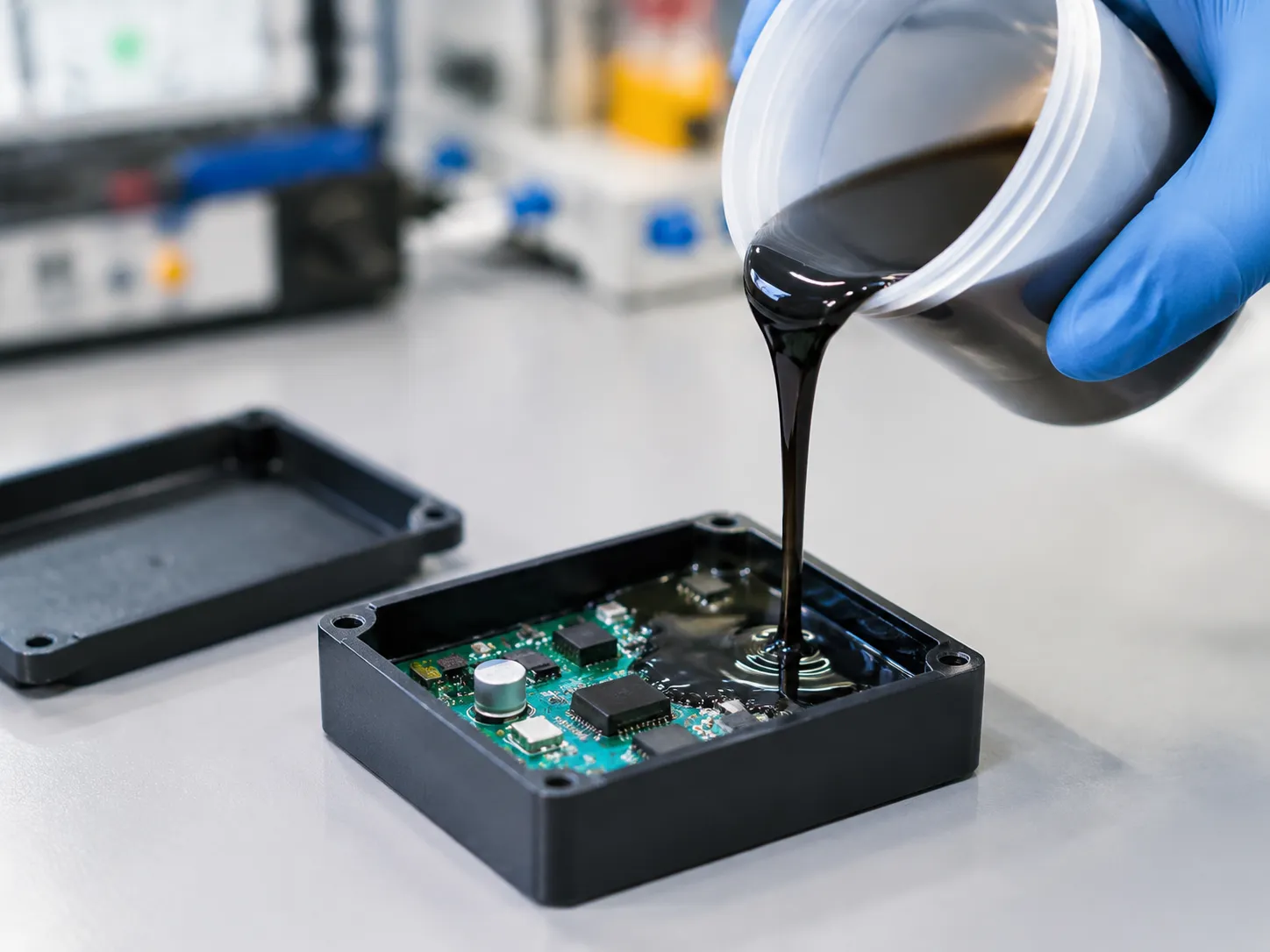
Are you struggling to find the right custom electronic potting compound that won’t crack, discolor, or fail under harsh conditions?
Choosing the wrong formulation can quickly lead to thermal breakdown, UV yellowing, and costly component failures.
In this guide, you’ll discover the critical selection factors, key failure risks to avoid, and exactly what to specify when sourcing a reliable custom electronic potting compound for your project.
Let’s dive right in.
Quick Answer
What Buyers Need to Know First
A custom electronic potting compound is engineered to eliminate the performance compromises of standard, off-the-shelf resins. When standard formulations fail to meet strict thermal, mechanical, or chemical thresholds, tailoring the resin chemistry ensures complete protection for mission-critical electronics.
Before sourcing a custom formulation, buyers must align on three core variables:
- Operating Environment: Pinpoint exact exposure risks, including continuous service temperatures, thermal shock cycles, moisture immersion, chemical contact, and outdoor UV exposure.
- Production Process Requirements: Define viscosity, working life (pot life), and cure schedules (heat-cure vs. room-temperature cure) to match your automated dispensing equipment and line speed.
- Target Performance Standards: Determine required dielectric strength, flame retardancy ratings (such as UL 94 V-0), hardness (rigid epoxy vs. flexible polyurethane), and thermal conductivity values.
Customizing your electronic resin formulation protects sensitive assemblies against field failures, moisture ingress, and thermal degradation while optimizing overall assembly yield.
Is any epoxy completely UV-proof?
Direct Answer
No epoxy is 100% UV-proof indefinitely. Standard epoxy resins naturally contain aromatic rings that absorb ultraviolet radiation, which breaks chemical bonds over time and causes yellowing, chalking, and brittleness.
However, we can formulate a custom electronic potting compound with specialized aliphatic backbones, UV absorbers, and hindered amine light stabilizers (HALS). While this does not make the material completely immune to solar radiation forever, it dramatically slows down photo-oxidation and extends the operational lifespan of outdoor electronic assemblies for years.
Key Selection Factors or Failure Risks
When selecting a potting material for UV-exposed environments, balancing chemical resistance and optical stability is critical to prevent field failures.
- Base Chemistry Selection: Standard bisphenol A/F epoxies offer excellent adhesion and mechanical protection but yellow rapidly in direct sunlight. For high UV clarity, cycloaliphatic epoxies or alternative hybrid chemistries are required.
- Loss of Dielectric Integrity: UV degradation is not just a cosmetic issue. As sunlight breaks down polymer chains on the surface, the compound can develop micro-cracks that compromise electrical insulation.
- Moisture Ingress Risk: Surface chalking and embrittlement from severe UV exposure weaken the environmental seal of a custom PCB encapsulation epoxy, allowing moisture, salt mist, and dust to reach sensitive components.
- Thermal Compounding: Outdoor units exposed to direct sunlight face combined solar heat and UV energy. An optimized electronic resin formulation must address both thermal aging and photochemical breakdown simultaneously.
Why does overheating increase discoloration?
Direct Answer
Excess heat triggers rapid thermal oxidation within the polymer matrix. When a custom electronic potting compound faces high temperatures—either from an uncontrolled curing exotherm or intense device operating heat—the molecular bonds in the resin break down. This thermal breakdown forms light-absorbing chemical groups called chromophores, shifting clear or light compounds into yellow, amber, or dark brown.
Key Selection Factors or Failure Risks
Controlling thermal stress requires matching the compound chemistry to your device’s thermal profile.
- Exotherm Peak Control: Pouring thick sections can cause runaway curing temperatures. A tailored electronic resin formulation balances reactivity to keep peak exotherm low during bulk cures.
- Continuous Operating Temperature: Using a resin with an inadequate thermal rating causes steady degradation. Always specify the maximum operating temperature of the assembly.
- Thermal Dissipation: Low thermal conductivity traps heat around power components, accelerating localized discoloration and heat aging.
| Factor | Failure Risk If Overheated | Prevention Strategy |
|---|---|---|
| Cure Exotherm | Immediate scorched amber color, shrinkage voids | Optimize catalyst levels and step-cure thick sections |
| Operating Heat | Progressive yellowing, brittleness, loss of optical clarity | Select heat-stabilized or high-Tg potting systems |
| Localized Hotspots | Dielectric breakdown, micro-cracking around hot components | Use filled compounds engineered for thermal conduction |
Allowing an electrical insulation resin to degrade from heat leads to compromised insulation resistance, cracked seals, and optical failure over active components.
Do pigments hide or worsen yellowing?
Direct Answer
Pigments generally hide yellowing rather than worsen it, but the final outcome depends entirely on the pigment color, chemistry, and loading level. In our custom electronic potting compound formulations, dark pigments like black and charcoal completely mask the natural amber shift of degrading polymer backbones.
However, light pigments do not prevent the underlying chemical degradation. In white or pastel formulations, an aging resin matrix will still discolor, shifting crisp white finishes toward cream, tan, or green-yellow tones over time. High-quality, UV-stable pigments provide a physical shield against UV penetration, slowing down resin breakdown beneath the surface.
Key Selection Factors or Failure Risks
Choosing the right colorant for an OEM potting compound requires balancing optical shielding with electrical and mechanical reliability:
- Carbon Black vs. Dielectric Integrity: Carbon black is the ultimate defense against visible yellowing and UV degradation. However, excessive loading can compromise surface resistivity and volume resistivity. We use specialized non-conductive grades for sensitive custom PCB encapsulation epoxy jobs.
- Inorganic vs. Organic Colorants: Cheap organic dyes photo-degrade faster than the resin itself, causing the potting compound to fade or shift shade rapidly. We rely on heat- and UV-stable inorganic metal oxides (like titanium dioxide for white or iron oxides for earth tones) to preserve color stability under thermal cycling.
- Light Shade Vulnerability: If your electronics require a white or light-grey aesthetic finish, standard bisphenol-A epoxy will inevitably show yellowing at the boundary layer. For these designs, we formulate using aliphatic, silicone, or polyurethane resin bases instead of relying purely on pigments to mask aging.
- Viscosity and Settling: Heavy pigment loadings can increase compound viscosity and risk settling during storage. Maintaining proper anti-settling additives guarantees consistent color and uniform thermal dissipation across every potted batch.
How should yellowing resistance be compared?
Direct Answer
To accurately compare yellowing resistance in a custom electronic potting compound, we rely on standardized accelerated weathering tests rather than subjective visual inspections. The gold standard involves running standardized UV aging protocols—such as ASTM G154 (QUV accelerated weathering) or ISO 4892-2 (Xenon arc exposure)—paired with spectrophotometric color measurements to track the change in Yellowing Index (ΔYI, ASTM E313) and total color difference (ΔE) over specific exposure intervals (500, 1,000, and 2,000 hours).
Key Selection Factors or Failure Risks
Evaluating an electronic resin formulation purely under standard room conditions creates major reliability risks once deployed in outdoor or high-heat environments. When comparing anti-yellowing performance across different formulas, focus on these critical benchmarks:
- Standardized Spectral Exposure: Ensure all test samples are exposed to the exact same UV wavelength spectrum (UVA-340 lamps replicate real sunlight most accurately; UVB-313 provides extreme, aggressive stress testing).
- Combined Thermal and UV Stress: High operating temperatures accelerate photo-oxidation. A dependable OEM potting compound must maintain optical clarity during combined heat cycles (e.g., 85°C) and UV radiation.
- Base Chemistry Matching: Compare like-for-like chemistries. Cycloaliphatic epoxies and modified aliphatic systems consistently outperform standard bisphenol-A based compounds in UV stability.
- Quantitative Data vs. Visual Estimates: Rely strictly on calibrated colorimeter data (ΔE < 2.0 indicates minimal, visually imperceptible shift) rather than simple side-by-side photography.
| Comparison Parameter | Standard Test Method | Pass/Fail Benchmark |
|---|---|---|
| Accelerated UV Stability | ASTM G154 (Cycle 1, UVA-340) | ΔYI < 3.0 after 1,000 hours |
| Thermal Yellowing Resistance | Continuous heat aging at 100°C | ΔE < 2.5 after 500 hours |
| Optical Clarity Retention | ASTM D1003 (Total Transmittance) | > 90% light transmission maintained |
Failure Risk: Selecting a custom PCB encapsulation epoxy based solely on initial out-of-the-mold clarity often leads to severe field discoloration, loss of sensor transmission, compromised aesthetic value, and surface micro-cracking under intense solar radiation.
Can a topcoat improve outdoor durability?
Direct Answer
Yes. Applying a specialized protective topcoat—such as an aliphatic polyurethane, acrylic, or fluoropolymer—over a standard epoxy-based custom electronic potting compound significantly boosts outdoor durability. The topcoat acts as a sacrificial UV-blocking and moisture-resistant barrier, stopping surface degradation, chalking, and discoloration before radiation reaches the underlying custom PCB encapsulation epoxy.
Key Selection Factors or Failure Risks
Adding a secondary coating introduces extra processing variables that we must manage during production:
- Interfacial Adhesion: The topcoat must chemically or mechanically bond with the cured OEM potting compound. Incompatible surface energies lead to blistering, flaking, or premature peeling under environmental stress.
- Thermal Expansion (CTE) Mismatch: The topcoat and potting compound expand and contract at different rates during thermal cycling. A mismatch creates shear stress at the interface, causing delamination or micro-cracks that let moisture enter.
- Cure Chemistry Interference: Certain topcoats require specific cure windows. Applying a topcoat over an under-cured amine-cured resin can cause amine blush, preventing the topcoat from curing properly.
- Process Cost vs. Direct Formulation: While a topcoat works well for retrofit designs, upgrading to an inherently UV-stabilized electronic resin formulation or dual-layer silicone/polyurethane system in a single step often cuts assembly labor and reduces failure points.
| Factor | Topcoat Layer | Direct UV-Resistant Formulation |
|---|---|---|
| Process Steps | Two-step (Potting + Spray/Dip) | Single-step (Direct Potting) |
| Delamination Risk | Moderate to High (Interfacial bond) | None (Homogeneous block) |
| UV Resistance | High (Surface shield) | High throughout total bulk |
| Best Used For | Large enclosures, retrofits | Compact PCBs, mass production |
What Information Should You Send to the Manufacturer?
When you request a custom electronic potting compound, providing exact technical and production details upfront ensures we engineer the exact formulation for your line. An accurate initial spec sheet speeds up potting sample development and avoids costly redesign cycles.
Application, Substrate and Process Details
To tailor an effective custom PCB encapsulation epoxy, we need to know how the material will be applied and what it must adhere to:
- Target Device: Specify the component type (e.g., automotive sensors, power supply units, LED drivers, or industrial controllers).
- Substrates and Housing: List all contact materials, including FR4 circuit boards, aluminum enclosures, copper leads, or plastics like ABS, PBT, and polycarbonate.
- Dispensing Method: State whether you use manual mixing, static mix nozzles, or automated meter-mix dispensing equipment.
- Curing Parameters: Define your cycle constraints, including desired pot life (working time), gel time, and whether your process requires a room-temperature cure or an accelerated heat cure.
Performance, Packaging and Estimated Quantity
Understanding what information is needed for a custom potting formula also requires clear operational and logistical targets:
| Specification Category | Details to Provide |
|---|---|
| Thermal & Electrical | Required thermal conductivity (W/m·K), dielectric strength, and operating temperature range (e.g., -40°C to +150°C). |
| Environmental Protection | Direct UV exposure levels, chemical resistance (fuels, solvents), water immersion depth (IP67/IP68), and UL 94 V-0 flame retardancy needs. |
| Mechanical Properties | Desired hardness (Shore A for flexible dampening vs. Shore D for rigid impact protection). |
| Packaging Specs | Duo-barrel cartridges, 1 kg twin-packs, 5-gallon pails, or 200 L industrial drums. |
| Volume Forecast | Prototype sample volume, pilot run size, and annual bulk production requirements. |
Providing these parameters allows us to tailor an OEM potting compound that delivers reliable electrical insulation resin performance directly compatible with your production line.
How Can Rongwei Support This Project?
As a direct wholesale epoxy resin manufacturer, Rongwei works directly with your engineering and procurement teams to develop the right custom electronic potting compound for your operating environment. We eliminate the middlemen to deliver factory-direct pricing, consistent quality, and responsive technical support.
Sample Matching and Formula Adjustment
Every potting project faces unique thermal, mechanical, and processing demands. Our R&D lab handles custom electronic resin formulation and rapid potting sample development to hit your exact design targets:
- Benchmarking & Reverse Engineering: Send us your benchmark sample or failed component. We analyze the matrix and adjust viscosity, cure speed, and shore hardness to match or outperform it.
- Property Customization: We tailor electrical insulation resin systems for elevated thermal conductivity, UL 94 V-0 flame retardancy, low glass transition temperature (Tg) stress relief, and enhanced UV stability.
- Process Optimization: Formulations are tuned for your specific dispensing method—whether automated meter-mix dispensing or manual batch mixing—preventing voids and incomplete cures in custom PCB encapsulation epoxy applications.
| Parameter | Tailoring Options |
|---|---|
| Viscosity | 500 cPs to thixotropic pastes (self-leveling vs. non-sag) |
| Cure Profile | Room temperature cure, heat-accelerated, or dual-cure systems |
| Thermal Performance | 0.3 W/m·K up to 2.5+ W/m·K thermal conductivity |
| Flexibility | Soft elastomeric gels to high-rigidity structural epoxies |
OEM / Private Label Packaging and Bulk Supply
We provide flexible, factory-direct OEM potting compound manufacturing and packaging tailored to production lines of any scale:
- Custom Packaging Formats: Available in dual-barrel cartridges (50ml, 200ml, 400ml), 1-gallon cans, 5-gallon pails, 55-gallon drums, and 1,000L IBC totes.
- Private Label Epoxy Resin Solutions: Complete OEM branding services, including custom labels, SDS documentation, technical data sheets (TDS), and regulatory compliance support (RoHS, REACH).
- Scalable Bulk Supply: As a dedicated bulk epoxy resin supplier, we maintain strict raw material sourcing and rigorous batch-to-batch testing to guarantee consistency across continuous high-volume production runs.
Final Buyer Checklist
Before issuing a purchase order for a custom electronic potting compound, we recommend walking through this final verification checklist. Aligning on these parameters ensures seamless batch-to-batch consistency, smooth production line dispensing, and long-term protection for your assemblies.
Questions to Confirm Before Placing an Order
- Operating Conditions & Environmental Exposure
- What is the continuous operating temperature range, including peak spikes?
- Will the encapsulated unit face direct UV exposure, moisture, thermal shock, or chemical solvents?
- Does the assembly require specific flame-retardant ratings, such as UL94 V-0?
- Electrical & Mechanical Requirements
- What are the target requirements for dielectric strength, volume resistivity, and thermal conductivity?
- Do sensitive electronic components require a soft, low-stress gel/elastomer, or does the enclosure require rigid structural support and tamper resistance?
- Dispensing & Process Compatibility
- Is the mixed viscosity optimized for your dispensing method (manual mixing vs. automated meter-mix equipment)?
- Does the working life (pot life) match your assembly cycle time, and is the cure schedule (heat cure vs. room temperature) validated for your manufacturing line?
- Has the adhesion profile been tested on all target substrates (PCB boards, FR4, metals, molded plastics)?
- Packaging, Supply & Compliance
- Have you confirmed the container sizing (dual-barrel cartridges, gallon pails, or bulk drums) to minimize material waste?
- Are all regulatory compliance certificates (RoHS, REACH, halogen-free) documented and up to date?
- Have the pilot production samples passed full electrical insulation and environmental reliability testing?
