
Removable Epoxy Potting Compound Yellowing Resistance Guide
Quick Answer
What Buyers Need to Know First
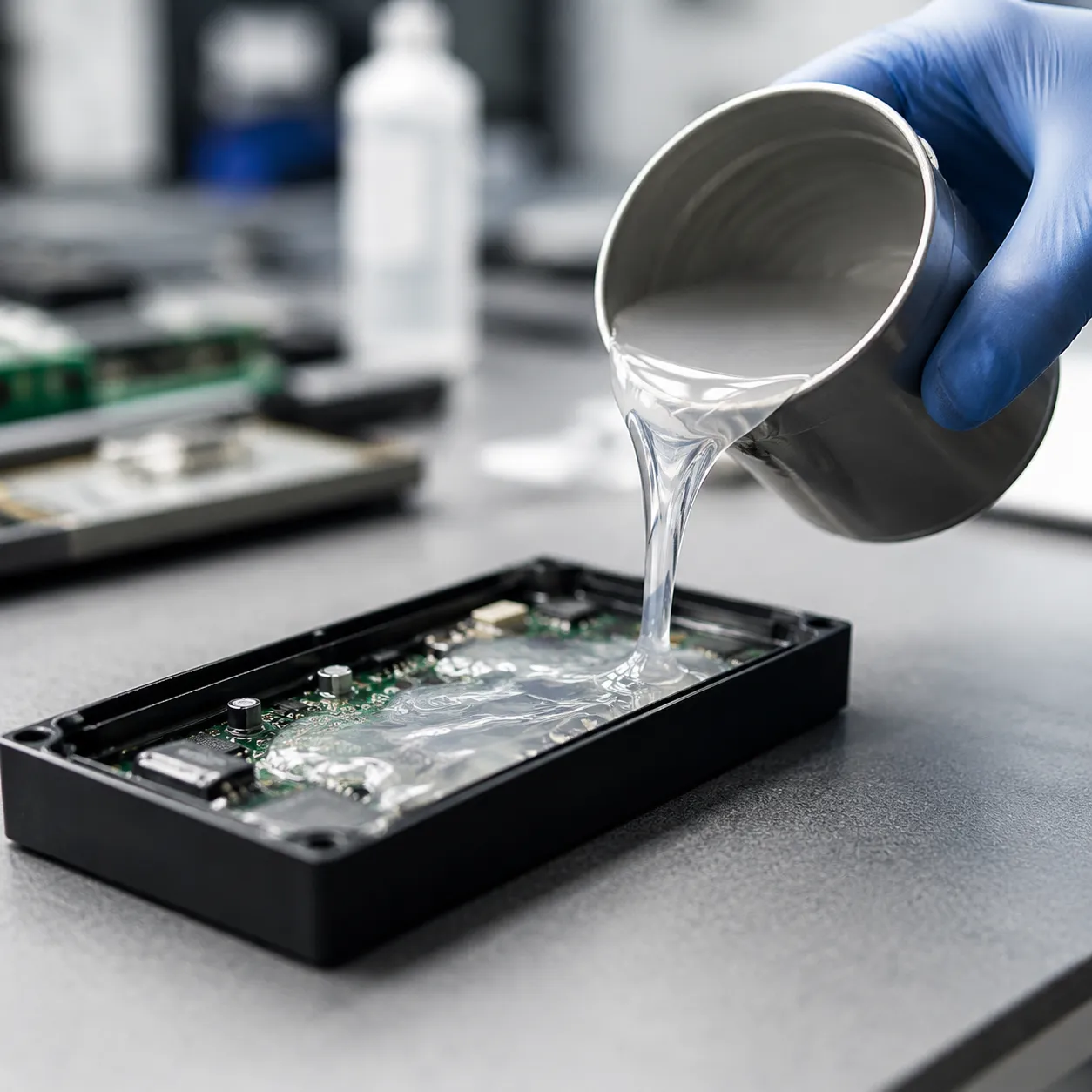
A removable epoxy potting compound is a specialized, reworkable formulation engineered to deliver robust electrical insulation and environmental protection while still allowing technicians to access, test, and repair potted PCBs. Unlike standard rigid epoxies that permanently lock components in an impenetrable block, removable or reworkable potting resins utilize modified cross-linking technology that enables depotting without destroying delicate electronic substrates.
- Depotting Feasibility: While traditional epoxies are permanent, removable formulations are designed for clean mechanical excision, localized heat softening, or targeted chemical breakdown.
- Hardness vs. Reworkability: These compounds typically feature a lower durometer profile (semi-rigid Shore D or flexible Shore A) to allow technicians to cut, peel, or dig out the material during maintenance.
- Core Protection Retained: Despite being repairable, the material maintains high dielectric strength, thermal conductivity, and resistance to moisture, shock, and vibration.
- Application Scope: Ideal for high-value assemblies, prototype testing, power modules, and sensors where field failure analysis or component replacement is economically required.
Is any epoxy completely UV-proof?
Direct Answer
No epoxy is 100% UV-proof over prolonged outdoor exposure. Standard epoxy chemistries inherently absorb ultraviolet radiation, which breaks down the molecular bonds over time. While we formulate our removable epoxy potting compound options with advanced UV absorbers and Hindered Amine Light Stabilizers (HALS) to dramatically delay discoloration and degradation, no epoxy can permanently resist solar radiation without eventual yellowing or surface chalking.
Key Selection Factors or Failure Risks
- Aromatic vs. Aliphatic Chemistry: Most standard reworkable potting resin systems use aromatic backbones, which are naturally vulnerable to UV-induced photo-oxidation.
- Loss of Protection: Prolonged UV exposure doesn’t just alter color; it causes micro-cracking and brittleness, undermining the protective moisture barrier of the electrical insulation resin.
- Impact on Reworkability: Heavy UV degradation alters the polymer matrix. When you need to repair potted PCB units, photo-oxidized material can become overly brittle or gummy, making clean depotting electronics far more difficult.
- Stabilizer Depletion: UV additives work by sacrificing themselves to neutralize free radicals. In high-exposure environments, these stabilizers eventually deplete, accelerating the aging process of any soft encapsulation compound.
Why does overheating increase discoloration?
Direct Answer
Overheating accelerates thermal oxidation inside the polymer matrix. When a removable epoxy potting compound faces excessive heat—either from an uncontrolled exothermic cure reaction or high continuous operating temperatures—the polymer backbone breaks down. This thermal degradation generates quinoid structures and conjugated double bonds (chromophores) that absorb blue light, causing the cured resin to rapidly shift from clear or translucent to amber, dark brown, or yellow.
Key Selection Factors or Failure Risks
Thermal discoloration is often a visible warning sign of deeper material degradation. When choosing and processing a reworkable potting resin, keep these critical factors in mind:
- Exothermic Spike Control: Potting deep enclosures in a single pour can trigger severe heat buildup. Uncontrolled exotherm discolors the core and degrades the soft encapsulation compound before it even enters service.
- Continuous Operating Temperature Limits: Running electronics above the resin’s rated glass transition temperature (Tg) causes persistent oxidative yellowing and reduces service life.
- Compromised Reworkability: Excessive thermal exposure can cause unreacted crosslinking. When an overheated resin bakes and hardens beyond its specification, attempting to repair potted PCB assemblies becomes significantly more difficult and risks board damage during depotting.
- Loss of Electrical Insulation: Severe thermal degradation breaks down molecular chains, leading to micro-cracking, dielectric breakdown, and reduced moisture resistance.
Do pigments hide or worsen yellowing?
Direct Answer
Pigments hide yellowing—they do not worsen it. In our formulations, adding stable colorants shields the base polymer from direct light penetration, effectively masking the amber shift that untreated resins experience over time.
However, color choice makes a critical difference:
- Black and dark grey pigments: Completely conceal underlying resin discoloration, keeping the visual appearance uniform even after long-term heat and UV exposure.
- White and pastel tints: Do not worsen degradation, but they expose yellowing quickly as the resin shifts hue beneath the pigment.
- Translucent or clear systems: Show thermal and UV oxidation first, displaying visible darkening across hot components.
While adding pigment protects against visible color change in a removable epoxy potting compound, it masks polymer aging rather than stopping it. The chemical backbone still needs proper UV and thermal stabilizers to retain its physical performance.
Key Selection Factors or Failure Risks
When formulating or choosing a pigmented, reworkable potting resin, balance visual stability against practical maintenance and reliability:
| Selection Factor | Practical Impact | Failure Risk to Watch |
|---|---|---|
| Inspection & Repair Access | Opaque pigments block visual tracking of delicate traces during maintenance. | Harder to safely repair potted PCB units; increases trace damage during mechanical depotting. |
| Depotting Electronics | High filler loading used for opacity alters compound hardness. | A soft encapsulation compound can become overly rigid if overloaded with pigments and fillers, reducing reworkability. |
| Dielectric Integrity | High-grade carbon black or mineral pigments protect against light. | Low-grade pigments introduce conductive pathways, reducing the performance of your electrical insulation resin. |
| Heat Dissipation | Pigmented and filled systems generally manage thermal loads better than clear resins. | Excessive thermal buildup under continuous load still degrades polymer chains beneath the color layer. |
How should yellowing resistance be compared?
Direct Answer
Yellowing resistance should always be evaluated using standardized accelerated weathering tests paired with objective spectrophotometer measurements (Delta E), not casual visual checks. When selecting a removable epoxy potting compound, you need to compare how the polymer holds its optical clarity under combined UV radiation and operating heat, rather than relying on how transparent the material looks right out of the mixing nozzle.
Key Selection Factors or Failure Risks
To accurately assess discoloration resistance between different formulations, we rely on concrete testing benchmarks and operational parameters:
| Comparison Metric | Standard Test Method | What to Look For |
|---|---|---|
| Accelerated UV Aging | ASTM G154 (QUV) / ASTM G155 (Xenon Arc) | Hours to visible shift; minimum 500–1,000 hours without significant ambering. |
| Color Shift (Delta E) | ASTM D2244 Spectrophotometry | A Delta E under 2.0 to 3.0 indicates changes barely noticeable to the human eye. |
| Thermal Discoloration | Continuous bake at maximum rated temp (e.g., 85°C to 125°C) | Resistance to oxidation caused by component heat rather than external light. |
| Initial Base Color | Gardner Color Scale or APHA/Pt-Co | Lower baseline numbers indicate higher initial purity of the electrical insulation resin. |
- The Flexibility Trade-off: A reworkable potting resin or soft encapsulation compound often incorporates specialized flexibilizers or aliphatic modifiers to make depotting electronics practical. Some of these modifying agents can be more sensitive to photo-oxidation than rigid cycloaliphatic systems if not properly stabilized.
- Inspection and Indicator Failures: Excessive yellowing or darkening poses a severe failure risk if technicians need clear optical access to inspect traces, read serial numbers, or check status LEDs when planning to repair a potted PCB.
- Mismatched Testing Data: Never compare a supplier’s fluorescent bulb test to an outdoor xenon arc exposure test. Ensure all prospective formulations are tested under identical irradiance levels, humidity cycles, and surface temperatures.
Can a topcoat improve outdoor durability?
Direct Answer
Yes. Applying a specialized protective topcoat dramatically improves the outdoor durability of a removable epoxy potting compound. Because reworkable formulations are engineered to remain soft or chemically breakable for PCB maintenance, they often lack the extreme UV and weather resistance found in permanent, rock-hard resins. A thin, weather-stable topcoat acts as an external shield against UV radiation, moisture ingress, and chemical exposure without compromising the easy-to-repair characteristics of the underlying reworkable potting resin.
Key Selection Factors or Failure Risks
When pairing a topcoat with a soft encapsulation compound for outdoor assemblies, balance durability against field serviceability:
- Interlayer Adhesion: Ensure chemical compatibility between the base electrical insulation resin and the protective coat. Poor bonding causes bubbling, cracking, or moisture entrapment at the interface.
- Depotting Complexity: A rigid polyurethane, acrylic, or fluoropolymer topcoat adds an extra barrier layer. Choose coatings thin enough to score or peel away quickly when depotting electronics to access and repair potted PCB components.
- Thermal Expansion Matching: Significant differences in the Coefficient of Thermal Expansion (CTE) between the flexible potting material and a rigid topcoat will induce shear stress during thermal cycling, leading to layer separation.
- Environmental Match: Confirm the topcoat’s primary strength—such as UV blockers, hydrophobic sealers, or salt-mist barriers—matches the specific field environment of the enclosure.
| Topcoat Option | Primary Benefit | Impact on Repairability |
|---|---|---|
| UV-Stable Polyurethane | Excellent sun and water resistance | Requires simple mechanical scoring to strip |
| Thin Acrylic Conformal Layer | Fast curing and high clarity | Minimal resistance; dissolved easily during maintenance |
| Peelable Fluoropolymer Mask | Extreme chemical and moisture barrier | Pulls off cleanly prior to depotting |
What Information Should You Send to the Manufacturer?
Getting the right formulation on the first try comes down to the specifics you provide. When sourcing a removable epoxy potting compound, sharing detailed project parameters allows us to tailor the chemistry for easy depotting while ensuring reliable protection during active operation.
Application, Substrate and Process Details
To recommend the ideal reworkable potting resin formulation, we need a clear picture of your hardware design and manufacturing workflow:
- Assembly Type: The exact product you are potting (e.g., EV battery modules, LED drivers, sensors, or PCB control units).
- Substrate Materials: The surfaces in contact with the resin, including FR4 boards, delicate copper leads, silicone wiring, aluminum casings, or engineering plastics (ABS, PC, Nylon).
- Rework Strategy: How you intend to repair potted PCB units—whether you prefer mechanical peeling, heat-assisted softening, or specialized chemical solvents for depotting electronics.
- Dispensing Method: Manual hand-mixing, static dual-cartridge guns, or automated meter-mix dispensing systems.
- Cure Limitations: Production cycle requirements, such as room-temperature gel time or oven-cure temperature limits for heat-sensitive electronics.
Performance, Packaging and Estimated Quantity
Different operating environments demand specific mechanical and electrical properties. Providing the following requirements helps us supply the exact grade needed:
| Parameter Requirement | Details to Specify |
|---|---|
| Mechanical Hardness | Desired durometer range (e.g., a soft encapsulation compound under Shore A 60 for easy digging out vs. semi-rigid Shore D). |
| Thermal & Flame Ratings | Continuous operating temperature range (-40°C to 150°C) and required flame retardancy (such as UL 94 V-0). |
| Electrical Insulation | Target dielectric strength, surface resistivity, and moisture/chemical resistance for the electrical insulation resin. |
| Packaging Format | 50ml / 400ml dual-barrel cartridges, 1kg / 5kg / 20kg pre-weighed pails, or 200L bulk industrial drums. |
| Volume Forecast | Initial prototype sampling volume, pilot trial needs, and projected annual bulk production requirements. |
How Can Rongwei Support This Project?
As a direct wholesale epoxy resin manufacturer, Rongwei works directly with engineering and procurement teams to deliver reliable, process-ready encapsulation solutions. We understand that depotting electronics and maintaining production yields require a delicate balance between mechanical protection and easy reworkability.
Sample Matching and Formula Adjustment
Every potting line has unique curing cycles, thermal limits, and maintenance needs. We customize and fine-tune your removable epoxy potting compound to match your exact process requirements before scaling to mass production:
- Hardness and Rework Calibration: We adjust cross-link density to provide a soft encapsulation compound that allows easy mechanical removal to repair potted PCB units without component damage.
- Viscosity and Flow Rate Control: We optimize flow characteristics for deep component penetration, self-leveling, and void-free electrical insulation resin performance.
- Thermal and Environmental Tuning: Custom formulations to meet specific thermal conductivity, flame retardancy (UL94 standards), and moisture-barrier requirements.
- Rapid Lab Prototyping: Free sample batching and fast-turnaround formula adjustments based on your direct bench-test feedback.
OEM / Private Label Packaging and Bulk Supply
Rongwei operates as a full-service bulk epoxy resin supplier and factory-direct partner, providing scalable packaging solutions that integrate seamlessly into your assembly lines or distribution network:
- Custom Packaging Options: Supplied in dual-component cartridges (50ml, 200ml, 400ml), 1kg/5kg kits, 20kg pails, or 200L bulk drums.
- Private Label Epoxy Resin Services: Full OEM branding, custom labeling, and standardized technical data sheets (TDS/SDS) formatted to international regulatory standards.
- Consistent Batch Production: Strict automated mixing and degassing protocols guarantee uniform batch-to-batch viscosity, mix ratios, and curing profiles.
- Reliable Global Logistics: Factory-direct fulfillment with hazardous and non-hazardous shipping compliance to ensure steady inventory flow worldwide.
Final Buyer Checklist
Questions to Confirm Before Placing an Order
Before finalizing your purchase order for a removable epoxy potting compound, ensure your formulation precisely matches your production and rework requirements. Using the wrong material can lead to damaged components during repair cycles or inadequate field protection.
Review this essential procurement checklist with your technical team:
- Removal Mechanism & Ease of Depotting: Confirm whether the compound requires localized heat, chemical solvents, or mechanical peeling to access components. If you plan to repair potted PCB assemblies frequently, verify that the formulation softens without damaging sensitive solder joints.
- Hardness and Flexibility Profile: Check the cured Shore hardness. A soft encapsulation compound or semi-rigid reworkable potting resin prevents stress on fragile microelectronics while remaining easy to excavate.
- Dielectric and Thermal Ratings: Ensure the material provides adequate electrical insulation resin performance, breakdown voltage, and thermal conductivity for your operating environment.
- Viscosity and Flow Properties: Verify that the mixed viscosity allows the resin to self-level and eliminate air voids around tight surface-mount devices before gelation.
- Cure Schedule and Line Compatibility: Confirm whether the formula cures at room temperature or requires thermal acceleration to fit your production cycle times.
- Packaging Format and Shelf Life: Ensure the material is packaged to match your dispensing equipment—whether dual cartridges for quick repairs or bulk pails for high-volume automated lines.
| Key Evaluation Parameter | Target Specification to Confirm | Risk of Non-Verification |
|---|---|---|
| Depotting Method | Mechanical cut / Heat soften / Chemical peel | Board damage during rework |
| Shore Hardness | Shore 00 to Shore A range | High stress on microchips |
| Insulation Strength | Dielectric strength (kV/mm) | Short circuits or signal leakage |
| Pot Life / Gel Time | Working time at 25°C | Incomplete fill or flow issues |
Locking in these technical parameters ensures you receive the exact material grade needed for reliable insulation, long-term environmental protection, and effortless component recovery.
