AB Epoxy Adhesive | UV-Resistant, Yellowing & Durability Tip
Quick Answer
What Buyers Need to Know First
AB epoxy adhesive is a high-performance, two-component reactive bonding system consisting of a resin (Part A) and a hardener (Part B). When mixed in the correct ratio, it initiates a chemical cross-linking process that cures into a rigid, high-strength structural bond capable of withstanding extreme mechanical loads, thermal variations, and harsh chemical environments.
- Core Composition: Formulated as a precise two part epoxy glue system (epoxy resin and hardener) for industrial and structural applications.
- Substrate Versatility: Bonds effectively to metals, engineered plastics, ceramics, glass, composites, wood, and concrete.
- Performance Highlights: Exceptional shear and peel strength, gap-filling capability, low shrinkage during cure, and superior resistance to moisture, oils, and solvents.
- Curing Options: Available in rapid-set formulations (5–15 minutes) for fast assembly lines or extended pot-life grades for large-area structural alignment and deep potting.
| Key Parameter | Industrial Standard Range | Buyer Focus Point |
|---|---|---|
| Mix Ratio (A:B) | 1:1, 2:1, 4:1, or 10:1 (by volume or weight) | Requires precise metering for optimal cross-linking |
| Viscosity | Liquid flowable to thixotropic paste | Determines non-sag performance on vertical joints |
| Temperature Resistance | -40°C to +150°C (Specialty grades up to 200°C+) | Match directly with continuous operating environments |
| Bonding Function | Structural epoxy adhesive load-bearing | Replaces mechanical fasteners, welding, and rivets |
Selecting the right industrial AB glue requires matching the formulation’s open time, viscosity, and cured flexibility to your manufacturing cycle and end-use stress requirements.
Is Any AB Epoxy Adhesive Completely UV-Proof?
Direct Answer
No epoxy adhesive is 100% UV-proof. Standard epoxy formulations—especially common bisphenol-A based systems—naturally degrade when exposed to ultraviolet radiation. When manufacturers label a two part epoxy glue as “UV-resistant,” it means the formula contains stabilizers designed to significantly slow down yellowing and degradation, not eliminate it entirely. Under continuous outdoor sunlight, even the highest-grade epoxy resin and hardener systems will eventually experience some degree of color shift or surface breakdown without additional protection.
Key Selection Factors or Failure Risks
When specifying an industrial AB glue for outdoor or high-light applications, we evaluate several critical performance and failure factors:
- Resin Chemistry: Standard aromatic epoxies provide superior mechanical strength but yellow quickly under UV. Cycloaliphatic or aliphatic curing agents offer better clarity retention over time.
- Stabilizer Packages: High-performance structural epoxy adhesive formulations incorporate UV absorbers (UVA) and Hindered Amine Light Stabilizers (HALS) to intercept damaging free radicals before they attack the polymer chain.
- Chalking and Surface Micro-Cracking: Prolonged photo-oxidation breaks the surface bonds of the cured resin, turning a smooth gloss finish into a dull, powdery chalk layer that compromises weather sealing.
- Bond Line Degradation: In transparent assemblies (like glass bonding), UV light penetrates directly to the bond line, which can weaken adhesion over time if the formula lacks appropriate photostabilizers.
- Protective Topcoats: For permanent outdoor exposure, the industry standard is applying an opaque paint or a specialized UV-blocking polyurethane clear coat directly over the cured AB epoxy adhesive.
Why does overheating increase discoloration?
Direct Answer
Overheating accelerates thermal oxidation inside the AB epoxy adhesive matrix. When mixing a two part epoxy glue, the chemical reaction between the epoxy resin and hardener generates natural exothermic heat. If this heat spikes beyond the formula’s threshold, it degrades unreacted amine compounds, forming light-absorbing chromophores that permanently scorch the bond line into a yellow or dark amber tint.
Key Selection Factors or Failure Risks
Controlling temperature during storage, mixing, and curing prevents premature discoloration and structural weakness in your bond line:
- Exotherm Management: Pouring or applying industrial AB glue in thick cross-sections traps heat, resulting in an exothermic runaway that discolors the core. For deep joints, we recommend layered application or a slow-cure formula.
- Off-Ratio Mixing: Adding too much hardener leaves free, unreacted amine molecules exposed. These unlinked molecules oxidize rapidly under ambient heat, accelerating severe yellowing.
- Aggressive Heat Curing: Forcing a structural epoxy adhesive to cure too quickly in high-temperature bake cycles risks burning the polymer chains, causing immediate discoloration and micro-cracking.
- Formulation Chemistry: Standard aliphatic and aromatic amine hardeners darken significantly when exposed to peak curing temperatures. For heat-sensitive or visual joints, select modified cycloaliphatic or heat-resistant custom structural epoxy systems designed for stable thermal performance.
Do pigments hide or worsen yellowing in AB epoxy adhesive?
Direct Answer
Pigments physically hide baseline resin ambering, but they do not stop chemical degradation caused by UV radiation or heat. Dark pigments effectively mask yellowing throughout the service life of an AB epoxy adhesive, whereas white, light gray, and translucent pastels often make discoloration appear worse as the underlying polymer matrix shifts tone.
Key Selection Factors or Failure Risks
Choosing the right colorant strategy is critical when formulating or ordering two part epoxy glue for aesthetic or exposed industrial applications.
- Color Shade Selection: Dark shades (black, charcoal, dark bronze) completely conceal polymer discoloration. White and off-white formulations reveal UV degradation the quickest, turning yellowish or beige over time.
- Pigment Type (Inorganic vs. Organic Dyes): We formulate industrial AB glue with stable inorganic mineral pigments. Liquid dyes and low-grade organic tints fade or oxidize rapidly, compounding the yellowing effect.
- Pigment Loading Ratios: Adding too much aftermarket paste can disrupt the stoichiometric balance between the epoxy resin and hardener, leading to incomplete cross-linking, under-curing, and accelerated thermal discoloration.
- Surface Chalking Risks: Even if an opaque pigment hides resin yellowing inside a structural epoxy adhesive, outdoor UV exposure can still degrade the surface layer, leading to loss of gloss and visible surface chalking.
- Formulation Chemistry: For light-colored or white applications, relying purely on pigment is a mistake. The base formulation must use non-aromatic curing agents and UV stabilizers directly integrated by the wholesale epoxy resin manufacturer.
How Should Yellowing Resistance in AB Epoxy Adhesive Be Compared?
Direct Answer
To accurately evaluate the yellowing resistance of an AB epoxy adhesive, skip the marketing claims and look directly at standardized laboratory test data. We measure discoloration through accelerated weathering tests—specifically ASTM G154 (QUV exposure) or ASTM D4329—tracking the Yellowness Index (ASTM E313) and the overall color change value (Delta E or $\Delta E$, measured via spectrophotometer) over 500, 1,000, and 2,000 hours of continuous UV and condensation cycles. A formula with verified $\Delta E < 2.0$ after 1,000 hours will retain visual clarity far better in practical use than standard options.
Key Selection Factors or Failure Risks
When evaluating two part epoxy glue formulas for color stability, focus on raw chemistry and verifiable test metrics rather than unverified product labels.
- Hardener Chemistry (Aliphatic vs. Aromatic): Standard industrial AB glue commonly uses aromatic amine hardeners, which offer high strength but yellow rapidly under minimal UV exposure. For clear visual lines, demand aliphatic amine or cycloaliphatic curing agents.
- Additive Stabilization Packages: Premium formulations integrate both HALS (Hindered Amine Light Stabilizers) and organic UV absorbers. HALS traps free radicals generated during degradation, while UV absorbers filter damaging light wavelengths.
- Normalized Test Comparisons: Always compare products under identical test conditions. A structural epoxy adhesive tested under indoor fluorescent exposure cannot be compared against one subjected to high-intensity UVA-340 bulbs.
| Metric / Parameter | High-Resistance AB Adhesive | Standard Epoxy Adhesive |
|---|---|---|
| Curing Agent Type | Cycloaliphatic / Polyetheramine | Standard Aromatic Amine |
| QUV Exposure (1,000h $\Delta E$) | $\Delta E \le 2.0$ (Minimal shift) | $\Delta E \ge 8.0$ (Noticeable ambering) |
| Primary Stabilizers | HALS + UV Absorbers | None or basic optical brighteners |
Common Failure Risks:
Relying on “Non-Yellowing” Labels: No pure epoxy resin and hardener system is immune to photolytic degradation. Unbacked claims usually indicate the use of optical brighteners (blue tinting agents) that mask yellowing temporarily rather than preventing base polymer breakdown.
Ignoring Heat and UV Synergy: In real-world assemblies, UV radiation generates localized heat. If the epoxy has poor thermal stability, thermal oxidation accelerates the photolytic yellowing process exponentially.
Can a Topcoat Improve Outdoor Durability for AB Epoxy Adhesive?
Direct Answer
Yes, absolutely. Adding a protective topcoat is the most effective way to protect an AB epoxy adhesive in exterior environments. While a structural two part epoxy glue delivers unmatched tensile and shear strength, standard epoxy chemistry breaks down under direct ultraviolet light. A specialized exterior topcoat acts as a sacrificial UV screen, preventing chalking, surface cracking, and deep yellowing.
Key Selection Factors or Failure Risks
When pairing a protective coating over our industrial AB glue systems, long-term durability depends on proper chemical matching and surface preparation:
- Topcoat Chemistry: Aliphatic polyurethane (PU) and fluoropolymer clear coats provide the highest UV defense. Avoid standard acrylics or uninhibited varnishes for harsh outdoor exposure.
- Intercoat Adhesion: Never apply a topcoat over uncured or slick resin. Sand cured epoxy resin and hardener bonds with 220–320 grit paper to create a mechanical profile for the coating to grip.
- Amine Blush Interference: Standard curing agents often migrate to the surface in humid conditions, forming a waxy film. Wash the cured seam with warm water and an abrasive pad before sanding to prevent peeling.
- Thermal Movement Mismatch: Rigid topcoats applied over flexible, custom structural epoxy joints can craze or crack when substrate temperatures cycle between day and night.
| Coating Type | UV Blocking | Abrasion Resistance | Outdoor Service Life |
|---|---|---|---|
| Aliphatic Polyurethane | Excellent | High | 5–10+ Years |
| Acrylic Urethane | Good | Moderate | 3–5 Years |
| Uncoated Epoxy Joint | Poor (Chalks / Yellows) | High initial, degrades | Under 1 Year |
What Information Should You Send to the Manufacturer?
When you source an AB epoxy adhesive, providing exact project parameters upfront ensures we formulate and deliver the right chemistry on the first trial. Here is the technical data sheet checklist you should provide to your wholesale epoxy resin manufacturer.
Application, Substrate and Process Details
- Bonding Substrates: Specify the exact materials to be joined (e.g., anodized aluminum, carbon fiber, polycarbonates, stainless steel, or engineered ceramics). Include surface finish conditions if applicable.
- Operating Environment: List continuous service temperatures, peak thermal spikes, chemical or solvent exposure, moisture levels, and direct outdoor UV exposure.
- Assembly Working Window: Define your required pot life (open time) and minimum fixture time to match your production cycle speed.
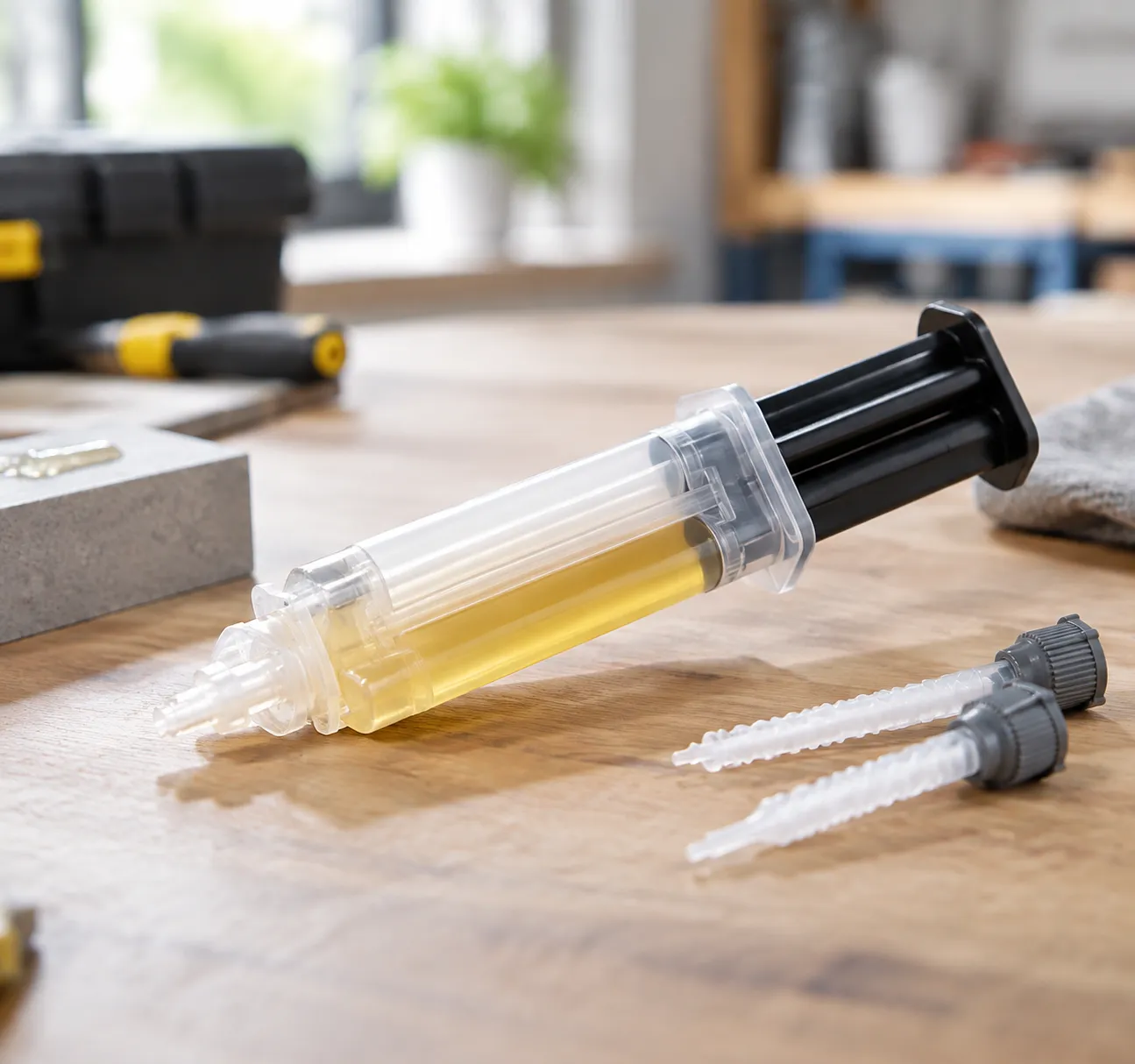
- Dispensing Method: State whether your line uses manual dual-barrel cartridges with static mix nozzles or automated high-pressure meter-mix dispensing systems.
Performance, Packaging and Estimated Quantity
- Mechanical Targets: Clarify critical strength metrics, including lap shear strength, peel resistance, impact toughness, and required structural flexibility or shore hardness.
- Color and Optical Clarity: Indicate whether you require an optically clear, non-yellowing two part epoxy glue or a filled, pigmented custom structural epoxy.
- Packaging Formats: Define the delivery configuration—standard 50ml or 400ml dual cartridges (1:1, 2:1, or 10:1 ratio), 5-gallon pails, or 200L drums for bulk epoxy resin supplier direct lines.
- Order Volumes: Provide estimated trial batch needs and projected annual order volume to secure proper lead times and direct factory pricing.
How Can Rongwei Support This Project?
We back your production line and product launches directly from our manufacturing facility. Whether you need a high-strength AB epoxy adhesive for industrial bonding or a tailored retail product, we provide factory-direct engineering and scalable supply solutions.
Sample Matching and Formula Adjustment
Standard off-the-shelf formulas do not always fit specialized assembly lines. We analyze your substrate requirements and operating environments to deliver the exact performance profile you need:
- Custom Viscosity & Flow: Adjusted for precise automated dispensing or non-sag vertical applications.
- Cure Speed Control: Tailored working time (pot life) from 5-minute rapid sets to extended open times for large assemblies.
- Environmental Resistance: Custom formulation for high-temperature stability, chemical exposure, and enhanced UV yellowing resistance.
- Benchmarking & Lab Testing: Send us your benchmark sample; our chemists will match or exceed its bonding strength and shear performance.
| Adjustment Parameter | Customization Range | Typical Application |
|---|---|---|
| Working Time (Pot Life) | 3 mins to 4 hours | Fast assembly vs. large-area potting |
| Viscosity | Liquid pourable to heavy thixotropic paste | Deep gap filling vs. vertical structural bonding |
| Shore Hardness | Semi-flexible (D40) to rigid (D85+) | Impact resistance vs. maximum load bearing |
OEM / Private Label Packaging and Bulk Supply
As a direct wholesale epoxy resin manufacturer, we simplify supply chain logistics and brand building with full-scope packaging and production options:
- Dual-Cartridge Systems: 50ml, 200ml, and 400ml side-by-side cartridges (1:1, 2:1, 10:1 ratios) ready for static mixing nozzles.
- Bulk Container Delivery: 1kg/5kg sets, 20kg pails, 200kg steel drums, and 1,000L IBC totes for high-volume manufacturing.
- Private Label Packaging: Custom label design, silk-screen printing, and multi-language retail packaging.
- Reliable Batch Consistency: Strict raw material QA ensures zero variance in mix ratio, adhesion strength, or shelf stability between batches.
Final Buyer Checklist
Questions to Confirm Before Placing an Order
Before finalizing a purchase order for AB epoxy adhesive, run through this verification checklist. Aligning these technical and commercial details with the supplier prevents costly downtime, bond failures, and shipping delays.
- Substrate Compatibility: Have you tested the two part epoxy glue on your exact production materials, including coated, treated, or oily surfaces?
- Mix Ratio & Work Life: Does the formulation match your shop floor conditions? Confirm the working pot life, open time, and full cure schedule at your ambient operating temperature.
- Mechanical & Environmental Specs: Does the structural epoxy adhesive meet your targets for lap shear strength, peel resistance, continuous operating temperature, and outdoor UV exposure?
- Dispensing & Packaging Setup: Is the packaging format (dual-barrel cartridges, pails, or bulk drums) fully compatible with your current pneumatic guns, static mixers, or automated dispensing equipment?
- Shelf Life & Storage Requirements: What is the guaranteed shelf life of the epoxy resin and hardener components, and what warehouse temperature limits apply during transit and storage?
- Certifications & Compliance: Are all required safety and regulatory sheets (SDS, TDS, RoHS, REACH, or VOC compliance) verified and matched to the production batch?
- Production Lead Times & MOQ: Have you locked in the minimum order quantities, batch-to-batch color tolerances, and guaranteed lead times for peak season demands?
