Epoxy Adhesive for Metal Bonding UV Yellowing Guide
Quick Answer
What Buyers Need to Know First
An industrial-grade epoxy adhesive for metal bonding delivers exceptional shear strength, rigid load distribution, and long-term chemical resistance across metallic substrates. Unlike mechanical fasteners, a high-performance structural metal adhesive eliminates stress concentration points, seals joints against galvanic corrosion, and bonds dissimilar metals efficiently.
Before sourcing or selecting a formulation, verify these core technical essentials:
- Substrate Compatibility: Formulations must match the specific base metal—whether functioning as a dedicated steel bonding epoxy, an aluminum epoxy glue, or a joint compound for brass and alloys.
- Surface Preparation Demands: Proper cleaning, degreasing, and mechanical abrasion remain mandatory; surface energy dictates ultimate bond strength.
- System Formulation: Two-part high strength AB glue systems provide controlled curing schedules, high peel resistance, and gap-filling stability under dynamic mechanical stress.
- Environmental Exposure: Operating temperature ranges, thermal cycling, moisture contact, and UV exposure directly determine resin lifespan and joint integrity.
- Procurement Scalability: Working directly with an epoxy resin manufacturer ensures stable batch consistency, tailored viscosity adjustments, and cost-effective bulk or private-label supply.
Is any epoxy completely UV-proof?
Direct Answer
No epoxy formulation is 100% UV-proof. While high-grade UV stabilizers, hindered amine light stabilizers (HALS), and specialized additives significantly slow down degradation, every standard epoxy adhesive for metal bonding will eventually experience chemical changes under prolonged, direct ultraviolet radiation. Epoxy chemistry naturally absorbs UV energy, meaning outdoor durability depends on formulation quality, joint exposure, and protective measures.
Key Selection Factors or Failure Risks
- Bondline Exposure: In most structural metal assemblies, the adhesive layer is encapsulated between opaque substrates (such as steel or aluminum), naturally shielding it from direct sunlight and preventing UV degradation.
- Surface Chalking and Yellowing: When an exposed bondline faces direct sunlight, UV exposure breaks down surface polymer chains, leading to discoloration, loss of gloss, and micro-chalking.
- Embrittlement and Micro-Cracking: Continuous outdoor UV exposure without protective coatings can cause the outer adhesive edge to lose flexibility, creating micro-fissures that allow moisture penetration into the joint.
- Selecting the Right Structural Metal Adhesive: If exposed edges cannot be avoided, choose an adhesive modified with high-performance UV absorbers or apply a protective, UV-resistant topcoat over the finished metal joint.
Why does overheating increase discoloration?
Direct Answer
Epoxy curing is naturally exothermic, meaning it generates heat during the chemical cross-linking process. When an epoxy adhesive for metal bonding overheats—either from an uncontrolled chemical exotherm in thick bond lines or excessive external heat during application—it accelerates the thermal oxidation of polymer chains and amine hardeners. This rapid breakdown damages the molecular matrix and causes immediate yellowing, browning, or darker discoloration.
Key Selection Factors or Failure Risks
Managing heat exposure during formulation and application is vital to maintaining both visual clarity and structural integrity:
- Bond Line Thickness: Applying heavy glue layers traps exothermic heat. For thick gap-filling on steel bonding epoxy applications, use controlled-cure systems to avoid thermal scorching.
- Cure Speed Matching: Fast-curing high strength AB glue systems generate high peak temperatures quickly. Selecting a properly paced cure profile prevents early discoloration.
- Loss of Mechanical Strength: Overheating does not just discolor the resin; it makes the cured structural metal adhesive brittle, significantly lowering shear and peel strength against aluminum and steel substrates.
- Substrate Thermal Dissipation: While metals dissipate heat quickly, confined joints or insulated assemblies trap heat, requiring a custom structural epoxy engineered for low exotherm performance.
Do pigments hide or worsen yellowing?
Direct Answer
Pigments primarily hide surface yellowing rather than prevent chemical degradation. Dark or metallic pigments—such as black, dark gray, or charcoal—effectively mask the natural ambering of an epoxy adhesive for metal bonding. Conversely, light-colored formulations, especially pure white or transparent fills, can show noticeable color shifts or dullness over extended outdoor exposure.
Key Selection Factors or Failure Risks
When formulating or tinting a high strength AB glue for metal assemblies, consider how color additives interact with joint integrity and appearance:
- Pigment Stability: Inorganic pigments like carbon black and iron oxides resist UV breakdown and hide matrix discoloration far better than organic dyes.
- Bond Strength Impact: Overloading a custom structural epoxy with liquid colorants or dry powders can reduce mechanical adhesion, lowering lap shear performance on steel and aluminum.
- Moisture Contamination: Non-industrial color pastes may introduce moisture into the mix, leading to micro-foaming, reduced hardness, and premature bond line failure.
- Color Matching Accuracy: For exposed seams on architectural or automotive metals, matching the adhesive tint directly at the factory ensures consistent hue without sacrificing structural ratings.
How should yellowing resistance be compared?
Direct Answer
We always advise comparing yellowing resistance through standardized accelerated aging data rather than visual claims. The only reliable metric is a measured Delta E (color variation) score obtained through QUV accelerated weathering tests (such as ASTM G154) over 500 to 1,000+ hours. When evaluating an epoxy adhesive for metal bonding, verify how the cured joint handles both UV light and thermal cycles together, because heat often accelerates chemical discoloration faster than sunlight alone.
Key Selection Factors or Failure Risks
Evaluating yellowing performance requires looking beyond surface aesthetics. Discoloration usually signals the start of chemical degradation in exposed joints.
- Test Metrics Over Marketing Terms: Never rely on terms like “UV-proof.” Demand actual spectrophotometer test data showing Delta E shifts after defined exposure hours.
- Aromatic vs. Aliphatic Chemistry: Standard bisphenol-A and aromatic amine systems naturally amber when exposed to sunlight. If exposed bond lines are visible on architectural panels or outdoor metal assemblies, we formulate or source modified cycloaliphatic or hybrid curing systems.
- Bond Line Degradation Risk: On joints using steel bonding epoxy or aluminum epoxy glue, surface yellowing often leads to chalking, surface embrittlement, and micro-cracking along the edge of the seam.
- Joint Geometry and Exposure: Thick adhesive squeeze-outs absorb more radiation and yellow rapidly. For critical assemblies, design the joint to minimize exposed adhesive or use a structural metal adhesive with UV-stabilized additives to prevent loss of mechanical shear strength over time.
Can a topcoat improve outdoor durability?
Direct Answer
Yes, applying a dedicated protective topcoat is the most dependable way to boost the outdoor lifespan of an epoxy adhesive for metal bonding. While structural epoxies deliver unmatched shear strength and mechanical holding power, they naturally degrade and chalk when exposed to continuous direct UV radiation. Sealing the exposed bond line with a UV-stable topcoat—such as an aliphatic polyurethane, fluoropolymer, or exterior-rated clear coat—creates an impenetrable barrier against sunlight, rain, and oxidation.
Key Selection Factors or Failure Risks
Adding a secondary coating layer demands careful attention to how the two chemistries interact over time:
- Intercoat Adhesion Failure: Topcoats will peel if applied to fully cured, glossy epoxy joints. To ensure a solid mechanical bite, the exposed squeeze-out or seam must be lightly abraded and cleaned before coating.
- Thermal Expansion Mismatch: Metals expand and contract rapidly under outdoor temperature swings. A rigid topcoat over a flexible structural metal adhesive joint will crack, allowing moisture and UV rays to reach the bond line.
- Solvent Sensitivity: Aggressive solvent-based topcoats applied too early can soften or distort a curing epoxy joint. We always recommend letting the metal epoxy reach full cure before spraying or brushing top layers.
- Edge Corrosion Creep: A topcoat must properly seal the exposed seam edges of steel and aluminum joints. If the seal fails at the perimeter, trapped water can induce crevice corrosion beneath the adhesive layer.
What Information Should You Send to the Manufacturer?
To get the exact epoxy adhesive for metal bonding that matches your assembly line or production setup, sharing precise technical requirements upfront saves testing time and prevents bonding failures. Here is the operational data we need to recommend or formulate the right solution.
Application, Substrate and Process Details
Different metals and manufacturing workflows require specific resin behavior and cure kinetics. Providing these details ensures seamless integration into your process:
- Substrate Specifics: Clarify whether you need a steel bonding epoxy, an aluminum epoxy glue, or a solution for joining metal to composites, plastics, or glass. Include surface conditions such as bare, anodized, powder-coated, or lightly oiled surfaces.
- Joint Geometry & Gap Size: Specify joint overlap, bond line thickness, and whether the formula requires gap-filling properties or non-sag characteristics for vertical applications.
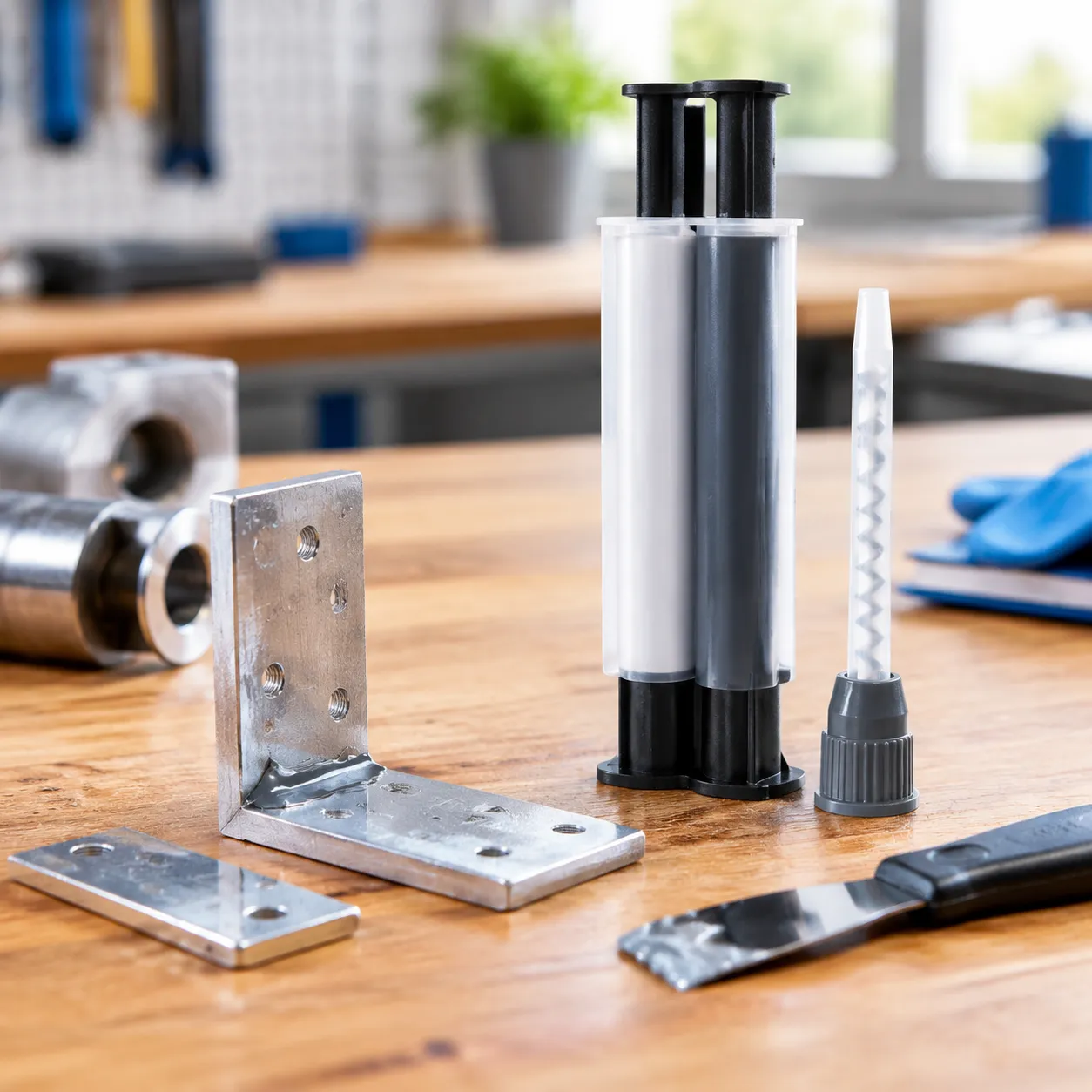
- Application Method: State whether you apply the adhesive manually, use dual-cartridge dispensing guns with static mixers, or run automated high-speed dispensing equipment.
- Curing Conditions: Provide your available curing parameters, including ambient room temperature cure windows or heat-assisted curing cycles.
Performance, Packaging and Estimated Quantity
Technical performance and supply specifications help determine whether a standard high strength AB glue fits your needs or if a custom structural epoxy formulation is required:
- Mechanical Demands: Target requirements for lap shear strength, peel resistance, impact strength, and structural load limits.
- Environmental Exposures: Operating temperature ranges (continuous and peak), thermal cycling, UV exposure, humidity, and contact with fuels, oils, or harsh chemicals.
- Packaging Options: Preferred container styles, such as 50ml or 400ml dual-barrel cartridges, 1kg sets, 5-gallon pails, or 200L drums for automated bulk feeding.
- Volume & Supply Schedule: Initial evaluation batch size, projected monthly or annual demand, and requirements for private label epoxy resin branding or direct factory bulk supply.
How Can Rongwei Support This Project?
We manufacture, customize, and supply high-performance epoxy adhesive for metal bonding directly from our production lines to meet strict industrial and retail demands.
Sample Matching and Formula Adjustment
Every manufacturing process has distinct bonding, curing, and load requirements. We adapt our chemical formulations to match your exact substrate and application criteria:
- Custom Structural Epoxy Formulation: We adjust viscosity, thixotropy, and working time to formulate dedicated steel bonding epoxy, aluminum epoxy glue, or multi-metal composite systems.
- Targeted Performance Profiling: We optimize shear strength, peel strength, impact resistance, and thermal tolerance based on your operating environment.
- Lab-Grade Sample Matching: Send us your target substrates or reference samples. We run full compatibility testing to determine which epoxy adhesive is best for bonding metal in your assembly line, delivering verified testing batches before full-scale production.
OEM / Private Label Packaging and Bulk Supply
As an established wholesale epoxy resin manufacturer and bulk epoxy resin supplier, we streamline high-volume procurement and turnkey retail packaging:
- Versatile Packaging Formats: We package high strength AB glue into 50ml, 200ml, and 400ml dual-component cartridges, squeeze tubes, metal tins, 5-gallon pails, and 200L industrial drums.
- Turnkey Private Label Epoxy Resin: Complete private labeling services including custom branded labels, packaging design, multilingual instructions, and market-ready Technical Data Sheets (TDS) and Safety Data Sheets (SDS).
- Epoxy Resin Factory Direct Scalability: Direct manufacturing ensures consistent batch-to-batch quality, stable supply chains, competitive wholesale pricing, and worldwide export compliance for global distribution.
Final Buyer Checklist
Questions to Confirm Before Placing an Order
Before finalizing your bulk purchase or custom formulation run, we recommend going through this critical verification checklist to ensure your epoxy adhesive for metal bonding delivers flawless structural integrity and production efficiency.
| Evaluation Area | Key Questions to Confirm | Sourcing Impact |
|---|---|---|
| Substrate Compatibility | Are you joining steel, aluminum, copper, or mixed composites? | Ensures proper adhesion promoter selection (e.g., dedicated steel bonding epoxy or aluminum epoxy glue). |
| Mechanical Strength | What are your target shear, tensile, and peel strength requirements? | Determines whether standard or toughened structural metal adhesive chemistry is required. |
| Environmental Exposure | Will the bond line face extreme heat, thermal cycling, moisture, or UV? | Dictates temperature rating thresholds and additive packages. |
| Working & Cure Time | What open time does your assembly process require before fixture? | Balances rapid handling speed with adequate assembly time using a high strength AB glue system. |
| Dispensing & Packaging | Do you require dual-barrel cartridges, ready-to-mix cans, or industrial bulk drums? | Optimizes integration with manual tools or automated dispensing lines. |
| Sample Validation | Have our sample formulations been fully tested on your actual production parts? | Eliminates batch-to-batch risk before full-scale manufacturing. |
Reviewing these operational parameters guarantees that our factory-direct adhesive formulations integrate seamlessly into your manufacturing workflow, providing reliable joint performance and lower total assembly costs.
