Resin Transfer Molding RTM Carbon Fiber Manufacturing Guide
Are you struggling to scale up your composite production without watching your costs skyrocket? Finding a manufacturing method that delivers aerospace-grade precision at automotive-level volumes can feel like an impossible balancing act.
As a composite manufacturing specialist, I know that choosing the wrong process can lead to crippling cycle times and endless quality control headaches.
That is exactly where Resin Transfer Molding (RTM) for carbon fiber manufacturing comes in.
RTM has quietly become the gold standard for high-volume, high-performance composites. It bridges the gap between raw strength and mass production, but getting it right requires a perfect alignment of mold design, resin selection, and automated process control.
Whether you are targeting lightweight automotive interior parts or complex aerospace structural components, this guide will break down the exact strategies, chemistry, and system setups needed to optimize your production line.
Let’s dive right in.
Understanding Resin Transfer Molding (RTM)
What is RTM: Definition, Principle, and Advantages
Resin Transfer Molding (RTM) is a low-pressure, closed-mold composite manufacturing process used to produce high-performance carbon fiber components. The process begins by placing a dry fiber preform into a matched metal mold cavity. Once the mold is securely closed and clamped, a liquid thermosetting resin is injected under pressure into the cavity, thoroughly permeating the fiber reinforcement. After the resin cures under controlled temperature, the mold is opened to yield a net-shape or near-net-shape composite part.
Key advantages of the resin transfer molding process include:
- High Surface Quality: Excellent surface finish on both sides of the part due to the matched closed-mold design.
- Dimensional Accuracy: Tight tolerances and high repeatability for complex geometries.
- Environmental Efficiency: Reduced volatile organic compound (VOC) emissions compared to open-molding methods.
- Structural Optimization: Ability to integrate cores, inserts, and tailored fiber orientations.
Why RTM is Ideal for High-Volume Production
Modern industrial demand requires scalability, and high-volume composite manufacturing relies heavily on RTM. By utilizing automated preforming, fast-curing RTM epoxy resin, and specialized automated resin injection systems, manufacturers can significantly compress the RTM cycle time.
[Dry Fiber Preform] ➔ [Closed Mold] ➔ [Automated Injection] ➔ [Fast Curing] ➔ [Net-Shape Part]
This closed-mold composite technique minimizes manual labor, reduces scrap rates, and ensures consistent material properties across thousands of cycles, making it the definitive choice for automotive and commercial production lines.
Process Comparison: RTM vs. Alternative Methods
Selecting the right composite RTM production method depends on volume, cost, and performance targets. The table below outlines how standard RTM compares to Hand Lay-up and Autoclave Prepreg processing.
| Feature / Process | Hand Lay-Up | Autoclave Prepreg | Resin Transfer Molding (RTM) |
|---|---|---|---|
| Tooling Type | Open Mold | Vacuum Bag / Single Mold | Closed Mold Composite |
| Production Volume | Low (Prototype) | Medium (Specialized) | High-Volume Production |
| Cycle Time | Very Long (Hours) | Long (Hours) | Short (Minutes) |
| Fiber Volume Fraction | Low (30% – 40%) | Very High (60%+) | High (50% – 65%) |
| Surface Finish | One Side Smooth | One Side Smooth | Both Sides Smooth (Class A) |
| Capital Investment | Low | High | Medium to High (Scalable) |
By balancing structural integrity with rapid cycle times, RTM bridges the gap between low-volume aerospace quality and high-volume commercial viability.
Part 2: The RTM System Components
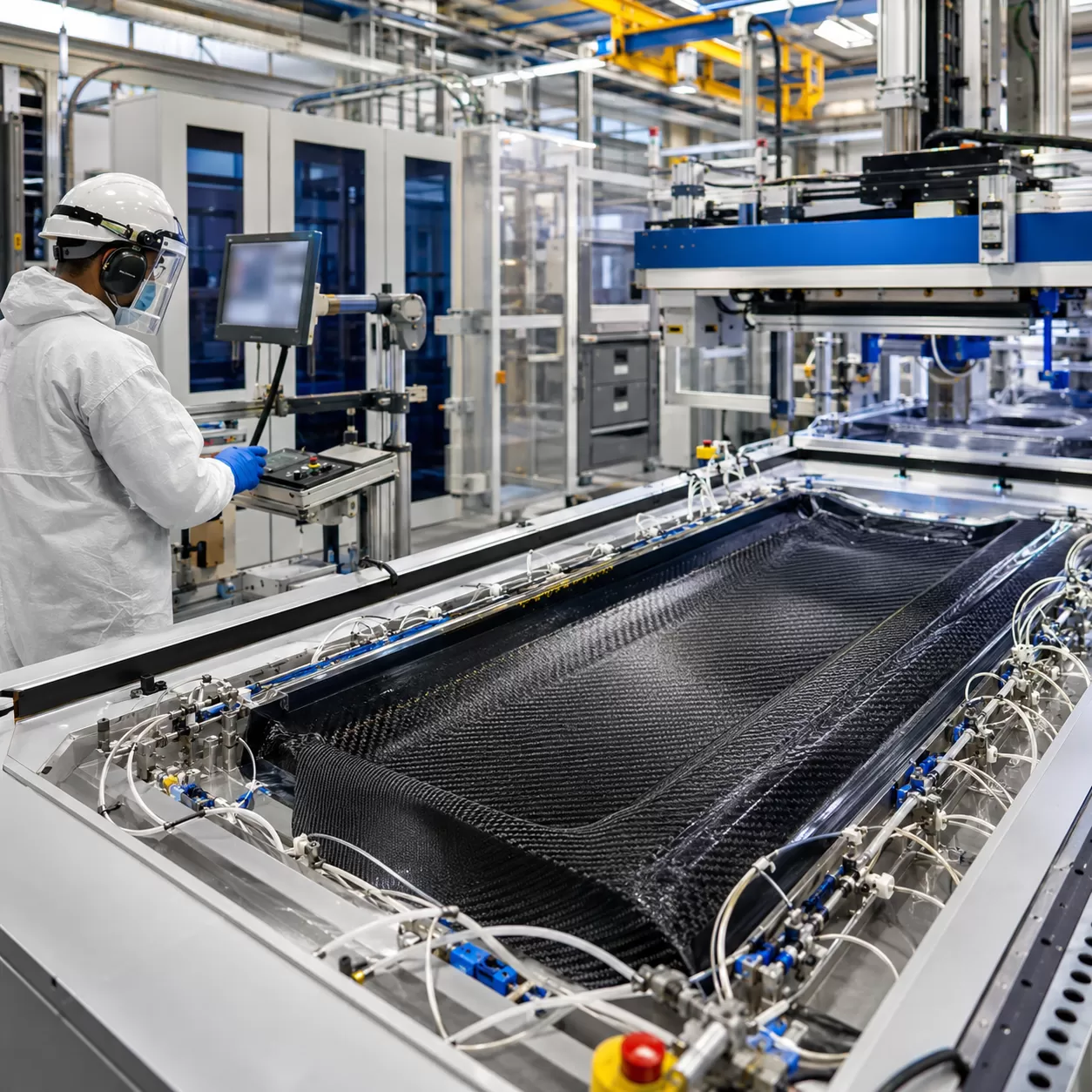
An efficient resin transfer molding process relies on a tightly integrated, closed-mold system. Every component must work in harmony to ensure consistent part quality and fast cycle times. Here is a breakdown of the core hardware powering our RTM setup.
Closed Mold Design
The foundation of high-volume composite manufacturing is a rigid, high-precision RTM mold design. Unlike open molding, this system uses a matched male and female mold set to dictate the exact internal and external dimensions of the carbon fiber part.
- Materials: Typically machined from high-grade steel or aluminum to withstand injection pressures.
- Sealing: Heavy-duty perimeter seals prevent resin leakage and maintain internal vacuum.
Injection System
Automated resin injection equipment precisely mixes and delivers the liquid matrix into the sealed cavity.
- Precision Metering: Guarantees the exact stoichiometric ratio of resin to hardener.
- High-Pressure Delivery: Ensures the epoxy resin completely impregnates the dense carbon fiber preform without shifting the fabric.
Vacuum System
Air is the enemy of structural composites. A dedicated vacuum assistance system draws air out of the dry fabric preform before and during the injection phase.
- Porosity Reduction: Eliminates micro-voids and air pockets within the laminate.
- Aided Flow: Works alongside injection pressure to pull the resin through complex geometry.
Heating System
Managing the thermal profile of the mold is critical for controlling RTM cycle time and resin behavior.
- Integrated Channels: Built-in oil or electrical heating lines keep the mold at optimal processing temperatures.
- Thermal Consistency: Prevents premature gelling during injection and accelerates the final cure cycle.
Control System
The brain of the entire composite RTM production line is the central control unit. It monitors and automates every variable in real time.
| Monitored Variable | Purpose in the System |
|---|---|
| Injection Pressure | Prevents mold deformation and fiber washing. |
| Mold Temperature | Optimizes resin flow viscosity and cure kinetics. |
| Vacuum Levels | Ensures a completely void-free composite structure. |
| Flow Rate | Tracks filling progress to signal the transition to the curing phase. |
The Step-by-Step Resin Transfer Molding Process
To achieve success in high-volume composite manufacturing, following a precise resin transfer molding process is non-negotiable. Here is exactly how we run a cycle from raw material to a finished carbon fiber part.
Carbon Fiber Preform Preparation
The process starts outside the mold. We cut carbon fiber sheets and shape them into a dry, 3D structure called a preform.
- Precision Cutting: We use automated CNC cutters to ensure exact dimensions.
- Binder Application: A small amount of tackifier holds the dry fibers together.
- Pre-shaping: The fabric is pressed into the rough shape of the final part so it fits perfectly into the RTM tool without wrinkling.
Mold Closing and Heating
Once the preform is ready, we load it into our custom RTM mold design setup.
- Hydraulic Clamping: A heavy-duty press clamps the matching metal molds shut to withstand high injection pressures.
- Sealing: High-temp seals prevent any air leaks or resin blowouts.
- Pre-heating: The mold is heated to a precise target temperature to ensure optimal resin flow later.
Automated Resin Injection and Mixing
This is where the chemical magic happens. We use a dedicated, automated resin injection system to meter and mix our two-part RTM epoxy resin.
- Precise Ratios: The machine mixes the resin and hardener at the exact chemical ratio.
- Air Elimination: The system degasses the liquid before it enters the mold to eliminate micro-voids.
- Controlled Entry: Resin is pumped into the closed mold at a controlled flow rate and pressure.
Mold Filling and Curing
The resin flows through the dry carbon fiber, completely soaking the preform from the inside out.
- Complete Wet-out: The liquid drives out any remaining air as it fills the cavity.
- Pressure Holding: Once full, we maintain hydrostatic pressure to pack the part tightly.
- Fast Curing: The heated mold triggers the resin’s cross-linking reaction, hardening the part in a short RTM cycle time.
Demolding and Post-Processing
After the curing cycle finishes, the mold opens, and we harvest the final component.
- Ejection: Internal mechanical ejector pins pop the hot part out of the mold cleanly.
- Trimming: We use robotic CNC routers to trim away the flash lines and injection gates.
- Inspection: The part moves to quality control for dimension checks and surface evaluation, ready for assembly.
Choosing the Right RTM Epoxy Resin for High Performance
Selecting the proper formulation is the most critical factor in successful resin transfer molding / RTM carbon fiber manufacturing. The chemistry must balance processability with final part performance.
Low Viscosity and Controlled Flow
To achieve total fiber wet-out in a closed mold composite setup, the matrix requires exceptionally low viscosity at the injection temperature.
- Viscosity Range: Ideally between 50–200 mPa·s during the injection window.
- Controlled Flow: Prevents fiber wash or displacement while ensuring the matrix penetrates tight carbon fiber weaves before gelation begins.
Fast Cure Kinetics for High-Volume Production
Maximizing throughput depends heavily on minimizing the RTM cycle time.
- Snap-Cure Behavior: Modern formulations offer a long window of low viscosity for injection, followed by a rapid polymerization reaction once trigger temperatures are reached.
- Production Boost: Fast cure kinetics drastically reduce demolding times, making it highly viable for high-volume composite manufacturing.
Degassing and Air Release Properties
Voids are the ultimate enemy of structural composites.
- Low Air Entrainment: The formulation must release trapped air quickly during pre-heating or under vacuum.
- Void Reduction: High-efficiency degassing ensures ultra-low porosity in the final cured part, maximizing mechanical strength.
Thermal Resistance and Temperature Range
The matrix must withstand both the processing heat and the end-use environment.
- Glass Transition Temperature ($T_g$): Formulations are engineered to maintain high stiffness at elevated operating temperatures.
- Thermal Window: Optimized to resist degradation during high-temperature demolding and post-curing cycles.
Our Proprietary RW Atelier RTM Resins
We developed our own lineup of RTM epoxy resin systems specifically to meet these rigorous global manufacturing standards.
| Resin Feature | Manufacturing Benefit |
|---|---|
| Ultra-low injection viscosity | Complete wetting of thick, complex carbon fiber preforms |
| Tailored latency window | Generous filling time followed by rapid, predictable curing |
| Excellent fiber adhesion | Superior interlaminar shear strength (ILSS) in structural parts |
Our systems integrate seamlessly into any automated resin injection line, giving you the consistency needed to scale up production without sacrificing part quality.
RTM Mold Design for Optimal Flow
Getting your RTM mold design right is the single most important factor in flawless resin transfer molding / RTM carbon fiber manufacturing. If the mold isn’t engineered for perfect fluid dynamics, you risk dry spots and scrapped parts. We design our closed molds to handle pressure, control temperatures, and guide the resin exactly where it needs to go.
Strategic Injection Point Location
The entry point dictates how the RTM epoxy resin fills the cavity. We position injection ports to ensure the shortest, most balanced wet-out path across the carbon fiber preform.
- Center Injection: Ideal for symmetrical parts to drive air outward radially.
- Edge Injection: Best for long, narrow structural profiles.
- Multi-Point Gates: Used for massive or complex parts to prevent premature gelling before full wet-out.
Advanced Air Vent and Venting Point Design
Where resin enters, air must escape. Poor venting leads to trapped air pockets and high porosity.
- Perimeter Venting: Placed at the furthest points from the injection gates.
- Vacuum Integration: Connects directly to our vacuum-assisted system to pull resin through the dry fabric.
- Self-Sealing Vents: Designed to bleed off air and seal automatically when hit by liquid resin.
Optimizing the Resin Flow Path
We simulate and refine the closed mold composite filling path to prevent “race-tracking”—where resin bypasses the fabric and flows along the easier edges.
| Flow Strategy | Mechanism | Benefit |
|---|---|---|
| Controlled Permeability | Tailoring edge gaps to match fabric resistance | Eliminates dry spots and internal voids |
| Sequential Gating | Opening injection ports in a timed sequence | Perfect for high-volume composite manufacturing |
| Flow Channels | Machined internal grooves to distribute resin | Speeds up overall cycle times |
Integrated Mold Thermal and Cooling Systems
Consistency in Composite RTM production relies heavily on thermal management. A mold isn’t just a forming tool; it is a heat exchanger.
- Zoned Heating: Internal lines heat the mold evenly to keep resin viscosity low during injection.
- Rapid Cooling Channels: Circumvent the part post-cure to drop temperatures quickly, shortening the RTM cycle time for fast demolding.
- Thermal Isolation: Prevents heat loss to the press, keeping energy costs low and curing cycles highly predictable.
Production Efficiency in RTM Carbon Fiber Manufacturing
Maximizing throughput and lowering per-part costs are the main reasons we utilize the resin transfer molding process for high-volume production. By focusing on cycle times, automation, and smart costing, we turn composite manufacturing into a highly predictable, lean operation.
Optimizing RTM Cycle Time
Reducing the RTM cycle time is the fastest way to boost your bottom line. We achieve rapid cycles by focusing on three main areas:
- Fast-Curing Chemistries: Utilizing specialized RTM epoxy resin that cures in minutes rather than hours.
- High-Pressure Injection: Speeding up the mold-filling phase without disturbing the dry fiber preform.
- Active Thermal Management: Using localized heating to trigger rapid polymerization the moment the mold is full.
Production Capacity Calculations
To accurately scale your composite RTM production, capacity planning must account for every second of the tool cycle.
$$text{Hourly Output} = frac{3600 text{ seconds}}{text{TACT Time (seconds)}} times text{Number of Cavities}$$
| Stage | Process Step | Target Duration |
|---|---|---|
| Step 1 | Preform Loading & Mold Closure | 60 – 90 seconds |
| Step 2 | Automated resin injection & Cavity Filling | 30 – 60 seconds |
| Step 3 | Curing & Polymerization | 120 – 180 seconds |
| Step 4 | Part Demolding & Cleaning | 45 – 60 seconds |
| Total | Average Cycle Time | 4.3 – 6.5 Minutes |
Cost Analysis for High-Volume Composite Manufacturing
While the initial investment in a robust RTM mold design and injection system is high, the variable costs drop significantly at scale.
- Material Efficiency: Near-net-shape preforming minimizes carbon fiber scrap compared to traditional hand lay-up.
- Labor Reduction: Shifting from manual lamination to a closed mold composite process cuts direct labor costs by up to 70%.
- Consumables Savings: Eliminating vacuum bags, release films, and breather cloths drastically reduces per-part consumable expenses.
Automation Level
Transitioning from manual intervention to full automation is essential for consistent, commercial-scale high-volume composite manufacturing.
Automation Blueprint: We integrate robotic ply nesting and automated preform cutters to feed the molding line. Robots handle the preform placement, mold sealing, and part extraction, ensuring the injection equipment delivers a precise, repeatable resin shot every single time.
Quality Control in Resin Transfer Molding
Maintaining strict quality control is what sets premium closed mold composite parts apart from the rest. In our composite RTM production, we focus on four critical metrics to ensure every single part meets high-performance standards.
Fiber Content Uniformity
Achieving a consistent fiber-to-resin ratio is vital for structural integrity.
- Uniform Strength: We precisely control the resin transfer molding process to prevent resin-rich or resin-lean areas.
- Consistent Weight: Proper fiber distribution ensures every component hits its exact weight target, which is critical for aerospace and automotive clients.
Void and Porosity Control
Air pockets ruin composite parts. Minimizing porosity is our top priority during automated resin injection.
- Vacuum Assistance: We use high-efficiency venting and vacuum draw to pull out trapped air before the RTM epoxy resin cures.
- Optimized Flow: Controlling the injection pressure keeps the resin front stable, completely eliminating micro-voids.
Surface Quality
Our RTM mold design guarantees a flawless, paint-ready surface straight out of the tool.
- Class-A Finish: Perfect replication of the mold surface eliminates the need for heavy sanding or post-cure filling.
- No Dry Spots: Total fiber wet-out ensures there are no surface imperfections or exposed fibers.
Dimensional Accuracy
High-volume manufacturing demands perfect repeatability, and our setup delivers exactly that.
| Quality Metric | Target Standard | How We Achieve It |
|---|---|---|
| Thickness Tolerance | Within $pm 0.1text{ mm}$ | Heavy-duty matched metal tooling |
| Shrinkage Control | Near Zero | Optimized RTM cycle time and controlled cooling |
| Part-to-Part Consistency | $99.9%$ Repeatability | Fully automated process tracking |
Case Studies in RTM Carbon Fiber Manufacturing
We have successfully implemented Resin Transfer Molding (RTM) across various high-stakes industries. By utilizing optimized RTM mold design and automated injection, we deliver parts that meet the strictest performance standards.
Automotive Interiors
In the automotive sector, the demand for high-volume composite manufacturing is relentless. We use RTM to produce lightweight interior structures that don’t sacrifice aesthetics for strength.
- Application: Dashboard supports, seat frames, and decorative trim.
- Result: A 40% weight reduction compared to traditional steel components and a significantly faster RTM cycle time for mass production.
Aerospace Structural Components
For aerospace, the focus shifts to extreme precision and reliability. Our closed mold composite process ensures that every part meets rigorous safety certifications.
- Application: Wing ribs, brackets, and secondary flight control surfaces.
- Result: Minimal void content and superior mechanical properties that withstand high-stress environments.
Industrial Components
We help industrial partners replace heavy metal parts with durable carbon fiber alternatives using the Resin Transfer Molding process.
- Application: High-speed robotic arms, wind turbine components, and pressure vessels.
- Result: Increased equipment lifespan and lower energy consumption due to reduced rotational inertia.
| Industry | Primary Benefit | Key RTM Metric |
|---|---|---|
| Automotive | Mass production | Fast Cycle Time |
| Aerospace | High Strength-to-Weight | Low Porosity |
| Industrial | Corrosion Resistance | Dimensional Accuracy |
Ready to Elevate Your RTM Carbon Fiber Manufacturing?
Accelerating production and minimizing defects requires the right setup. As your manufacturing partner, we provide the precise engineering support and high-performance materials needed to optimize your entire resin transfer molding process.
Scale Up Your Composite RTM Production
Let’s optimize your factory floor. Get expert RTM process consulting to eliminate dry spots, reduce scrap rates, and stream-line your cycle times.
- Process Audits: Pinpoint bottlenecks in your current injection setup.
- Automation Integration: Transition seamlessly to high-volume composite manufacturing.
- Troubleshooting: Expert support for porosity control and fiber alignment issues.
Request RW Atelier RTM Epoxy Resin Samples
The right chemistry drives fast cycle times. Test our advanced RTM epoxy resin formulations designed specifically for low viscosity and rapid cure cycles.
| Resin Type | Key Benefit | Ideal Application |
|---|---|---|
| RW-FastCure | Ultra-low RTM cycle time | Automotive structural parts |
| RW-HiTemp | Extreme thermal resistance | Aerospace components |
| RW-FlowMax | Superior wetting & low viscosity | Large-scale industrial parts |
Optimize With Precision RTM Mold Design Guidance
Perfect parts start with perfect tooling. Work directly with our engineering team to develop a closed mold composite system built for longevity and flawless surface finishes.
- Flow Simulation: Optimize automated resin injection paths before cutting metal.
- Gate & Vent Positioning: Ensure complete air evacuation to eliminate voids.
- Thermal Management: Integrated heating channels for uniform, fast curing.