Epoxy Potting Electronics Guide Principles and Material Performance
The Critical Demands of Modern Electronics
Today’s global electronics market demands absolute reliability under extreme conditions. From automotive control units to aerospace sensors, sensitive electronic components must endure relentless environmental stressors.
Without adequate protection, delicate circuitry is highly vulnerable to:
- Moisture and Humidity: Leading to short circuits and electrochemical migration.
- Mechanical Stress: Causing solder joint fractures from severe vibration and physical impact.
- Thermal Shock: Resulting in component failure due to rapid temperature fluctuations.
- Corrosive Elements: Such as salt spray, industrial chemicals, and dust accumulation.
To meet these rigorous electronic demands, manufacturers require a robust, uncompromising barrier that guarantees long-term operational stability.
The Principle of Epoxy Potting
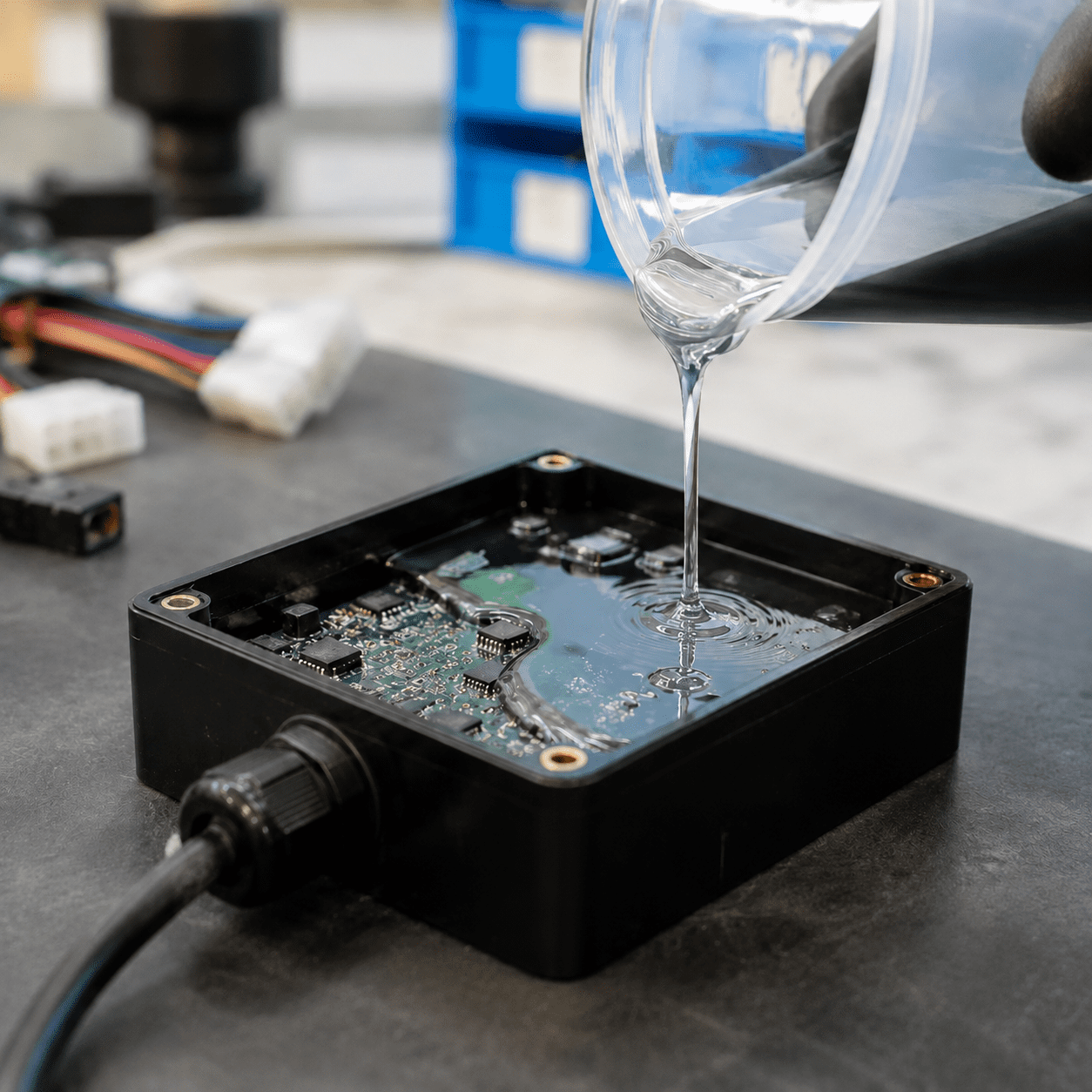
Epoxy potting is the definitive process of encasing an entire electronic assembly within a liquid resin, which then cures to form a solid, permanent protective mass.
The encapsulation mechanism operates on three core principles:
- Complete Void Elimination: The low-viscosity liquid flows seamlessly into intricate gaps, displacing air and sealing fragile components entirely.
- Structural Integration: Upon curing, the resin binds tightly to the substrate, transforming the loose assembly into a rugged, unified monolithic structure.
- Environmental Isolation: It creates an impenetrable physical shield that completely cuts off the internal circuitry from external atmospheric hazards.
Advanced Material Performance
The superior performance of epoxy potting compounds stems from their exceptional chemical and physical properties, engineered specifically for high-reliability applications.
| Performance Metric | Benefit to Electronics |
|---|---|
| High Dielectric Strength | Prevents electrical arcing and ensures excellent high-voltage insulation. |
| Thermal Conductivity | Efficiently dissipates heat away from critical hot spots to extend component lifespan. |
| Low Shrinkage Rate | Minimizes internal mechanical stress on fragile SMD components during the curing phase. |
| Chemical Resistance | Resists degradation from automotive fluids, industrial solvents, and moisture. |
By combining maximum structural reinforcement with elite electrical insulation, our advanced epoxy potting solutions deliver the ultimate protection required by the global electronics industry.